Skip to content
Skip to main content

Go Beyond the Basics with PubMed

PubMed is the National Library of Medicine’s index to medical literature and includes over 22 million bibliographic citations in life sciences. This one-hour session will show you how to improve your search results by using subject headings (MeSH) and advanced keyword searching techniques.

This session is hands-on and free for UI students and affiliates. There will be time for questions at the end.

Our next session is:

Tuesday, April 22 from 9-10 am

Location: Hardin Library for the Health Sciences (EAST Information Commons classroom)

Register today or check out our quick tutorial to learn the basics of using PubMed.

Need help? Contact us at lib-hardin@uiowa.edu or by calling (319) 335-9151.

R. Palmer Howard Dinner April 25: W. Bruce Fye on the Mayo Clinic

The University of Iowa History of Medicine Society announces the R. Palmer Howard Dinner

6 pm on Friday, April 25, 2014

W. Bruce Fye, Professor of Medicine & Medical History, Mayo Clinic, will speak on:

The Origins and Evolution of the Mayo Clinic from 1864 to 1939: A Minnesota Family Practice Becomes an International Medical Mecca

Fye. [Image via mayoclinic.org]

     “This presentation describes the origins and international impact of the Mayo clinic through 1939. Multi-specialty group practice was invented at the clinic a century ago. A visiting Canadian physician wrote in 1906, ‘Specialization and cooperation, with the best that can be had in each department, is here the motto. Cannot these principles be tried elsewhere?’ Mayo Clinic’s major (and under-appreciated) role in the development of rigorous postgraduate (specialty) training will be addressed. Unlike traditional academic medical centers that emphasize research, Mayo’s main mission has always been patient care. This activity has been undertaken in an environment enriched by extensive programs, devoted specialty training, and clinical research. The talk is complemented by more than 200 images.”

Registration and event details here.

Dr. William Mayo. [Image via mayoclinic.org]

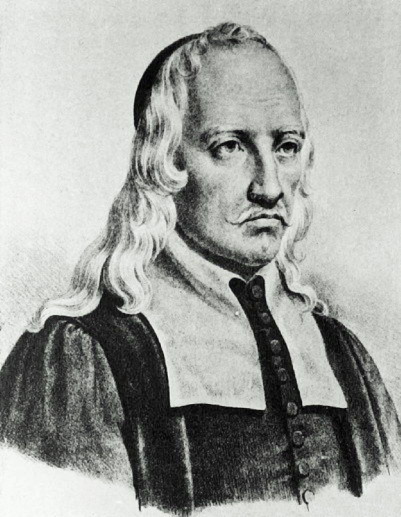
The Father of Biomechanics: Giovanni Alfonso Borelli, 1680-1681

File:Giovanni Alfonso Borelli.jpg

Borelli. [Image via wikipedia.org]

Giovanni Alfonso Borelli (1608-1679) was an Italian Renaissance physicist who sought to make mechanical laws applicable to all physiological phenomena. Borelli, who studied at Padua under Galileo, regarded the human body essentially as a machine whose functions could be explained by the laws of physics. He mentored Marcello Malpighi– who went on to become the father of microscopical anatomy– and was instrumental in the foundation of the Iatrophysical school of thought, which used mathematical and physical principles to understand the material world. At his laboratory in Pisa, Borelli made a number of important discoveries about respiration, circulation, and the muscular system. De Motu Animalium is an illustrated study of human and animal muscular exertion.

File:Giovanni Alfonso Borelli De Motu Animalium 1680.jpg

Model for an early submarine. [wikimedia.com]

http://www.anthrobot.com/press_images/figure10.jpg

 Hinged elbow joint. [anthrobot.com]       

Bearing weight. [archivioflaviobeninati.com]

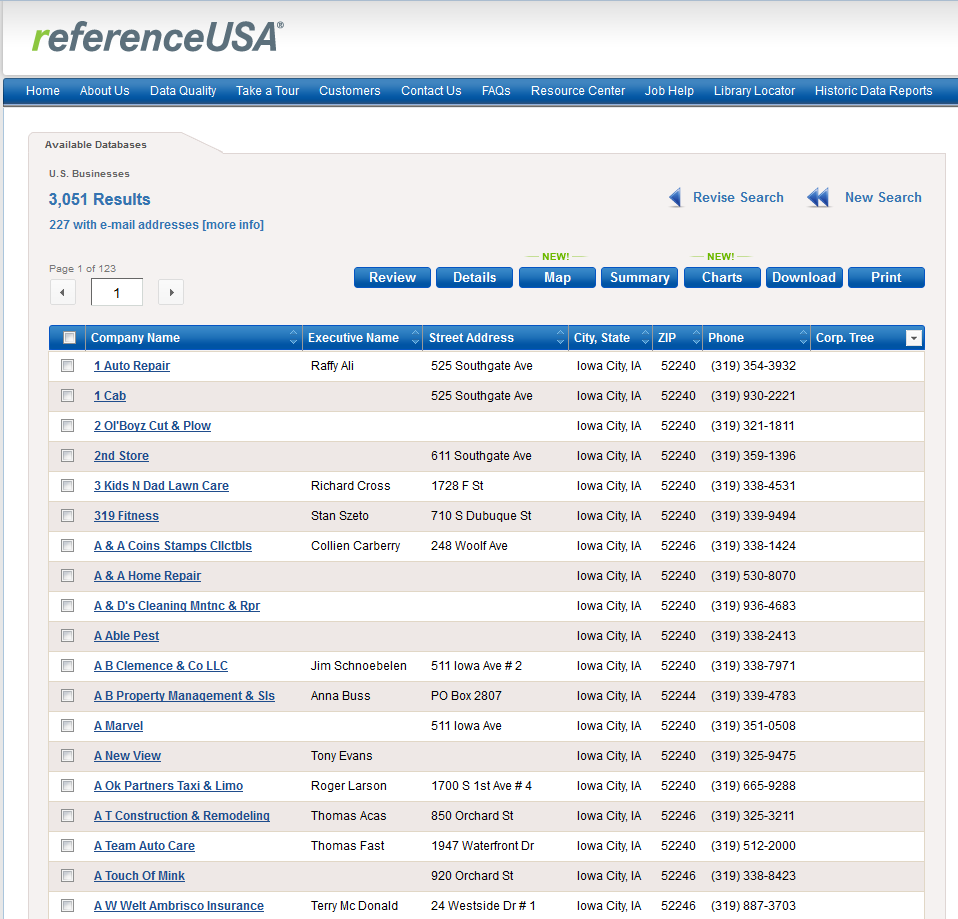
Database of the Week: ReferenceUSA

Each week we will highlight one of the many RefernceUSAdatabases we have here at the Pomerantz Business Library.

The database: ReferenceUSA

Where to find it: You can find it here, and under S in the databases A-Z list.

Use it to find:

  • Directory information for 24 Million US Businesses
  • Often includes Executive Name, Address, Phone Number, Sales Volume, Employee Size
  • US Consumers/Lifestyle Database
  • US Jobs/Internships Database

Custom Search

Tips for searching:

  • Use the “Quick Search” to search by Company Name, Executive Name, City, State or Phone
  • Use the “Custom Search” to build a more complex search.  Can refine by Business type (Industry Code / Group), Geography (Radius, County, Map Based Search, etc), Business Size, Ownership, and more


RefUSADisplay

Demos: The following demo (from the University of Texas) shows how to make lists with ReferenceUSA:

Want help using ReferenceUSA? Contact Willow or Kim and set up an appointment.

Learn to use EndNote Basic at Hardin Library’s workshop Monday, April 21

EndNote Basic is a web-based citation management software that is freely available to all UI affiliates. It allows you to import, organize and format citations for papers, articles, etc. EndNote Basic is not the same as EndNote desktop software. This workshop is hands-on and free for UI students and affiliates. There will be time for questions at the end.

Our next session is:

Monday, April  21, 2-3 pm

Location: Hardin Library East Information Commons

Register online or contact us at 335-9151 or by emailing lib-hardin@uiowa.edu

No time for class? We offer an easy online tutorial for EndNote Basic.

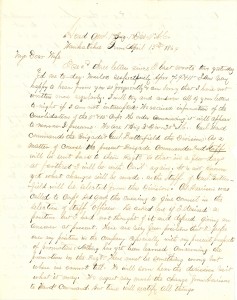
I recd. three letters since I last wrote: two yesterday and one to-day

Joseph Culver Letter, April 15, 1864, Page 1

Head Qurs., 1st Brig., 1st Div., 11th A.C.
Wauhatchie, Tenn., April 15th 1864
My Dear Wife

I recd. three letters since I last wrote: two yesterday and one to-day, mailed, respectively, Apr. 7th, 9th & 11th.1 I am very happy to hear from you so frequently & am sorry that I have not written more regularly. I will try and answer all of your letters to-night if I am not interrupted.

We received information of the consolidation of the 11th & 12th Corps; the order announcing it will appear to-morrow, I presume. We are 1st Brig., 3rd Div., 20th A.C. Genl. Ward commands the Brigade, & Genl. Butterfield the Division.2 As a matter of course, the present Brigade Commander [Col. Benjamin Harrison] and Staff will be sent back to their Regts., so that in a few days at farthest, I will be with Co. “A” again. It is not known what changes will be made, as the Staff of Genl. Butterfield will be selected from this Division.

Col. Harrison was called to Corps Hd. Qurs. this evening to give counsel in the selection of Staff Officers. He asked me if I desired a position, but I had not thought of it and deferred giving an answer at present. There are very few positions that I prefer over my position in the Company, especially with my present prospects of promotion [to Captain]. Nothing has yet been learned concerning the promotions in the Regts. There must be something wrong, but where we cannot tell. We will soon hear the decision be it what it may. We regret very much the change from Harrison to Ward’s command, but time will rectify all things.3

Col. Harrison has just informed me that he has recommended me as A.D.C. on the Division Staff (Maj. Genl. Butterfield’s).4 I do not know that I should refuse if I were selected, but I feel as if I would prefer staying with the Company. Staff duty costs much more, & I feel the necessity of Saving until our home is paid for. It has cost me nearly all I made in two months to keep me three, & that is a very heavy tax. There are many advantages it is true, and I presume more honor, but not more pleasure and much more responsibility. Besides I have the impression that Genl. Butterfield is inclined to be a little fast, and fear my qualifications would not come up to his standard.

I was at the Company this evening. All are well. The boys seem very glad at the prospect of my returning.

I am sorry to hear of so much sickness in Pontiac. I hope to hear soon of Bro. Johnson’s recovery.5 Mrs. Shellenbarger is a widow. I recd. a letter yesterday from Mrs. Minton, a married sister of Joe’s; she has besides a Brother in the Army of the Ohio at Knoxville and another sister, the one who wrote the letter sent you. Mr. Paige has not yet returned.

I bought a pair of shirts of Capt. Hoskins thinking you might not have an opportunity to send any very soon, & I was much in need of them. The socks will be very acceptable, as those I have are much worn.

You say “Mrs. Culver is beginning to make a little progress in her present study,” but I do not know what the study is. I am very happy that your headaches disapper so readily. Hoskins said nothing “of our circumstances,” what could he say?6 I hope Bro. Sammy may soon get to the Battery; it will be much more pleasant for him. I would have written to him but expected him along almost daily.

I fear you will not be able to get Fleming to settle. If I thought it would do any [good], I would write to him.

I am happy to hear that Sis. enjoys life so well & hope it may continue so. Remember me kindly to her. I hope your Sabbath School class may prove interesting. I am sorry, however, to hear that Bro. Fisher has left.7 What has become of his shop? Is the Boyer Estate settled up yet?

I was surprised to hear of Bob Edgington’s ill health.8 He has been around all the time and looks well and hearty, and I never heard that he was sick. Harry McDowell can very easily get an order returning him to his Regt. if he will report his desire to Col. Case. I am certainly surprised to hear of his treatment of Miss Thayer and cannot understand it.9 I supposed he was more gallant and gentlemanly.

Our review came off yesterday but was not as good as those we had at Nashville which you saw.10 I was much pleased with the appearance of Maj. Genl. Thomas; he is quite an old man and very pleasant looking.11

The balance of the staff [Harrison’s] have been discussing their prospects under the new organization, and I have been writing at intervals until I have occupied nearly 4 hours in producing this letter. I fear you will find it disconnected and uninteresting. Continue to write often. I am very happy to hear from you so often. It is five minutes past 12 o’clock, & I must go to bed. I will send this letter by Mr. Amos Clark who is going home on furlough to-morrow.12

May God in his infinite Mercy bless you with health and bestow upon you the richest of his Grace. Remember me to all. Accept the love and affection with a kiss from

Your Affect. Husband
J. F. Culver
Direct as before until I can safely notify you of the change [of address].

  1. Mary Culver’s letters of April 7, 9, and 11 are missing from the Culver Collection.
  2. General Thomas’ order announcing consolidation of the XI and XII Corps and organization of the XX Corps was dated April 14, 1864. Maj. Gen. Daniel Butterfield, before assuming command of the Third Division, had served as chief of staff to Generals Hooker and George G. Meade. He had accompanied Hooker to the west. General Thomas on April 8 had suggested to General Sherman that Butterfield be assigned a division in Hooker’s corps. Today, Butterfield is best remembered as composer of the bugle call “Taps”. Brigaded with the 129th Illinois in General Ward’s 1st Brigade would be the 70th Indiana, 79th Ohio, and the 102d and 105th Illinois Infantry Regiments. O.R., Ser. I, Vol. XXXII, pt. III, pp. 292, 364; Warner, Generals in Blue, pp. 62-63.
  3. A number of soldiers in the brigade had even stronger opinions regarding General Ward. Lt. Charles H. Cox of the 70th Indiana had written on July 22, 1863, “Genl. Ward has gone to Nashville and will probably go home on a furlough (if he can get one) which I hope he can and will go home and slay, it would be for the ‘good of the service’ if he should. He is the ranking Brigadier in this Dept., but by his incompetency, has been continually kept in the rear. Confound such a General as Ward!” “The Civil War Letters of Charles Harding Cox,” edited by Lorma Luter Sylvester, Indiana Magazine of History, Vol. LXVIII, No. 1, p. 62.
  4. A.D.C. is the abbreviation for aide-de-camp.
  5. Morris Johnson had moved in 1859 to Livingston County from Virginia. He and his wife, Minerva Ellir Johnson, were the parents of two children. Johnson was engaged in merchandising. History of Livingston County, p. 637.
  6. This is a reference to Mrs. Culver being five months pregnant.
  7. It has been impossible to further identify Bro. Fisher.
  8. Twenty-eight-year-old Robert P. Edgington was mustered into service on Sept. 8, 1862, as 1st lieutenant of Company C, 129th Illinois Infantry. Lieutenant Edgington was placed on detached duty on Nov. 14, 1864, as quartermaster of the Third Division Hospital, XX Corps. He was mustered out near Washington, D.C., June 8, 1865. Compiled Service Records of Union Soldiers, NA.
  9. Lt. Harry McDowell, who had returned to Illinois on recruiting detail, had jilted Emma Thayer, a local belle.
  10. Private Grunert reported, “At 8 o’clock the brigade marched to the parade ground and soon after General Thomas appeared. Generals Hooker, Ward, Butterfield, &c. were present. The parade was one of the finest we had ever witnessed.” According to Private Dunham, “there was something like eight thousand soldiers present,” and it was a grand review. Grunert, History of the 129th Illinois, p. 50; Through the South with a Union Soldier, p. 115.
  11. General Thomas at 47 was prematurely gray which made him appear much older than his years.
  12. Amos Clark, a 39-year-old farmer, was mustered into service on Sept. 8, 1862, as a private in Company G, 129th Illinois Infantry. Private Clark was granted a 30-day furlough on April 16, 1864. He rejoined the regiment in January 1865 and was mustered out near Washington, D.C., June 8, 1865. Compiled Service Records of Union Soldiers, NA.

April 15th is Eraser Day!

ERASER 3

April 15th is National Rubber Eraser Day!

When  celebrating the invention of the eraser, the names and stories of several European scientists intertwine: Frenchman Charles Marie de la Condamine, Portuguese Jean Hyacinthe de Magellan, and Englishmen Edward Nairne and Joseph Priestley are collectively responsible for its discovery and use.

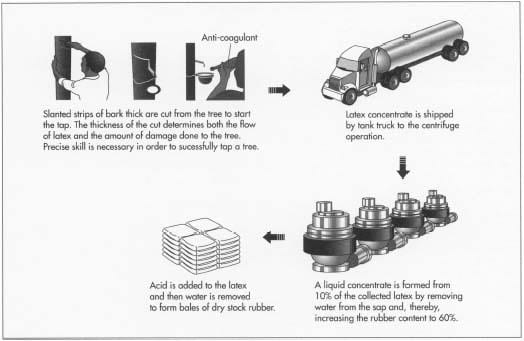
Condamine was sent to South America in 1735 by the French Academy of Science to calculate the diameter of the Earth at the equator.  In his travels through Peru, Ecuador, and Brazil, he was fascinated by caoutchouc, a milky white elastic substance produced under the bark of a tropical tree.  He returned with samples in 1745.  By 1752, Jean Hyacinthe de Magellan, a Portuguese scientist who corresponded with internationally known scientists of his day, is thought to have been the person responsible for suggesting that caoutchouc be used as an eraser in the Proceedings of the French Academy.  Until that time, pieces of bread had been used to eliminate marks on paper. According to Inventors and Inventions, Sir John Priestly noted the erasing properties of vegetable gum:  “I have seen a substance excellently adapted to the purpose of wiping from paper the mark of black pencil lead.” By 1778, Priestley suggested that caoutchouc be called “rubber” for its properties. A decade later, by 1790, the word “eraser” was in use and referred to the object used to remove pencil marks.

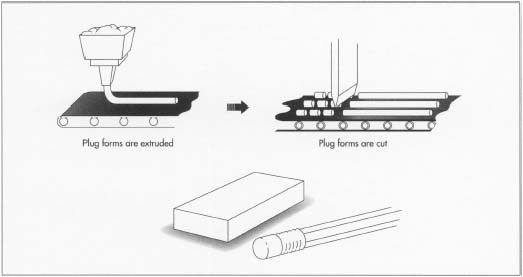
In 1839, American Charles Goodyear developed and patented a process to keep the rubber material from rotting.  The process, vulcanization which is named after the Roman god of fire, cured and stabilized the rubber.  Today, erasers are made from synthetic rubber or vinyl.  The engineering and production process involved can be seen in a short You Tube video by the Staedtler Corporation http://youtu.be/FocX6Fews6k or in the article Eraser:  Raw Materials and Manufacturing Process are described in detail at a site called: http://www.madehow.com/Volume-5/Eraser.html

ERASER 5      ERASER 6

Sources:

Hyacinthe Magellan (2014) retrieved from  http://www.amphilsoc.org/exhibits/magellan/magellan.htm

Innovateus, Edward Nairne (2006-2013) retrieved from  http://www.innovateus.net/inventor/edward-nairne

Online Etymology Dictionary (2001-2014) retrieved from http://etymonline.com/index.php?allowed_in_frame=0&search=eraser&searchmode=none

Colonel Percy Harrison Fawcett, Charles Marie De La Condamine (1999) http://www.phfawcettsweb.org/condam.htm

Patents:

Combination of Lead-pencil and eraser (US 19783A) https://www.google.com/patents/US19783?dq=eraser&hl=en&sa=X&ei=_GVNU4qLL4KE2wXRhIHQAg&ved=0CDUQ6AEwAA

Systematic Reviews Open Workshop

“A systematic review is a comprehensive and unbiased review process that locates, appraises and synthesizes evidence from the scientific studies to obtain a reliable overview” (ebd.ada.org).

This class will focus on tips and techniques for carrying out a successful literature search in support of a systematic review. Topics will include techniques for developing search strategies, deciding which databases to search and how to seek out grey literature for a given topic. There will also be discussion on selecting journals for hand searching, documenting search strategies, and saving and organizing references.

This session will be hands-on and there will be time for questions at the end. All HOW classes are free for UI students and affiliates.

Our next session is:

Thursday, April 17, 3-4 pm

Location: Hardin Library East Information Commons Classroom

Register here. For more information, email us at lib-hardin@uiowa.edu or call 335-9151.

Stages of a systematic review. [Image via http://www.ispor.org/news/articles/July09/CLR.asp]

Blood Moon – April 14, 2014

Last night’s clear skies provided ideal conditions for viewing the Blood Moon. Did you miss it? Never fear! Here are some links to amazing time-lapse videos and photographs of this extraordinary event: