Skip to content
Skip to main content

Finals Week Activities & Hours

Join us at Hardin during finals week for some activities to help you relax!

Free Coffee: The library will be providing coffee free of charge from 5pm this Friday through Friday, May 16th.

Therapy Dogs: Spend some time relaxing with a therapy dog this Saturday from 5pm to 7pm. No appointment is necessary.

Hunt for Xiao: Be the first to locate Xiao, our library owl, in the stacks and receive a free Hardin Library mug! This contest will be held daily from Monday, May 12th through Friday, May 16th. If you are the first to locate Xiao, please bring him to the circulation desk to receive your prize.

Write Home: University Libraries postcards are available to those who would like to write home during finals week. Postcards and postage are free! These materials will be available all week.

Finals Week Hours:

Friday, May 9th 7:30am – Midnight
Saturday, May 10th 10:00am – Midnight
Sunday, May 11th Noon – Midnight
Monday, May 12th 7:30am – Midnight
Tuesday, May 13th 7:30am – Midnight
Wednesday, May 14th 7:30am – Midnight
Thursday, May 15th 7:30am – Midnight
Friday, May 16th 7:30am – 8:00pm


Good luck during finals week!

Finals De-Stress Activities at the Sciences Library

The Sciences Library is not only a great place to study for finals, we’ve also organized some fun activities to help you de-stress. Here’s what’s going on:

  • Refuel with free hot beverages and treats. (During Sciences Library hours, May 11th – 16th.)
  • Take a break from your studies to build your own creation! Legos, K’NEX and idea books provided. Bring your imagination! (During Sciences Library hours, May 11th – 16th.)
  • Exercise your brain with card games, Phase 10 and Uno! (During Sciences Library hours, May 11th – 16th.)
  • Challenge your study buddy to a game on our Wii console! (6-10PM, May 11 – 15)

Sciences Library hours during Finals Week:

Monday – Thursday 8:30 a.m. – 10:00 p.m.
Friday 8:30 a.m. – 5:00 p.m.
Saturday CLOSED
Sunday 1:00 p.m. – 10:00 p.m.

Database of the Week: SimplyMap

Each week we will highlight one of the many databases we have here at the Pomerantz Business Library.

The database: Simply MapSM-Iowa_City

Where to find it: You can find it here, and under S in the databases A-Z list.

Use it to find:

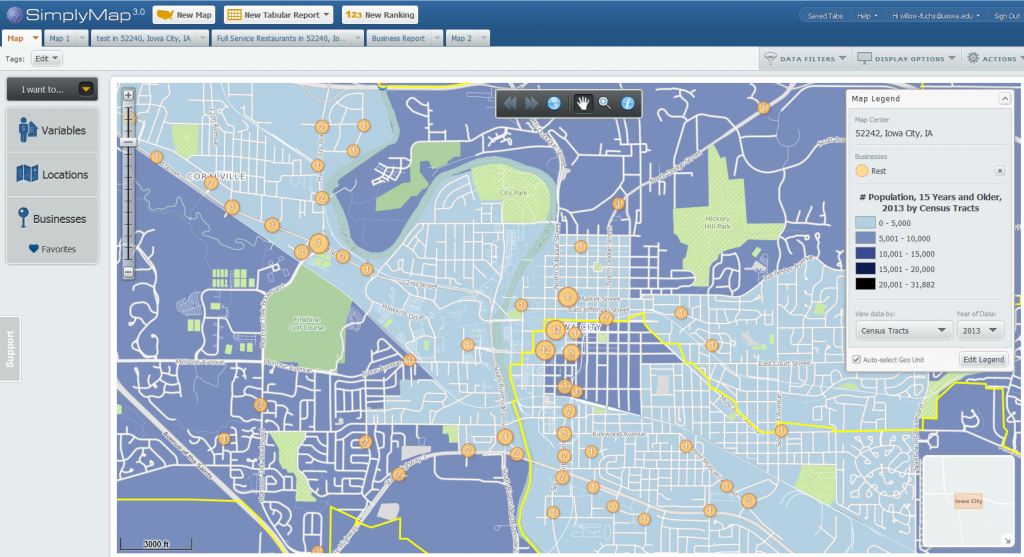
  • An array of data that can be applied to maps (from all of the USA to Census tracts and block groups)
  • More than 75,000 data variables related to demographics, employment, housing, market segments, businesses, consumer spending, brand preferences, and public health.
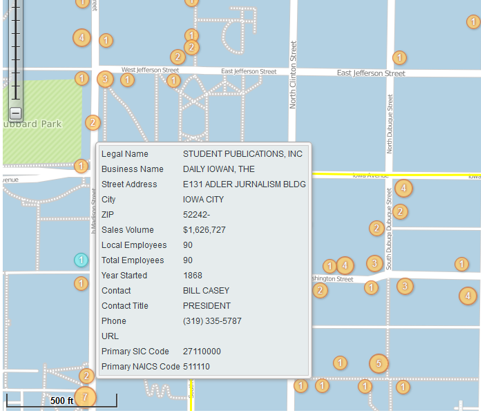
  • Plot business using: business names, NAICS / SIC codes, sales volume, and number of employees
  • Business information, including address, sales, volume, number of employees, and contact information

SM-_IofITips for searching:

  • Use your UI email address to create an account and save whatever you are working on.
  • Create a new map, tabular report, or ranking by clicking the top buttons
  • Select your variables (must select a variable), locations, and businesses on the left, or use the the map, report, or ranking “Wizard” to guide you through
  • Take note of the tabs on the top right (data filters, display options, and actions)

Demos: Demos can be viewed directly in SimplyMap – just go to help in the top right hand corner, or click below.

Map Tutorial

Business Points Tutorial

Report Tutorial

Want help using SimplyMap? Contact Willow or Kim and set up an appointment.

UI Libraries receives Carver grant to renovate exhibition space

Tuesday, May 6, 2014

Exhibit Hall 1960In April, the University of Iowa Libraries was awarded $500,000 by the Roy J. Carver Charitable Trust in support of the renovation of the Main Library Exhibition Space. Very exciting news!

Our current space was constructed in 1951 and has not changed much since then. Over the years, using the space as an exhibit became more and more challenging. Plus it was a space that people walked through to get from one side of the building to the other making it very difficult to engage anyone in an exhibit.

Due to the Learning Commons project which was completed in 2013, the current exhibition space is now a self-contained area. Anticipating the exhibition possibilities that the Exhibit Hall 2014 ConceptLearning Commons renovation would open up, we began working with consultant Liz Kadera on a gallery and exhibition space presentation. We were delighted that our new Library Director John Culshaw liked our concept drawings and pulled a team together to draft a proposal to present to the Carver Trust.

The renovation will create a more suitable and secure space dedicated to displaying books, manuscripts, maps, documents, artworks, and more from the Libraries collections.

Construction is planned to begin this fall with a proposed completion date of spring 2015.

First image courtesy of the UI Archives, 1960. Second image courtesy Liz Kadera, 2013.

From DNA to Beer: Harnessing Nature in Medicine and Industry.

Need a break from studying? Check out the new exhibit at the Hardin Library for the Health Sciences. Titled From DNA to Beer: Harnessing Nature in Medicine and Industry, the exhibit was produced by the National Library of Medicine and the National Museum of American History.

The National Library of Medicine’s description of the exhibit explains:

Microbes—tiny organisms too small to be seen with the naked eye have altered human history. Life forms such as bacteria, yeasts, and molds can cause sickness or restore health, and help produce foods and beverages. Scientists, in partnership with industry, have developed techniques to harness the powers of these microbes. In recent years, headline-grabbing technologies have used genetically modified bacteria to manufacture new medicines.

The exhibit is located on Hardin Library’s 3rd floor, and will be on display through June 15, 2014. Visit NLM online for more information, and to explore the digital gallery: http://www.nlm.nih.gov/exhibition/fromdnatobeer/index.html

We have had no mail for several days, so that I have not heard from you

Joseph Culver Letter, May 6, 1864, Page 1

Nickajack Trace, Georgia1
May 6th 1864
My Dear Wife

We have had no mail for several days, so that I have not heard from you, but earnestly hope you are in good health. Phil [Plattenburg] joined us to-day, and I have returned to my Company.2 We are on Picket to-night but will commence the march before morning.

Hoping that this may find its way to you, I am happy to say that my health is excellent. Keep a brave heart. All will be well.

The health of the Company is good. May our Father in Heaven keep you in health and ever make you happy. Kiss Mother [Murphy] and Maggie for me and remember me kindly to all. I have every reason to be thankful for the many blessings I enjoy. God has been very bountiful in mercy, and I feel content to suffer his will. Heaven is all bright and glorious. Pray for us. Write often; it may be several days before I have another opportunity to write.

May Holy Angels guard thee, and all our hopes of happiness be centered in Heaven. Accept all the love of an affect. heart.

Good bye.
Your Husband
J. F. Culver

  1. The division remained in camp at Pleasant Grove Church on the 5th, and late in the day soldiers of the 129th drew three days’ rations. On May 6, the division broke camp at an early hour and turning south halted on the Nickajack Trace, east of Leet’s Tanyard. O. R., Ser. I, Vol. XXXVIII, pt. IV, p. 44. General Johnston on the 5th had ordered his infantry and artillery out of their camps and into defensive positions along the rugged ridges and in the gaps. Lt. Gen. William J. Hardee’s corps was on the left with his men holding Rocky Face; Lt. Gen. John B. Hood’s corps guarded the right, where the line bent down to the east of Dalton; and Maj. Gen. Joseph Wheeler’s cavalry covered the flanks, guarded the gaps through Taylor’s Ridge, and observed the advance of the Union columns as they felt their way forward. Gilbert E. Govan & James W. Livingood, A Different Valor: The Story of General Joseph E. Johnston, C.S.A. (Indianapolis, 1956), p. 262.
  2. Adjutant Plattenburg had been sent to Louisville with money contributed by the officers and men of the 129th to purchase a gift horse and saddle and bridle for Colonel Case.

U.S. Intelligence on the Middle East, 1945-2009 – Trial ended 5 June 2014

U.S. Intelligence on the Middle East, 1945-2009 sheds light on the U.S. intelligence community’s spying and analytic efforts in the Arab world, including the Middle East, the Near East, and North Africa. It covers the time period from the end of World War II to the present day, up until the 2002-2003 Iraqi Weapons of Mass Destruction (WMD) assessments, the Global War on Terror, the Iraq War, and Iran’s nuclear program.

Please send additional comments to Edward Miner.

Standards Workshop : Guides and Regulations for Building and Evaluating Resources, Thursday, May 8 @Hardin

This workshop provides an introduction to standards and specifications. Learn how to access a wide variety of standards including ASTM, ISO, ADA, NFPA (Fluid), and the US Code of Federal Regulations. Featuring a new database, TechStreet, and more. This session will be led by Kari Kozak, the head of the Lichtenberger Engineering Library. This session is hands-on and free for UI students and affiliates. There will be time for questions at the end.

Our next session is:
Thursday, May 8, 3-4 pm
Location: Hardin Library East Information Commons
Register online here or by calling 319-335-9151.
Image via oviss.co.jp

PubMed Food Problem: Cranberry & Cranberries

By Eric Rumsey and Janna Lawrence

[Check out additional articles on PubMed & Plant-Based Foods]

Part of the problem in searching for food in PubMed is that it’s often the case that there’s a fuzzy border between between food and medicine.   A food that is enjoyed for its taste and general nutritional benefits may have properties that make it therapeutic for specific health conditions. A good example of this is cranberries, and cranberry juice, which may have benefits for prevention of urinary tract infections.

As with most plant-based foods, in MeSH indexing, cranberry is in the Plants explosion, and it’s not in any food, diet or nutrition (FDN) explosion. Fortunately, most articles on cranberries and cranberry juice are assigned some FDN indexing terms so that they are retrieved in broad FDN searches. Articles on cranberry juice are often under Beverages, and some articles on cranberries are under Fruit or Dietary supplements.

To show how this works in PubMed, we searched for cranberry or cranberries in the article title, limited to human, and retrieved 322 articles. We then combined this with our broad hedge search to get all articles that contain food, diet or nutrition MeSH terms or text words. This retrieved 255 articles — 79% of the cranberry/cranberries articles, which is a fairly good retrieval. But still, it’s certainly notable that there are 67 articles that are not retrieved, many of which appear to be very much on target, that don’t contain any FDN MeSH terms or text words. Here are some examples:

As we mentioned above, plant-based foods are tricky to search in PubMed because the name of the food plant is usually only in Plants, and not in any FDN explosion. The five articles above are all indexed under Vaccinium macrocarpon, the taxonomic name of cranberry, which is in the Plants explosion. So if you were searching for articles on urinary tract infections and plant-based foods, a strategy that would retrieve these articles would be to combine Urinary Tract Infections AND Plants.