Skip to content
Skip to main content

Searching Nutrition in PubMed is Difficult – Hardin Class will teach you HOW – Thursday, July 24

Nutrition is a trending subject that’s important in many areas of the health sciences. Nutrition is one of the most difficult subjects to search in PubMed, because relevant aspects of the subject are scattered among multiple  subject terms.

We’re offering a class to help you optimize your searches for nutrition, diet and food in PubMed. The class is appropriate for all health sciences specialties.  It will be taught by Janna Lawrence and Eric Rumsey, both of whom are experienced in searching nutrition and other subjects in PubMed.

Time: Thursday, July 24, 10:30-11:30 AM

Location: Hardin Library  EAST Information Commons Classroom, 2nd floor

Register online:  http://www.lib.uiowa.edu/hardin/workshop/ 

Questions? Contact us by calling (319) 335-9151 or email us at lib-hardin@uiowa.edu.

As background for the class, or if you’re not able to attend, we have written several blog articles on nutrition searching in PubMed. This one will get you started, and lead to our other articles:

Searching for Food, Diet & Nutrition in PubMed


Scopus & Web of Science: Learn HOW with Hardin Open Workshops

Scopus is a multidisciplinary database with substantial international coverage which allows you to track an article’s cited and citing references. All citations in EMBASE are also in Scopus. Web of Science is a citation database which covers over 10,000 journals and specializes in citation tracking. Come to this free, hands-on session and learn to search Scopus systematic reviews, find articles citing your work in Web of Science, and use the Journal Citation Index to measure scholarly impact. 

Our next session is:

Thursday, July 10, 2-3 pm

Location: Hardin Library EAST Information Commons Classroom

Register here. Questions? Contact us by calling (319) 335-9151 or email us at lib-hardin@uiowa.edu

[Image credit: Wikimedia Commons]

The mail came in twice yesterday but brought no letter from you

Joseph Culver Letter, July 16, 1864, Page 1

Head Qurs. Co. “A” 129th Regt. Ills. Vols.
In the Field Near Chattahoochie River
July 16th 1864
My Dear Wife

The mail came in twice yesterday but brought no letter from you. I heard from you, however, up to July 5th through Mrs. McDowell; she writes to Harry that you are well. I am indeed happy to hear it.

My health continues to be good. Col. Case recd. a letter from Lieut. Smith yesterday, in which he says he expects to be able to return to the Company in a few days. Major Hoskins recd. a letter from his wife yesterday of date the 5th in which she says you are well.

We still remain in Camp, while the rest of the army is working its way rapidly toward Atlanta.1 We have heard no news lately, except that some 2,000 prisoners have been forwarded to the North.2 The health of the Regiment is good, and all the boys are full of life. We have not been able yet to determine what disposition will be made of us. Some conjecture that we will be left to guard the rear, while McPherson’s army moves to the front to do the fighting for awhile.3

The pay-master is expected in a few days. Chris [Yetter] went out for blackberries this afternoon; we have had them quite plenty for a few days past. Nate [Hill] is well and enjoying himself. We had a very excellent meeting last night and anticipate a good day to-morrow. Quite a number of our Regt. are seeking the Savior. I will try and write a short letter to the Sabbath School to-morrow if I am not sent on duty. Give my love to all the family and remember me kindly to all our friends. May our Heavenly Father bless you.

Good bye,
Your Affect. Husband
J. F. Culver

  1. Howard’s IV Corps had been rushed to Schofield’s support at Phillips’ Ferry; Dodge’s XVI Corps, reinforced by Newton’s IV Corps division, bridged the Chattahoochie at Roswell; and Thomas’ Pioneers on the night of the 12th laid a pontoon bridge at Powers’ Ferry. Sherman’s plans called for Schofield’s Army of the Ohio to advance from its bridgehead at Phillips’ Ferry by way of Cross Keys toward Decatur. McPherson’s Army of the Tennessee, having been moved from the right, would cross the Chattahoochie at Roswell, and, covered by a cavalry division, take position on the extreme left and strike the Georgia Railroad between Decatur and Stone Mountain. Thomas’ Army of the Cumberland was to cross the Chattahoochie at Pace’s and Phillips’ Ferries and approach Atlanta from the north. Cox, Atlanta, pp. 142-147.
  2. During July, Sherman’s “army group” captured 3,200 Confederates and paroled 732 deserters. Of this number, the Army of the Cumberland had captured 2,722 Rebels and counted 576 deserters. O.R., Ser. I, Vol. XXXVIII, pt. I, p. 159.
  3. General McPherson’s Army of the Tennessee in the second week of July was withdrawn from its position on the right of Hooker’s corps and marched northeast to Roswell, where Dodge’s XVI Corps had established a bridgehead. By the morning of the 17th, the last of McPherson’s soldiers had crossed the 700-foot pontoon bridge and were south of the Chattahoochie. In the advance on Atlanta, McPherson’s army would be on the left, Schofield’s in the center, and Thomas’ on the right. O.R., Ser. I, Vol. XXXVIII, pt. III, p. 38.

Engineering the Bicycle

Iowa is known for many things: the butter cow, John Wayne, ethanol, and the Register’s Annual Great Bicycle Ride Across Iowa (RAGBRAI). On July 20th, 8,500 riders will mount their two-wheeled pedal machines to cover more than 400 miles in one week. Would this have been possible without the engineering feats of light-weight carbon fiber materials, multiple-speed performance gears, durable traction wheels and brakes, and ergonomically adjustable handle bars and seat posts?
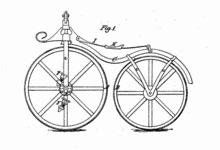
original pedal-driven bicycle

The original pedal-driven bicycle (velocipede) as it appears in Pierre Lallement’s U.S. Patent No. 59,915 of 1866.

The earliest sketch of a bicycle-like machine was drawn in 1493 by a student of Leonardo da Vinci. However, the earliest claim to a two-wheel “running machine” was called the Draisine, named for its inventor, Karl von Drais. who patented his wood-built, steerable design in 1818. Soon after, Denis Johnson of London patented a similar version called the “velocipede” or “pedestrian curricle.” The rider walked or ran on top of the two-wheel machine. It commonly was referred to as the “hobby-horse” since it was an alternative to riding a horse as a means of transportation.

In 1863, a French metalworker, Pierre Lallement, introduced the first crank and pedal-operated serpentine-frame velocipede. His 1866 U.S. patented design became the basis for the first popular and commercially successful “bicycle.” By the 1890s, continued improvements had been made to the steering, safety, comfort and speed of the bicycle design, as well as the addition of the chain-drive from the front wheel hub to the rear.

By the start of the 20th century, cycling had become a viable and popular means of transportation. Mass production increased its affordability and recreational riding clubs formed. Susan B. Anthony coined the phrase “freedom machine” because the bicycle gave women unprecedented mobility. It also reshaped the women’s fashion industry since corsets and angle-length skirts encumbered riding.

REFERENCES

Books:

Bicycle Design book coverBicycle design : an illustrated history / Tony Hadland and Hans-Erhard Lessing ; with contributions from Nick Clayton and Gary W. Sanderson. Cambridge, Massachusetts : The MIT Press, [2014] (eLibrary)

Bicycle Design by Mike BurrowsBicycle design : the search for the perfect machine / Mike Burrows with Tony Hadland. London : Snowbooks Ltd., 2008. (Engineering Library TL410 .B8 2008)

Bike, Scooter and Chopper Projects book cover

Bike, scooter, and chopper projects for the evil genius / Brad Graham, Kathy McGowan.  New York : McGraw-Hill, c2008. (Engineering Library TL400 .G689 2008)

TThe Racing Bicycle book coverhe racing bicycle : design, function, speed / foreword by Robert Penn ; general editors, Richard Moore, Daniel Benson. New York : Universe, 2013. (Engineering Library TL437.5 .R63 2013)

Racing Bicycles book coverRacing bicycles : 100 years of steel / David Rapley ; [photography by Susie Latham]. Mulgrave, Vic. : Images Publishing Group Pty, 2012. (Engineering Library TL410 .R37 2012)

Cyclepedia book cover

Cyclepedia :
a century of iconic bicycle design
 /
Michael Embacher ; foreword by Paul Smith ; photographs by Bernard Angerer.  San Francisco : Chronicle Books, 2011. (Engineering Library FOLIO Tl410 .E43 2011)


Article:
LaFrance, Adrienne. “How the Bicycle Paved the Way for Women’s Rights.” The Atlantic [serial online], June 26 2014.

Patent:
Lallement, Piekre. Improvement in velocipedes. U.S. Patent 59, 915, November 20, 1866 (Google Patents)

Standards:
Cycles — Safety requirements for bicycles –

Part 1: Terms and definitions — First Edition, ISO 4210-1 July 1, 2014 (14 pages)

Part 2: Requirements for city and trekking, young adult, mountain and racing bicycles — First Edition, ISO 4210-2 July 1, 2014 (42 pages)

Part 3: Common test methods — First Edition, ISO 4210-3 July 1, 2104 (16 pages)

Part 4: Braking test methods — First Edition, ISO 4210-4 March 20, 2014 (36 pages)

Part 5: Steering test methods — First Edition, ISO 4210-5 July 1, 2014 (20 pages)

Part 6: Frame and fork test methods — First Edition, ISO 4210-6 July 1, 2014 (32 pages)

Part 7: Wheels and rims test methods — First Edition, ISO 4210-7 March 20, 2014 (14 pages)

Part 8: Pedal and drive system test methods — First Edition, ISO 4210-8 July 1 2014 (16 pages)

Part 9: Saddles and seat-post test methods — First Edition, ISO 4210-9 March 20, 2014 (14 pages)

Searching for Genetic Info, PubMed’s Gene Sensor, NCBI and More: Learn HOW with Hardin Open Workshops

Overwhelmed by the number of databases that the National Center for Biotechnology Information has to offer on nucleotide sequences, genes and proteins? Wondering which database you should always start with? Would you like to learn how to set up an NCBI account to link articles in PubMed to records in other databases? Do you know about PubMed’s Gene Sensor? Are you familiar with the concept of linear navigation? Learn all of these tips and more in this session that is designed for anyone who needs to search the NCBI databases for genetic information. This session is hands-on and free for UI students and affiliates. There will be time for questions at the end.

Our next session is:

Friday, July 18, 1-2 pm

Location: Hardin Library for the Health Sciences, EAST Information Commons Classroom

Register here or contact us by calling 335-9151 or emailing lib-hardin@uiowa.edu


[Image via astrobio.net]

The Treasure in the Old Will: Iowa Women’s Archives Inherits Valuable Nancy Drew Collection

mwb4

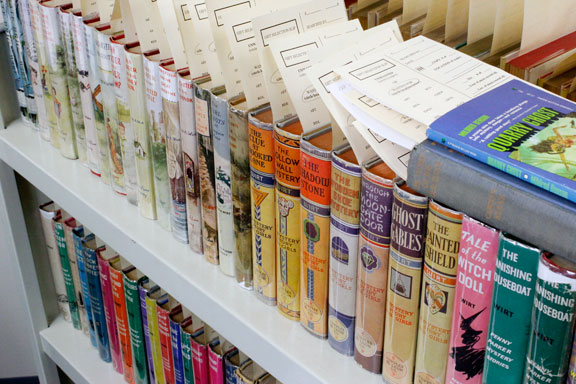
There were no missing documents, phony relatives, or suspicious fires — just a straightforward bequest from Peggy Wirt, whose mother, the late Mildred Wirt Benson, was the original ghostwriter of the Nancy Drew series. But the collection that was recently left to the Iowa Women’s Archives calls to mind another mystery trope – the hidden treasure: the gift of 150 books, written and signed by Benson, was appraised at $115,000. According to IWA Curator Kären Mason, however, the true value of the donation lies in further documenting an important figure in American popular culture.

The first student to earn a master’s degree in journalism from the University of Iowa, Mildred Wirt Benson wrote the original Nancy Drew novel, The Secret of the Old Clock, in 1930 under the pseudonym Carolyn Keene. She completed nearly two dozen more titles in what has become one of the most successful children’s book series ever. Benson published numerous other children’s novels, both as a ghostwriter and under her own name, before turning to a career in journalism. The Peggy Wirt bequest will be added to the IWA’s Mildred Wirt Benson collection, used frequently by scholars and fans alike, that was donated by the author in 1992 and subsequent years until her death in 2002.

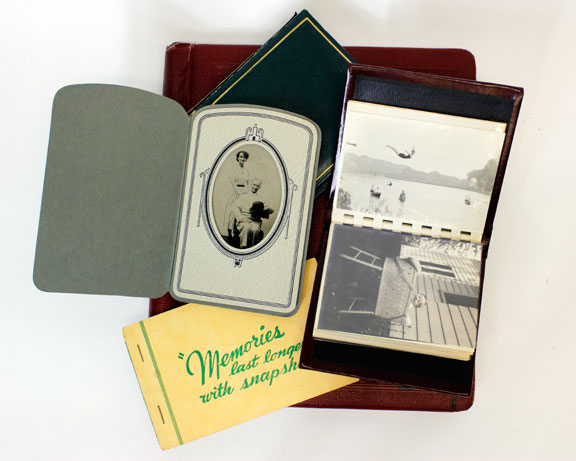
Two additional sets of new acquisitions complement the book donation. Purchased at auction from the estate of Peggy Wirt are a vintage typewriter of Benson’s, along with several photo albums. The latter include the original snapshot of an image that has become iconic to fans of the author: a college-age Benson, circa 1925, making a daring swan dive into the Iowa River near the current site of the UI’s student union.

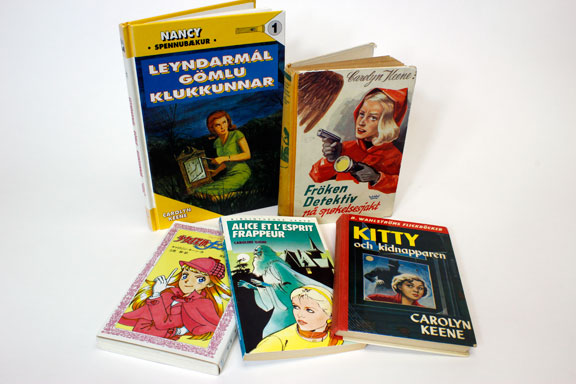
The other recent donation comes from UI Journalism Professor Emerita Carolyn Stewart Dyer, who gave the IWA her collection of foreign-language Nancy Drew novels. The covers of these French, Japanese, and Swedish translations depict a Nancy both familiar and strange – renamed Kitty or Alice, holding a gun, her trademark titian hair changed to brown or blonde.

In any language, the character continues to serve as a feminist icon who inspires women “to persevere, to achieve, to ask questions and find answers,” according to Dyer. While coordinating the UI’s 1993 symposium on Nancy Drew, she heard from many women who grew up on the series:

Most compelling of the many elements of the stories women told us about reading Nancy Drew were the accounts of how, as girls, they saw in Nancy an alternative to conventional notions of what a woman could be. Women in many occupations told of learning from Nancy to see adventure in solving problems and the joy of self-reliance. These qualities, they said, led them to the futures they chose as lawyers, researchers, librarians, and detectives, among other roles. (1)

The Mildred Wirt Benson materials may be viewed at the Iowa Women’s Archives. Selections from the collection have been digitized and made available at the Iowa Digital Library: digital.lib.uiowa.edu/mwb

  1. “The Nancy Drew Phenomenon: Rediscovering Nancy Drew in Iowa” by Carolyn Stewart Dyer, in Rediscovering Nancy Drew, edited by Carolyn Stewart Dyer and Nancy Tillman Romalov (University of Iowa Press, 1995)

mwb1

mwb2

mwb3

From top: the bequest of novels from Peggy Wirt, waiting to be processed; a vintage typewriter used by Benson; Benson’s photo albums; foreign-language versions of Nancy Drew novels, donated by Carolyn Stewart Dyer. Photographs by Hannah Scates Kettler

IMF eLibrary – Trial ends 13 August 2014

The International Monetary Fund’s (IMF) eLibrary simplifies analysis and research with direct access to the IMF’s periodicals, books, working papers and studies, and data and statistical tools. You will find information and perspective on macroeconomics, globalization, development, trade and aid, technical assistance, demographics, emerging markets, policy advice, poverty reduction, and so much more.

IMF eLibrary data interface

Please send additional comment to Kim Bloedel.

Contrary to expectation, we are still laying in Camp

Joseph Culver Letter, July 11, 1864, Page 1

Hd. Qurs. Co. “A” 129th Regt. Ills. Vol. Infty.
In the Field Near Chattahoochie River
July 11th 1864
My Dear Wife

Contrary to expectation, we are still laying in Camp resting. Alf [Heutson] was here a short time ago, & he thinks there is a prospect of our remaining here several days.

The mail has generally gone out at 4 o clock, but I have just learned that it goes out to-day at 2, so I have only a few minutes to write in. I just finished a letter to the Hill Sunday School, but I was interrupted so often that I fear it will not be interesting.

We are all well to-day and the weather very warm. There is light Skirmishing along the river bank, but it is three miles distant and we seldom hear it.1 We had prayer-meeting last evening and a very profitable time. Alf drew a sketch of the burning of a cotton factory by our Cavalry and left it at my tent when I was on picket, but someone stole it before I got to see it.2 He intended it for you. I sent you a map of our position two days ago.3

The mail has just arrived, and I hope has brought a letter for me, but I must send this out or it will be too late. Give my love to all. May our Father in Heaven bless and preserve you.

Your affect. Husband
J. F. Culver

  1. Historian Grunert reported that in the skirmishing on July 11, Private William F. Dermund of Company E was killed. Grunert, History of the 129th Illinois, p. 82.
  2. Union cavalry had occupied Roswell on July 7, where there were “extensive cotton, wool and paper mills, running at their full capacity and till this last moment turning out supplies for the Confederate government.” The owners in a futile effort to protect their property claimed their ownership was French and raised the tricolor. Sherman did not recognize this subterfuge, and they were burned. Cox, Atlanta, p. 137.
  3. This map is missing from the Culver Collection.

Summer Reading: The Best American Science And Nature Writing 2012

The Best American Science 

And Nature Writing 2012


Edited by Dan Ariely

Houghton Mifflin Harcourt Publishing Company c2012

Engineering PN6071. S3 B46 2012


The Best American series is the premier annual showcase for the country’s finest short fiction and nonfiction. Each volume’s series editor selects notable works from hundreds of magazines, journals, and websites. A special guest editor, a leading writer in the field, then chooses the best twenty or so pieces to publish. This unique system has made the Best American series the most respected — and most popular — of its kind.


From Booklist

There is so much we don’t know, which leads us to make so many irrational decisions that we need scientists and science writers to share their inquiries and discoveries in welcoming and lucid prose. Stellar examples of just this sort of cogent and compelling writing sustains this invaluable and exciting series. This year’s guest editor, Ariely, professor of psychology and behavioral economics and author of The (Honest) Truth about Dishonesty (2012), kicks things off with a provocative introductory essay about how we can and should use science to improve our lives. His commanding and eye-opening selections run the gamut from the micro (gut biota) to the macro (global air pollution) and steadily ramp up our sense of awe and concern. His engaging contributors write of food allergies (Jerome Groopman), the evolution of feathers (Carl Zimmer), the extraction of DNA from Neanderthal bones (Elizabeth Kolbert), and crowd disasters (John Seabrook). In the most intimate essay, Sy Montgomery describes her unexpectedly emotional encounters with Athena, a very smart and expressive giant Pacific octopus. How wondrous and complicated life is. –Donna Seaman

About the Author

Dan Ariely, author of The Upside of Irrationality and Predictably Irrational, is the James B. Duke Professor of Psychology and Behavioral Economics at Duke University.


My health continues to be very good for which I feel very thankful

Joseph Culver Letter, July 10, 1864, Page 1

Hd. Qurs. Co. “A” 129th Regt. Ills., Vols. Infty.
In the Field Near Chattahoochie River July 10th 1864
My Dear Wife

Yours of June 30th has just come to hand. I am most happy to learn that you enjoy such a good degree of health. May our Father in Heaven bless you with a continuance of the same. My health continues to be very good for which I feel very thankful. I am sorry to learn that Lt. Smith improves so slowly, as we certainly expected him to be with us soon.1 I hope, however, that he may soon recover. The health of the Company is very good.

Last night the enemy evacuated all their works on this side of the river, and our lines of Skirmishers were advanced to the river bank.2 The 23rd Corps are on the other side on the enemy’s right flank and probably to-morrow the whole army will advance. Rumor says the Rebs destroyed the R. R. Bridge which is very probable.3

I am sorry that Mathis is disposed to give you any trouble; I will write to Mr. Lyons and Mathis on the subject. Do not allow the matter to give you any unnecessary trouble. The well is not worth repairing and must remain until I get home, if it be God’s will to spare my life.4 If Mathis desires to leave the premises, he will probably give you notice, &, if you cannot readily rent it, it can remain empty. I cannot make any arrangements at present to regulate the matter. If you need money, try and borrow of Mrs. Fellows or Mr. Remick until pay-day.5

We packed up & moved out of camp this morning but were brought back again & now occupy the same ground we have occupied for the last three days.6 I have heard nothing from Bros. John or Sammy yet; they are about 3 miles to the left of us.7 I have enclosed a letter to Mrs. Moran and Wm. B. Lyons in this as I have no ink to back envelopes, though if I can succeed in getting any, I will mail them separately.

I have no desire to sell our property at present, though if Mathis offers you $1,250.00 cash, you can tell him he can have it for that if you desire to part with it. I am very glad you have told me of it, an early knowledge of such things may save me a great deal of trouble. I can very easily settle the matter. All matters relating to business should be known to me. I wish for your sake we could receive our pay, but that is improbable until after the Campaign closes.

I am much obliged for the extracts from the Chicago Tribune. It is always much later than any papers we get.

We had our S. School this morning, and it was a very profitable meeting to me, & I hope to all the rest of the Company present. Chris Yetter and Nate Hill are well. I will write a short note to the aid-society in behalf of Mrs. Moran. Unless they assist her, she will undoubtedly suffer. Her husband recd. no pay since Dec. 31st, 1863, & it will be 6 or 7 months before she gets back pay and bounty due him. Try & get the people interested in behalf of the needy soldiers’ wives. They are doing all they can for the country, & the thought that their loved ones at home may suffer is a great barrier to their enjoyment and a source of constant sorrow.

I should write to the Hill S. School to-day, but it is drawing near mail time, & I think of so much I would like to write as this may be the last opportunity for several days.

Give my love to Mother and Maggie and kiss the children for me. I have enjoyed much of the presence of God; let us praise his name and trust all to him.

The weather is very warm but the health of the troops good. Remember us in your prayers. We live in hopes that the time will soon come where we can mingle our voices with those we love in praise to God for a Country saved from intestine war and in peace and prosperity. Pray for our Country. Now is the day of trial, but, God being with us, all will be well. May the richest of Heaven’s blessings rest upon you.

Your affect. Husband
J. F. Culver

P.S. Tell Remick Hume Tuckerman has just come into my tent — that he is well & looks well. He belongs to the 20th Ills.8

  1. Lieutenant Smith was at home, recovering from the wound received at Resaca in mid-May.
  2. The Confederates, on the night of July 4, evacuated their lines behind Nickajack Creek and retired into previously prepared defenses covering the crossings of the Chattahoochie River. On the 5th, Ward crossed Nickajack Creek and advanced his division along Turner’s Ferry road. It was an exhausting march, and on the 6th the division took position “confronting the enemy’s fortifications on the Chattahoochie.” The camps were on a high ridge overlooking the river. O. R., Ser. I, Vol. XXXVIII, pt. II, pp. 327, 388.
  3. General Sherman, in a successful effort to flank the Confederates out of their Chattahoochie line, pulled General Schofield’s Army of the Ohio (the XXIII Corps) out of its position on the right of the Army of the Cumberland and marched it to Smyrna Camp Ground, near the Western & Atlantic Railroad. On the 8th Schofield’s divisions, with the army’s pontoon train, marched northeast and forced its way across the Chattahoochie at a lightly defended crossing at Phillip’s Ferry. Confederate efforts to destroy Schofield’s bridgehead failed, and on the night of the 9th, General Johnston withdrew to the south bank of the Chattahoochie. Next morning Rebel engineers removed their pontoon bridges, and Johnston’s rear guard retired, burning the railroad and highway bridges. Cox, Atlanta, pp. 134-140.
  4. Mathis was renting the Culver property. Apparently, the well had failed and Mathis was demanding its repair.
  5. Mrs. Fellows was either the wife or mother of the hospital steward J. Allen Fellows of the 129th Illinois Infantry.
  6. In a futile effort to cut off and capture Confederate stragglers, Ward advanced a line of skirmishers to the Chattahoochie. After establishing a picket line, the troops returned to their camps to rest and wait for the Pioneers to bridge the river. O.R., Ser. I, Vol. XXXVIII, pt. II, p. 327.
  7. Company M, 1st Illinois Light Artillery, on the 5th had unlimbered its six guns on high ground, near Pace’s Ferry, from where could be seen the spires of Atlanta, eight miles to the southeast. Next day a number of ranking officers, including Generals Sherman and Howard, visited the battery and watched as the gunners engaged Rebel cannon on the opposite side of the Chattahoochie. Report of the Adjutant General of Illinois, Vol. XIII, p. 668.
  8. Hume Tuckerman, a 21-year-old farmer, was mustered into service on June 13, 1861, at Joliet, Ill., as a private in Company D, 20th Illinois Infantry. Wounded at Shiloh in April 1862, he was detailed in June as regimental teamster. On Jan. 5, 1864, he reenlisted as a veteran volunteer at Big Black Bridge, Miss., and in June 1864 was detailed as brigade wagonmaster. Private Tuckerman was mustered out at Louisville, Ky., July 16, 1865. Compiled Service Records of Union Soldiers, NA.