Skip to content
Skip to main content

New Housing Option for Conservation

Thursday, September 11, 2014
Submitted by Bill Voss

Goblet in phase boxWith the recent acquisition of a riveter and a board creaser, the Conservation Lab has a new housing option – phase boxes constructed from sturdy 40 point featuring fore edge closures made of nylon string and riveted vinyl washers. Stronger than a regular 20 point four flap enclosure, and quicker to make than a full clamshell box, these phase boxes can also be modified with Volara foam padding or Ethafoam wells to accommodate objects of various shapes and sizes.Series of plates in phase box
Cross in phase boxCompleted phase box

Cambridge Archive Editions Online – Trial ends 15 October 2014

Cambridge Archive Editions Online presents a wealth of historical reference materials which otherwise would remain unknown, difficult to access, or fragmentary. Considered collectively, this body of documents represents many thousands of original documents of the National Archives (UK) represented in facsimile, including numerous maps, on the national heritage and political development of many countries.
Please send additional comments to Chris Africa.

Now available: IOP ebooks

The UI Libraries now has access to two new e-book collections from IOP. The Expanding Physics collection includes in-depth texts from the leading voices in physics research and related subject areas aimed at the recent graduate/researcher level. The Concise Physics collection includes shorter texts in rapidly advancing areas and introductory texts aimed at the undergraduate/researcher level.

Both collections are accessible instantly for multiple simultaneous users at: http://purl.lib.uiowa.edu/IOPBooks.

If you have any questions or would like to learn more about IOP ebooks, please contact Sara Scheib, Sciences Reference & Instruction Librarian.

Crowdsourcing soldiers on

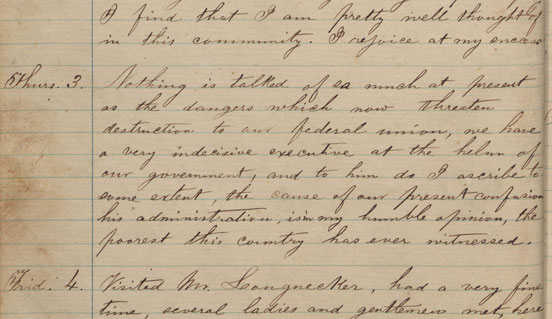
George C. Burmeister diary, 1861 | Civil War Diaries and Letters

George C. Burmeister diary, 1861 | Civil War Diaries and Letters

While our long-delayed launch of World War I & II documents at DIY History continues to be long delayed, there are still plenty of items currently available for transcription, including several new additions to our original crowdsourcing collection: Civil War Diaries and Letters.

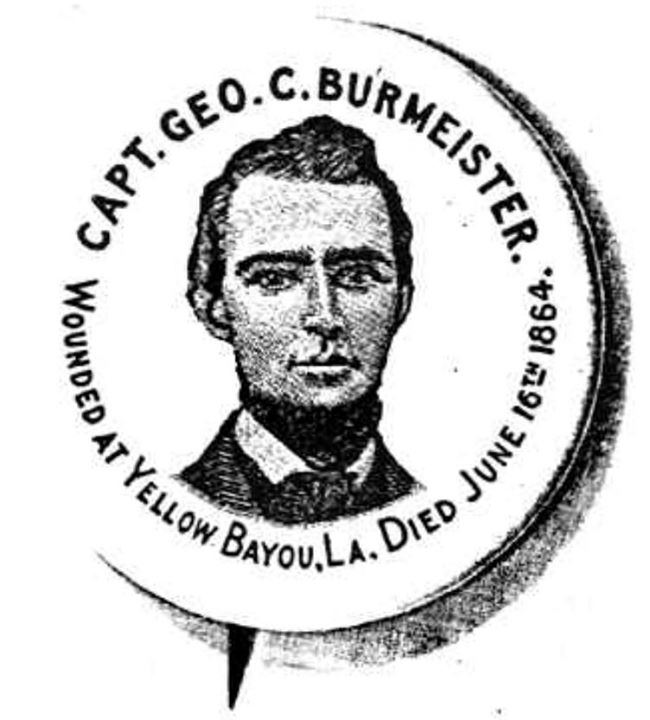
Among these are four diaries written by Muscatine, Iowa, native George C. Burmeister, a schoolteacher turned Civil War captain. From his first, optimistic entry on January 1, 1861 (“Once more we look with anxious expectations into the future, and fondly cherish this day as a harbinger of anticipated fortune”) to his 1864 newspaper obituary (“Let his memory be cherished as one who died that liberty might live”), Burmeister’s story unfolds in the diaries as he enlists in the First Iowa Infantry, musters out, studies business and law, applies to the UI, rejoins the army as a captain, and dies in the Battle of Yellow Bayou.

Please visit DIY History to help improve access to the stories of Captain Burmeister and his fellow soldiers.

Burmeister image via Ancestry.com and the Muscatine in the Civil War Facebook group

Burmeister image via Ancestry.com and the Muscatine in the Civil War Facebook group

I opened my letter to say that we remain all well

Joseph Culver Letter, September 14, 1864, Page 1

Sept. 14th 64 — 1 P.M.

I opened my letter to say that we remain all well. We have orders to move to Atlanta to-morrow morning;1 so, if they are not countermanded, we will be probably located in or near the city by this time to-morrow.

I intended to write to Bro. Tom but neglected it. I find I have to be very sparing of envelopes, as I have only a very few left & no way of obtaining more. As soon as I can get some money, I will get you to send me 100; by leaving the end open, the postage will not be much. I want the best. A very inferior article costs 50 cts per pack here, & just now they cannot be obtained.

The paymaster will arrive at Atlanta to-day or to-morrow, & we will probably be paid within ten days.2 I have not heard from my Leave of Absence yet. The weather is very pleasant to-day. I presume we will get no mail until to-morrow. Remember me kindly to all. With much love, I remain, as ever,

Your affectionate Husband
J. F. Culver

  1. The 1st Brigade would rejoin the Third Division in Atlanta. The 2d and 3d Brigades had been in the city for almost two weeks. One regiment would remain at the Chattahoochie Railroad Bridge to protect the supply depots. O. R., Ser. I, Vol. XXXIX, pt. II, p. 382.
  2. General Sherman on September 11 learned that the paymasters had arrived in Nashville and would be joining his “army group” as soon as funds were available. He suggested that his troops be paid “in great part in checks on New York.” O. R., Ser. I, Vol. XXXIX, pt. II, pp. 358-59.

I shall endeavor to remember the 21st September, and, if in my power, will keep it sacred with you

Joseph Culver Letter, September 13, 1864, Letter 2, Page 1

Head Quarters, Co. “A” 129th Regt. Ills. Vol. Infty.
Chattahoochie River, Georgia
September 13th 1864
My Dear Wife

Your letters of the 2nd & 4th came to hand this evening. I am very happy, indeed, to learn of your good health; God has very signally blessed us, and my heart is grateful. I shall endeavor to remember the 21st September, &, if in my power, will keep it sacred with you.1 I did hope to spend it with you, but that seems more and more improbable every day.

You have doubtless learned before this that our loss in the capture of Atlanta was very light. We lost not a man in our Corps [the XX]. The death of John Morgan and the repulse of the Rebels in our rear are very gratifying.2

You have not yet acknowledged the receipt of the $10 I sent. I fear it was in some of the captured mails.

I am not aware that I feel any more dignified than usual, there is so very little of it in my nature. I will try and be very dignified when I get home. I have now no recollection of what transpired two years ago from Sept. 4th. Though I cannot fix dates, yet I have many, very many, recollections of the past. I have written of them to you.3

I am glad to hear from Bro. Thomas [Murphy].4 I wrote to him a few weeks ago but have not heard from him yet. I would try and console him if I knew what was the matter.

I recd. the Tribune & North Western this evening of the 7th & have been reading to the boys until a late hour. I presume the draft has transpired.5

We are so far from the city that we get no letters except what come by mail. As the way is open again, I shall expect to hear from you very often until the Campaign opens again.6

I have not heard from Bro. John yet. You speak in your letter of writing to Hospital No. 19, Nashville. I presume therefore that Bro. Sammy is there and will write to him soon.7 [Albert] Green is looking anxiously for his book. He was very much pleased to learn of the baby. Chris [Yetter] & Nate [Hill] are well & all the boys with the exception of Wm. Sutcliff. I sent forward an application for a furlough for him to-day; if that fails, I will try for his discharge.

The weather last night and to-day has been very cool. It is probable that there will be early frosts in the North.

I have not answered Harry & Jennie’s [Cheston’s] letter yet. Is it not singular that we have no letters from Mother or Hannah [Culver]?

Politics ran very high here until the Chicago platform was received;8 the McClellan men have been very quiet ever since. We have considerable anxiety for results in the North this fall. The time is not long, but it will doubtless be hotly contested. I hoped to hear the result of the [Livingston] County Convention by to-day’s mail but was disappointed.

The moon shines brightly to-night, & it is cool enough for an overcoat. If we could have a light frost to kill off the numerous insects that swarm around, it would be very acceptable.

Remember me very kindly to Mother and Maggie. I presume sickness in her family has prevented Sister Maggie [Utley] from writing. Mother [Murphy] was disappointed in writing, as she expected to act [as] correspondent during your disability.

I have not yet wholly abandoned the idea of getting home, though I do not anticipate too much. Let us still hope for the best. I feel assured that should I fail to make the anticipated visit, you have still a great comfort in our child. May God bless you both with health and bestow upon you the riches of his Grace.

I should have much liked to hear what Chaplain Cotton had to say. Were my letters to the Sunday School received? Remember me kindly to all our friends. Allen Fellows recd. letters from his wife yesterday. I have not seen him since the mail came in this evening. He is well. [Major] Hoskins is also well. Lt. Smith came off Picket this evening; he is improving in health slowly.

I may have opportunity to add a line to-morrow. Kiss baby for Papa. If Mrs. Smith’s surmises be true, I may not have a right to the title. I shall take the credit, however, unless I am better informed. Hoping that the richest of Heaven’s blessings may rest upon you, I remain, as ever,

Your affectionate Husband
J. F. Culver

  1. Franklin Allen, the Culvers’ first child, had been born on September 21, 1862. He died October 30, 1863.
  2. Brig. Gen. John H. Morgan, the famous Confederate raider, had escaped from the Ohio State Penitentiary with a number of his officers. Making his way south, he was placed in command of the Department of Southwestern Virginia in April 1864. Morgan and his command camped in Greeneville, Tenn., on the night of September 3, while en route to attack Federal forces near Knoxville. Early the next morning he was surprised by a detachment of Union cavalry and was killed in the garden of the house where he had been sleeping. Warner, Generals in Grey, p. 221. By September 10 trains were again operating over sections of the Nashville & Chattanooga Railroad wrecked by General Wheeler and his raiders. Wheeler, having been hounded out of Middle Tennessee, was camped near Florence, Ala., while General Williams’ brigade, closely pursued by Federals, had fled eastward and had crossed the Clinch River, near Clinton, Tenn., O. R., Ser. I, Vol. XXXIX, pt. II, pp. 356, 378, 381.
  3. Mary Culver in her letters of September 2 and 4, missing from the Culver Collection, must have referred to something that had occurred on September 4, 1862.
  4. Thomas Murphy, Mary Culver’s oldest brother, was a Cleveland machinist and port engineer.
  5. A draft to provide additional manpower for the Union armies began on Monday, September 12.
  6. General Grant on September 10 notified General Sherman that “as soon as your men are sufficiently rested and preparations can be made, it is desirable that another campaign should be commenced. We want to keep the enemy constantly pressed to the end of the war.” O. R., Ser. I, Vol. XXXIX, pt. II, p. 355.
  7. Pvt. Sam Murphy was hospitalized in Chattanooga on July 26, 1864, where he remained until rejoining his unit at Atlanta in September. Compiled Service Records of Union Soldiers, NA.
  8. To please the war Democrats, Maj. Gen. George B. McClellan was nominated for the presidency by the Chicago convention, while the “peace faction” drafted the platform. After referring to “four years of failure to restore the Union by the experiment of war,” the platform demanded the cessation of hostilities “to the end that at the earliest possible moment, peace may be restored on the basis of the Federal Union of the States.” Randall, Civil War and Reconstruction, p. 619.

On my return from Atlanta last evening, I found three letters awaiting me

Joseph Culver Letter, September 13, 1864, Page 1

Head Quarters, Co. “A” 129th Regt. Ills. Vols. Infty.
Chattahoochie River, Ga. September 13th 1864
My Dear Wife

On my return from Atlanta last evening, I found three letters awaiting me. I am most happy to hear that you enjoy such good health, and feel thankful to “Our Father” for the continued manifestation of “His” love and mercy so richly bestowed upon us. Your letters were dated respectively 27th, 29th, & 31st. I also recd. Chicago papers to the 3d inst. How greatly God has blessed us in all things.

I wrote a short note from the Hospital in Atlanta yesterday but had to send it without an envelope. Atlanta looked very desolate yesterday. Genl. Sherman ordered all the citizens to leave and gave them their choice to go North or South.1 1,000 teams started out to Rough & Ready loaded with families with a little furniture allowed to each. They seemed in good spirits generally, except some few women who had several children and seemed quite delicate in health. All the Ambulances of the Army were sent out also, some of them filled with fair looking ladies.

The city is not over half as large as Nashville,2 but is very much scattered and in prosperous times was doubtedly a very pleasant place. I was only in the city a few hours. All that portion North of the square is very much injured with the shells, many houses are utterly ruined and quite a number burned to the ground. A majority of the principal business places are very seriously injured. There has been some fine gardens, but they are almost wholly destroyed. The citizens have dug large holes in their yards in which to protect themselves from shells. Nearly all the houses are vacated.

There are a few families which could not be moved at present. I saw one or two with very small infants & several whose condition would preclude the possibility of their being removed with safety; such, I presume, will be allowed to remain.

I am very much surprised that the Rebel Army should destroy all their commissary stores and abandon the wives and families of their soldiers to starvation. Had they left even a short supply, it had not been necessary to adopt such harsh measures as this seems to be. But it would be a matter of impossibility to take care of them here with our long base of supplies open to interruption all the time, and they did not wish to be sent North.3

I have not received Maggie’s promised letter yet, but hope it may arrive by next mail. I am almost satisfied that I shall get no opportunity to visit home this season. We are preparing rapidly for the fall Campaign, and it will doubtless open by the 1st of next month.

I have had no letters from home except the one from Harry and Jennie [Cheston], which I mentioned ten days ago. I have not heard from Bro. John [Murphy] since about the 20th of last month. I sent Seph. Ullery out [to] the front yesterday evening and expect to hear from him in a few days.4 I must close for the present but will try and add some this afternoon.

Till then, Good bye. I will write to-night. May our Father in Heaven keep & bless you and our child. We are all well.

Your affect. Husband
J. F. Culver

  1. General Sherman, having “resolved to make Atlanta a pure military garrison or depot, with no civil population to influence military measures, issued orders deporting all citizen and family residents.” In notifying General Hood of his decision on September 7, Sherman announced that those who preferred could go south and the rest north. For the latter the Union would “provide food and transportation to points of their election in Tennessee, Kentucky, or farther north.” For the former, he would “provide transportation by cars as far as Rough and Ready, and also wagons; but that their removal may be made with as little discomfort as possible, it will be necessary for you to help the families from Rough and Ready to the cars at Lovejoy’s.” The refugees would be allowed to take with them their moveable property (clothing, trunks, reasonable furniture, bedding, &c), and their servants, white and black, provided they did not coerce the blacks. Sherman knew that this measure would “raise a howl against my barbarity and cruelty,” and he answered that “war is war, and not popularity-seeking.” General Hood, in agreeing to Sherman’s proposal for a “truce in the neighborhood of Rough and Ready” to facilitate the mass deportation, branded it as “an unprecedented measure,” transcending “in studied and ingenious cruelty, all acts ever brought to my attention in the dark history of war.” On September 10 Sherman announced that pursuant to an agreement made with General Hood, “A truce is hereby declared to exist from daylight of Monday, September 12, until daylight of Thursday, September 22 … at the point on the Macon railroad known as Rough and Ready, and the country round about for a circle of two miles’ radius, together with the roads leading to and from in the direction of Atlanta and Lovejoy’s Station,” for the purpose of affording the people of Atlanta a safe means of removal to points south. Sherman’s chief quartermaster at Atlanta was directed to afford the refugees “all the facilities he can spare to remove them comfortable and safely, with their effects, to Rough and Ready, using cars and wagons and ambulances for that purpose.” O. R., Ser. I, Vol. XXXVIII, pt. V, p. 822; O. R., Ser. I, Vol. XXXIX, pt. II, p. 356; Sherman, Memoirs, II, pp. 111-12.
  2. In 1861 the population of Atlanta was about 10,000 compared with Nashville’s 37,000. By 1864 the number of people living in Atlanta had burgeoned to 20,000.
  3. The destruction of the commissary stores did not trigger Sherman’s decision to order the evacuation of Atlanta by the citizens, as J.F.C. supposed. In a letter to Maj. Gen. Henry W. Halleck on September 4, Sherman, in outlining an autumn campaign, announced his proposal “to remove all the inhabitants of Atlanta, sending those committed to our cause to the rear, and the Rebel families to the front.” He would “allow no trade, manufacturers, nor any citizens there at all, so that we will have the entire use of railroad . . ., and also such corn and forage as may be reached by our troops.” O. R., Ser. I, Vol. XXXVIII, pt V, p. 794.
  4. Company M, 1st Illinois Light Artillery, the unit to which John and Sam Murphy belonged, was camped two miles east of Atlanta, on the Decatur road. Ibid., p. 840.

Learn tips for searching Gene, Nucleotide Sequences & Protein Information @Hardin Library this fall

picture of instructor

Instructor Chris Childs Clinical Education and Outreach Librarian

Overwhelmed by the number of databases that the National Center for Biotechnology Information has to offer on nucleotide sequences, genes and proteins?
Wondering which database you should always start with?
Would you like to learn how to set up an NCBI account to link articles in PubMed to records in other databases?
Do you know about PubMed’s Gene Sensor? Are you familiar with the concept of linear navigation?

Learn all of these tips and more in this session that is designed for anyone who needs to search the NCBI databases for genetic information.

Our sessions this fall:

Thursday, September 18, 10:00 – 11:00 am (Location: East Information Commons, 2nd floor, Hardin Library)

Tuesday, October 7, 2:00 – 3:00 pm (Location: East Information Commons)

Tuesday, November 4, 10:00 – 11:00 am (Location: East Information Commons)

Register online:  http://www.lib.uiowa.edu/hardin/workshop/ .  You can also request a personal session if none of these times work for you!

Imposition and Format

Friday, September 12, 2014
Submitted by Gary Frost

Open Book ImpositionThere can be confusion regarding description of paper books; the given book needs description of how it was made as well as how it appears now and either perspective can unfairly dominate. Makers best describe their own work, but, perhaps, they cannot. Papermakers, printers and bookbinders can also prefer their own exclusive explanations. Bibliographers and book conservators can bring the description up to date but some estimation will be needed for missing information.

Book imposition and format provide a good example of this descriptive challenge. Imposition, or the print shop choice of paper dimension and arrangements of type on the press bed are decisions of makers alone. Format conveys cutting and folding sequences for assembly of the book gatherings. The formats have traditional names such as folio, quarto, octavo or various other explanations such as quarto in six from sheet and a half. A format designation can be assigned during examination of a book in-hand. But format alone that will not well describe the book makeup.

If you wish a tutorial on identification method of book imposition and format you will not be disappointed. Two admirable narrations are the description of imposition by Gabriel Rummons[1] and description of format by Thomas Tanselle.[2] Gabriel, the printer, describes print shop methods and Thomas the bibliographer, describes the format description methods. Both are aware of each other’s practice and perspectives. Still there is a curious feeling of difference in perspectives of these two narrative types.

Let’s relate the knowledge presented by Gabriel and Thomas and, at the same time, also examine the difference of their perspectives. Imposition and format are complements of page assembly method and ultimately they reflect a complex of expedients needed to convey book content in a physical object. Imposition and format comprise a practical origami constrained by decisive, economic choices of a sheet dimension and production management. Practicality must also follow implications of font size, line length and number of lines per page. Such reality will dominate all book production from the beginning to the present.

In most paper book production the cost of paper directly determines imprint investment and risk. In the hand sheet era “Paper could claim over two-thirds of the total production costs, and in some cases three quarters of cost.”[3]  Printing paper was also premium stock and each sheet would need to count, run through and, ultimately, fold to full use without waste. Print shop masters knew all the options of imposition and format choice and used these for greatest expedition and expedience and error avoidance. Book designers, compositors and pressmen knew accuracy of every lock-up and every move. Such focus should also convey to description of the products of such work.

Retuning to description, distractions and displacements are not needed! Features such as laid pattern orientation, commercial sizes of sheets, grain direction, or options of self-backing impositions or type array of pages can obscure the start of a descriptive narrative of imposition and format. Neither is the number of folds of an imposition or the final dimension of the page alone a sufficient descriptor.

We should consider description of the relation of the various features. I would offer that book shape can be a good starting point. A strange, but handy reference here are the photo format shapes or their aspect ratios, especially the cut film sizes of 4 x 5 and 5 x 7. These two happened to exemplify the proportions of two-fold quarto and three-fold octavo. They can also represent the general proportion of paper sheets. They and other photo shapes such as the 2 ¼” square or the 35 millimeter frame of an elongated rectangle can also help as concept templates.

General shapes of various books are suggested here. The squat shape of the parchment book, derived from a quartered skin, is reflected by the 4 x 5 photo proportion. A more elongated rectangle of 5 x 7 is an echo of the ergonomic shape of the hand paper mold and later conventions of cut machine-made paper are echoed by a 35 mm frame. Even the extreme shape of a half-square of the papyrus book is suggesting the fold of a square, 2 ¼-like, sheet.

Formulations of paper shape options are memorized in print shops. There is the “little-me” that any starting sheet proportion will be proportional to any ¼ cut sheet derived from it. This will then enable exact proportion smaller gatherings. Options of a one-third proportion cut from a sheet can enable strange elongated or squat book shapes or, perhaps, stocks from one-third cutting can be allocated to different books altogether.

Shape, meaning page proportion or aspect ratio, can also suggest bookbinding conventions. There we need to remember that the head to tail height represents a double trim while the width is only diminished by a single foredge trim. Another factor of 3-D book product shape is book thickness. Letterpress monographs range from a single gathering to almost one hundred gatherings in thickness. Blank and ruled paper stationery binding, by contrast, will feature a standard number of gatherings, including a consistent number of gatherings in the earliest long-stitch books. Finally, book shape is itself optimized for various handling and manipulation actions and this is ultimately the most relevant feature for the reader. The reader is at work after the process of imposition and format decisions that define a physical book. On opening and closing actions of reading the infinite possibilities of three-dimensional book shapes are revealed. The paper book is a complex product.


[1] Rummonds, Richard-Gabriel, Nineteenth-Century Printing Practices and the Iron Handpress, vol.1, Chapter Eight, Imposition, Oak Knoll Press, 2004.

[2] Tanselle, G. Thomas, “The Concept of Format”, Studies in Bibliography, Bibliographic Society of the University of Virginia, vol.53(2000), p.67-115.

[3] Raven, James, The Business of Books, Yale University Press, 2007, p.50.