Skip to content
Skip to main content

Use of Older Theses

By far the most heavily used collection in Iowa Research Online are our theses and dissertations. Most of the items in the collection are from the last decade, either from graduates who voluntarily submitted their thesis electronically or dating from after December 1999 graduation when electronic submission required by the Graduate College for all non-M.F.A graduates. All of them are freely available worldwide (after an embargo period, if requested).

We have also digitized a small number of older theses. We digitize items when requested by an interested reader, with the copyright holder’s permission. We are also posting digitized out of copyright theses as time allows. As one would expect, these items do not receive nearly as much use as the newer theses. However, we are pleased to see that they are receiving steady use, far more than the print theses circulated.

In all, these 217 theses have been downloaded 20,966 times, used on average once every 5 days. In fact, six items have averaged more than 1.2 uses/day, including two that have been downloaded more than 1000 times!

Graduation Year Title Author Degree Use/Day Total Downloads
1914 Morphology of cannabis sativa L Reed, Joyce Master of Science 2.023 534
1921 The development of Milton’s prosody Hunter, Grace Eva Master of Arts 1.204 236
1931 The catenary Kacmarynski, J. P. Master of Science 1.521 1,217
1949 A formal analysis of Hawthorne’s The Blithedale romance Levang, Lewis Dwight Master of Arts 2.024 498
1961 The Production book of “The Diary of Anne Frank” Longacre, Allan Kurtz II Master of Arts 1.219 1,403
2008 Teacher-initiated talk and student oral discourse in a second language literature classroom : a sociocultural analysis Thoms, Joshua J Doctor of Philosophy 1.320 545

If you are interested in having your thesis digitized and added to our open access collection, please let us know by submitting this permission form (PDF).

Streaming Media Makes Obtaining Content Harder for Libraries

An article in The Chronicle reveals the all-too-real frustrations of obtaining digital content for academic libraries, like the University of Iowa.

How Streaming Media Could Threaten the Mission of Libraries, by Steve Kolowich

Excerpt:

In March 2011, the University of Washington’s library tried to get a copy of a new recording of the Los Angeles Philharmonic, conducted by Gustavo Dudamel, playing Berlioz’s Symphonie Fantastique that the library could lend to students. But the recording was available only as a digital download, and Amazon and iTunes forbid renting out digital files.

So the librarians contacted the Philharmonic to see if there was some way they could get a copy of the album that they could lend out like a compact disc. The orchestra referred them to a distributor, which referred them to the publisher, the Universal Music Publishing Group. At first the corporation said it couldn’t license the recording to the university, according to the librarians. Later it offered to license 25 percent of the album for two years in exchange for a licensing fee plus a $250 processing fee.

No thanks, the librarians said.

Welcome to content licensing, a great source of anxiety for librarians in the digital era.

….The licensing of digital media, however, gives publishers far more power. Instead of selling an album outright, they can sell permission to access its contents for a fixed amount of time. (This is a boon for textbook publishers in particular. Under a digital regime, they may not have to worry about losing sales to students’ buying used copies.)

Continue reading>>

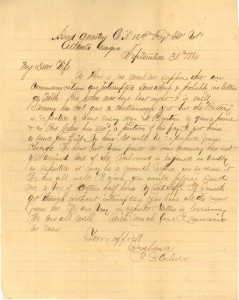
We suppose that our communications are interrupted somewhere, and probably no letters go north

Joseph Culver Letter, September 30, 1864, Page 1

Head Quarters Co. “A” 129th Regt. Ills. Vols.
Atlanta, Georgia September 30th 1864
My Dear Wife

As there is no mail, we suppose that our communications are interrupted somewhere, & probably no letters go north.1 Bro. John [Murphy] was here last night & is well. Sammy [Murphy] has not gone to Chattanooga yet, but the “Battery” is expected to leave every day.2 Lt. Burton is going home,3 and, as Bro. John has recd. a portion of his pay, I got him to send you $20 by him. It will be expressed from Chicago.

We have not been paid as our money has not yet arrived, and, if the rail-road is injured as badly as reported, it may be a month before we receive it.4

We are all well. I wish you would please send me a box of cotton half hose by Sutcliff.5 If [Lt.] Smith got through without interruption, you have all the news from us.6 We are busy on reports; Yetter is learning. We are all well. With much love, I remain, as ever,

Your affect. Husband
J. F. Culver

  1. To cope with Forrest’s cavalry and protect the Western & Atlantic Railroad, Sherman had rushed General Newton’s division to Chattanooga and Brig. Gen. John H. Corse’s to Rome, Ga. The force guarding the Nashville & Chattanooga Railroad was also strengthened, while Gens. Lovell Rousseau and Robert S. Granger marched to intercept Forrest with 8,000 men. On the 26th Sherman learned from his scouts that Hood’s Army of Tennessee had broken camp and had marched west from Lovejoy’s Station, and was camped in and around Palmetto Station on the Atlanta & West Point Railroad. Upon receipt of news that Forrest’s column was closing in on Pulaski, 70 miles south of Nashville, General Sherman ordered General Thomas with Morgan’s XIV Corps to return to Tennessee. There he would push a column west through Stevenson to threaten Forrest’s rear. Forrest, after briefly occupying Pulaski on the 27th, had turned east toward the vital Nashville & Chattanooga Railroad. Fayetteville was occupied on the 28th, and small parties sent to cut the telegraph and railroad north and south of Tullahoma. Next day Forrest advanced toward the railroad, but at Mulberry, on learning that Thomas had massed a strong force at Tullahoma, he called a halt. Forrest now divided his corps: Brig. Gen. Abraham Buford with 1,500 men headed south toward Alabama, with instructions to wreck the Memphis & Charleston Railroad from Huntsville to Decatur, while Forrest with the main column turned west to raise additional havoc on the Tennessee & Alabama Railroad. Damage to the railroad and telegraph, north and south of Tullahoma, caused by Forrest’s raid on the night of the 28th was repaired in less than 12 hours. General Thomas on the 30th from Chattanooga telegraphed Sherman that “this place” is “crowded with officers and soldiers on leave and furlough. No more should be allowed to leave until the [rail] road is reported clear to Nashville.” Sherman was agreeable, and he notified his army commanders to stop all furloughs. Although damage to the railroad and telegraph had been slight, all trains had been pre-empted to rush reinforcements north to cope with Forrest’s raid. O. R., Ser. I, Vol. XXXIX, pt. I, pp. 546-47; pt. II, pp. 459-532.
  2. Although Company M was under orders to follow Newton’s IV Corps division to Chattanooga, another month was to pass before the artillerists were able to board a northbound train. Report of the Adjutant General of Illinois, Vol. VIII, p. 667.
  3. Thomas Burton of Chicago, a 20-year-old clerk, had been mustered into service on July 16, 1861, at Cairo, Ill., as a private in Company A, 1st Illinois Light Artillery. He was promoted to corporal on Dec. 1, 1861; was wounded at Shiloh on April 6, 1862; and promoted to sergeant on July 1, 1862. Sergeant Burton was discharged on Oct. 14, 1862, to accept a commission as 2d lieutenant in Company M, 1st Illinois Light Artillery. He was promoted to 1st lieutenant on March 31, 1864, and was mustered out at Chicago on July 24, 1865. Compiled Service Records of Union Soldiers, NA.
  4. Damage inflicted by Forrest’s raiders on the railroads over which Sherman supplied his “army group” was insignificant. But with Hood’s army across the Chattahoochee and striking north, this situation was about to change.
  5. Pvt. William Sutcliff, having received a 20-day furlough, had accompanied Lieutenant Smith. Regimental Papers, 129th Illinois, NA.
  6. Lieutenant Smith, having received his discharge, had boarded a northbound train for Chattanooga on the 27th. Grunert, History of the 129th Illinois, p. 106.

Don’t Be the Bunny

Friday, September 26, 2014
Submitted by Gary Frost

bunny3

Feral Seminar, 2014
Resilience of Book Transmission

Please join us for open forums,
Thursdays, 2:00—3:30, Fall Semester
Room 2058, Main Library

We have a favorite dictum as we study and manipulate the experience of media. This is “don’t be the bunny” or otherwise fall victim to contending polarities. Such binary decoys provoke inconclusive debate and displace us from study of the wide territory exactly between simple contrasts.

Binary decoys are everywhere, emerging from embodied reflexes of Sinister and Dexter, right and left, of our bi-cameral brain. In the region of comparative media studies, we construe and entertain binaries such as analogue and digital, paper and screen or content and format. These are intrusions of embodied cognitions such hot or cold, light and dark or even Platonic vs. Aristotelian perception. As such, they are fairly harmless but these zigzags intrude busybody distractions, diverting us from more attentive study and richer experience of our bodily surroundings.

A useful feral move here is to look exactly in between such binaries. There we can encounter a wide territory for endless enjoyment and thoughtful product. The needed method includes actions of ambivalence, stealth, good humor and eerie relevance. Such feral behavior is actually rather well known and we can find both legacy and projected strategies to guide and authenticate any binary disrespects. We can recognize pioneering practitioners of philology and their models of reflexive comparative study. We can also apply tools of cognitive archeologists, resilience engineers and pragmatic philosophers.

This is the territory of lively “entanglement” described by Ian Hodder[1] and material engagement with “the cognitive life of things” as studied by Lambros Malafouris[2]. These cognitive archeologists have mapped zones of embodied cognition through study of thoughtful acts of tool making. It remains for us and for enclaves of bibliographers, publishers, conservators, artists and craft workers to narrate the exemplary cultural performance of books. Here we can study the unlikely diversity of the actions of books and why it is that different readers have unique engagements or disengagements with the same book. Here we can account for the book’s resilience of easy assimilation of ever-changing technologies and display formats and changing actions of literacy and book use and library assemblies. Why is there such innocent compliance with book making whenever we wish to convey embodied cognitions to an out-of-body cognitive thing?

Any pathway across this landscape will offer opportunities. As we advance investigation of the resilience of book transmission we notice not a cheap binary contest between codex and cloud or between haptic and automated navigations but a complementary performance of intersecting, interplaying and interdependent transmissions. We can stop thinking of things as things and see things as cognitions. For the cognitive archeologist a stone tool is a frame of mind dug out of the ground. For the feral seminarian considering resilience of book transmission the codex is a projectile intentionally thrown across time and cultures.

Feral living has risks. Amorphous composites are out there such as “digital humanities,” “print culture” or “search results.” Such phantoms displace our attentive, persistent investigations. They sound OK but serve as decoys for almost any kind of reflexive comparative study. They even parent self-condoning “cross-disciplinary” university departments. Amorphous composites divert us into overly partitioned specialties. Books transcend departments.

So, welcome to the reflexive life of feral learning and our chosen topic of resilience of book transmission. We value discovery and exploration of new territory. No enrollment, no credit, no tuition, no dismissive binaries of student/teacher or class room inside or outside. We are makers of product.

[1] See, Entangled, an archaeology of the relationships between humans and things, 2012.

[2] See, How Things Shape the Mind, a theory of material engagement, 2013.

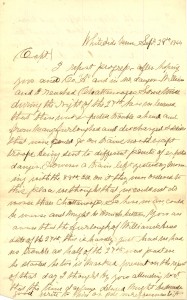
Capt, I report progress

Joseph Culver Letter, September 29, 1864, Page 1WhiteSide Tenn. Sept. 29th 1864
Capt.

I report progress – After hoping you and Co. “A” and in no danger William and I reached Chattanooga Some time during the Night of the 27th. here we learned that there was expected trouble ahead and from many furloughed and discharged soldiers that none could go on trains north except troops being sent to different points of expected danger. However a train left yesterday morning with the 88th Ill. on it they were ordered to this place we thought that we could not do worse than Chattanooga. So here we are, could be worse and might be much better. You are aware that the furlough of William’s bears date of the 27th. this is hardly just had we had no trouble as half of the 27th was past ere he started he too is marked present on the report of that day I thought by you attending [rpt.?] that the time delayed might be [illegible] good write to him or me in refference to it

I am in the telegraph office and learn from the operator that this road has not been cut unless done last night, That a heavy force of Rebels have taken Huntsville and Athens. Our forces are concentraiting at Tullahoma on those sent from [below?]. these indications of trouble here or at Bridge post. At this place The 88th Ill. part of the 1st Ohio and part of 9th Penn. Cavalry – the Regt. of which we were talking yesterday are stationed. Many rumors about the Rebel forces Some sa 40,000 We will move up just a fast as we can From what I can learn no train has been through from Nashville since Sabbath. One train came from Stephenson last afternoon. They sayed that one had started from the same place for Nashville in the Morning. I have not seen Capt. Coppage since I left Atlanta Could not find Sherman Mc[name] We shall be glad to get on farther may not get home for 8 or 10 days yet home or even from here

Nothing more

Your friend
J.W. Smith

J.F. Culver
Capt. Co. “A” 129th Ills.

New Resource: Board Vitals

Board Vitals Logo

Board Vitals is an exam preparation database. At this time, Hardin Library has subscribed to question banks for: Dermatology, Emergency Medicine, Neurology Shelf Exam, OB-GYN Shelf Exam, Otolaryngology, Pathology, Psychiatry, Psychiatry Vignettes, Child and Adolescent Psychiatry, and Radiology.

According to Board Vitals: “we provide up-to-date explanations from the literature with our answers and give you detailed feedback and assessment of your progress broken down by subject areas. With each question you can see how you compare to your peers, and gauge the difficulty of the question by what percentage of your peers answered it correctly or chose the same option you did.”

To use Board Vitals, you will need to:

  1. Access Board Vitals via the health science resources page: http://www.lib.uiowa.edu/hardin/eresources/
  2. Click the link that says “If Signing Up for the First Time, Click Here.”
  3. Fill out the form and you are ready to go.

You will have the option to select an area and then build a custom exam. The number of questions available is listed, and you can choose between a review or a timed exam. The reviewed exam provides explanations whether you answer the question or not. It will also show you how many exam takers correctly answered the question.

You can choose to answer between 1-50 questions, and, once you’ve used the resource, you’ll notice that you can choose to answer new questions, all questions, or incorrect questions.

Board Vitals is only one of the resources that Hardin Library provides for exam preparation. To find out about other resources, check out our Board Review Materials LibGuide http://guides.lib.uiowa.edu/boardreview

As always, please feel free to contact us http://www.lib.uiowa.edu/hardin/contact if you have any questions, comments, or concerns.

Database of the Week: ABI/INFORM Global

Each week we will highlight one of the many databases we have here at the Pomerantz Business Library.

The database: ABI/INFORM Global ABI_INFORM

Where to find it: You can find it here, and under A in the databases A-Z list.

Use it to find:

  • Full-text Academic articles (Journal of Economic Literature, Accounting Review, etc.)
  • Full-text periodicals (Wall Street Journal, Financial Times, Economist, etc.)
  • Market and industry reports from: Economist Intelligence Unit & Oxford Analytica
  • Also:
    • Working papers
    • Dissertations
    • Business cases
    • Conference proceedings

Tips for searching:

  • Start with a basic search
  • Use the “Advanced Search” to search by publication date, NAICs codes, source type, document type, etc.
  • Once you do a search, related searches will also be recommended

Video: View ABI/INFORM help videos below

Want help using ABI/INFORM Global ? Contact Willow or Kim and set up an appointment.

Another day has passed, another week commenced, and God has been and still is with me

Joseph Culver Letter, September 25, 1864, Page 1

Head Qurs. Co. “A” 129th Regt. Ills. Vols.
Atlanta, Georgia September 25th 1864
My Dear Wife

Another day has passed, another week commenced, and God has been and still is with me. I long for some news from home. No mail to-day, and consequently no letters for me. The Enemy captured and destroyed the mail train supposed to contain several days mail.1 I presume they have those intended for me. I still hope that you are well, but I cannot entirely remove the anxiety to know which continually haunts me.

The Sabbath Day has been unusually pleasant and happy. This morning I attended church in the city; this evening I preached at the Hd. Qurs. of Co. “G” from Hebrews, 2nd Chap. 2nd & 3rd verses. God was with me, & my soul is happy. We propose to commence a series of protracted meetings on Tuesday evening [the 27th] to continue so long as it may be profitable. Pray for us and ask all our friends to pray in Faith. We trust that God will pour out of his “Holy Spirit” upon us.

Lieut. Smith resigned some two weeks ago, and his papers returned home approved. He will start for home sometime next week. He was a good officer, & I am sorry to lose him.2 I shall try to have [Chris] Yetter succeed him but may not succeed. Godfrey is entitled by rank,3 but, having been promoted over Yetter without sufficient reason, I should much prefer Yetter, & I am satisfied the Company would also. Smith was loth to leave the company and service, but the condition of his wife’s mind and health left him no choice. He has been in perfect misery ever since he returned [from leave].

I thank God with all my heart for giving me a wife, who, while she is strong and earnest in her attachment, is willing to sacrifice so much for her Country’s good, who, instead of repining and mourning, can be cheerful and even comfort me. Believe me, I do not love you less than if you were less strong and self reliant; and, if I thought our Holy Father would not disapprove, I would pray to love you more. You have all my love, stronger than life and above all else, save God. I tried to imagine myself in the congregation at home, but there was so little resemblance. God is still the same in love and manifestations of mercy here.

All the Company are in good health. Nate Hill is still on duty in the city but was out to see us to-day. Alf Huetson was also here; he is well, & says there is a rumor afloat again that our Crops will be ordered to the Potomac.4 I cannot think it true so soon after this last call. We have no news to-day owing to the loss of our mail last night. We recd. by telegraph yesterday news of another victory in the Shenandoah Valley,5 also of rumors of Peace propositions from Jeff. Davis.6 The latter is rather improbable. If God will speed our cause until the close of the coming campaigns here and elsewhere, we may hope to have them in such a condition that such propositions may come within the bounds of reason. Just now I believe they would ask much more than we could honorably grant.

Atlanta is almost rid of citizens. You have doubtless read in the papers the correspondence between Genls. Sherman and Hood.7 To persons afar off the policy adopted may seem severe, but, under the circumstances, it was all that humanity could dictate. It was impossible to subsist them, & we have suffered so much from an inveterate foe in our rear that it has become a necessity to drive them before us.

The weather changed very suddenly last evening, and the night was very cold. We were scarcely comfortable with our overcoats this morning, but the day became very pleasant, though it is quite cool to-night.

Bill Myers of the 20th Ills. was here to-day.8 Alva Garner is sick in Hospital at Marietta;9 all the rest are well. [Lt.] Smith went to church in the city to-night with a squad of 12 of the Company. There is very encouraging revival in progress in several of the churches. May God increase the good work.

I saw a letter from Mrs. Paige to-day to Myers. She had heard of her husband’s death only through the papers & was trying to cheat herself into the belief that it was not her husband. May God deal kindly and pour the oil of consolation into her heart. Poor woman. With all his faults, she loved him dearly, and the future will look very gloomy to her. He was an excellent and faithful soldier and a very efficient officer.10

Let us lift our hearts in praise and thanksgiving for his boundless mercies to us. Give my love to Mother [Murphy] & Maggie and kiss baby for me. I would like much to see him.

I fear Green’s book & my stamps and tobacco have met the same fate of your last letters. May the richest of Heaven’s blessings rest upon you, and the Grace, Love, and Peace of “The Father, Son, and Holy Spirit” abide with you. Write as often as you can make it convenient.

Your affectionate Husband
J. F. Culver
  1. Confederate columns in the latter half of September again struck at Sherman’s supply lines. General Forrest’s corps advanced from its base in northeastern Mississippi, crossing the Tennessee River on the 20th, and headed north, wreaking havoc on the Tennessee & Alabama Railroad. Athens, Ala., was captured along with its garrison on the 25th. Next morning found Forrest’s horse-soldiers striking toward Pulaski, Tenn., as Northern generals frantically deployed units to counter this thrust toward Nashville and the vital Nashville & Chattanooga Railroad. Brig. Gen. William H. Jackson, whose cavalry division had remained with the Army of Tennessee when General Wheeler departed on his August raid, had forded the Chattahoochie in the fourth week of September at Phillips’ Ferry. On the evening of the 24th, one of Jackson’s columns captured a train near Marietta. O. R., Ser. I, Vol. XXXIX, pt. II, pp. 646, 881; Cox, Atlanta, pp. 222-23.
  2. Lieutenant Smith’s resignation was to take effect on Sept. 23, 1864. Compiled Service Records of Union Soldiers, NA.
  3. William A. Godfrey, a 35-year-old carpenter, was mustered into service on Sept. 8, 1862, as a corporal in Company A, 129th Illinois Infantry. Corporal Godfrey was promoted to 1st sergeant on Jan. 20, 1863. He was hospitalized at Savannah, Ga., in the late winter and spring of 1865, but rejoined the regiment in time to be mustered out with the unit on June 8, 1865, near Washington, D.C. Ibid.
  4. There was no truth to the rumor that the XX Corps was to be transferred to the Army of the Potomac.
  5. Secretary Stanton on the 23d had telegraphed Sherman that on the previous day Sheridan’s army, following up its success at Winchester, had defeated General Early’s army at Fisher’s Hill. “Nothing saved Early’s army from total destruction,” he added, “but the cover of night.” Leaving 2,000 prisoners in Federal hands, the Rebels retreated up “the Valley in the greatest confusion.” O. R., Ser. I, Vol. XXXIX, pt. II, p. 442.
  6. In the summer of 1864 there had been several abortive efforts by well-meaning individuals to find a formula that would bring peace. Negotiations always broke down in the face of President Davis’ “sine qua non of independence.” Randall, Civil War and Reconstruction, pp. 614-18. President Davis at this time was at Hood’s headquarters, where plans were made and approved for the Army of Tennessee to take the offensive. Hood was authorized to advance and destroy Sherman’s supply line, before the Federals could complete their build-up preparatory to a resumption of the campaign. Cox, Atlanta, p. 221.
  7. See J.F.C.’s letter of September 13, 1864.
  8. William H. Myers, a 21-year-old Pontiac carpenter, had been mustered into service on Aug. 9, 1861, as a private in Company D, 20th Illinois Infantry. Private Myers reenlisted as a veteran-volunteer at Big Black Bridge, Miss., in the winter of 1863-64. On May 28, 1864, he was detached to the Pioneer Corps, Third Division, XVII Corps, Army of the Tennessee, and in August was promoted sergeant. He was mustered out on July 16, 1865, at Louisville, Ky. Compiled Service Records of Union Soldiers, NA.
  9. Alva Garner, a 23-year-old Pontiac farmer, was mustered into service on June 13, 1861, as a private in Company D, 20th Illinois Infantry. Private Garner was wounded in the arm at Shiloh on April 6, 1862, and in January 1863 was detailed as a nurse in a LaGrange, Tenn., hospital. In the autumn of 1863 Private Garner was hospitalized at Memphis. On Jan. 5, 1864, at Big Black Bridge, Miss., he reenlisted as a veteran-volunteer. Private Garner was promoted to sergeant on Oct. 3, 1864, and discharged with his regiment at Louisville, Ky., on July 16, 1865. Ibid.
  10. Charles L. Paige, a 24-year-old Pontiac bookkeeper, was mustered into service on June 13, 1861, as a private in Company D, 20th Illinois Infantry. Private Paige was promoted regimental sergeant major on June 18, 1861. On Jan. 14, 1862, he was commissioned 1st lieutenant of Company D, and three months later captain. On April 20, 1863, he became acting lt. col. of the 9th Louisiana Colored Infantry, a position he held until rejoining his company in Sept. 1863. Captain Paige was killed in the battle at Atlanta, July 22, 1864. Ibid.