You can now watch the UI’s Open Access Week 2014 panel discussion “Open Access and the Public Good” via Iowa Research Online. Professor Russell Ganim (Division of World Languages, Literatures, and Cultures) moderates a conversation between the Honorable James Leach (Law), Professor Christina Bohannan (Law), and Professor Bernd Fritzsch (Biology). Among the topics are how research in the Humanities and Sciences is financed and conducted and who has the right to access its results.
Open Access Week video available online
You can now watch the UI’s Open Access Week 2014 panel discussion “Open Access and the Public Good” via Iowa Research Online. Professor Russell Ganim (Division of World Languages, Literatures, and Cultures) moderates a conversation between the Honorable James Leach (Law), Professor Christina Bohannan (Law), and Professor Bernd Fritzsch (Biology). Among the topics are how research in the Humanities and Sciences is financed and conducted and who has the right to access its results.
Halloween Party!
Ready for Halloween? Get a jumpstart on your celebration at the Sciences Library Halloween Party this Sunday, October 26 from 6-10PM!
Activities include:
- Private screenings of Halloween classics: Nosferatu the Vampyre and Young Frankenstein;
- Spooky Halloween exhibit in our display cases;
- And Halloween treats in addition to our always free coffee and tea.
We hope you can join us. Happy Halloween!
Story of Leprosy in Hawaii and Iowa – Lecture October 23, 5:30pm
The University of Iowa History of Medicine Society invites you to hear:
Richard Caplan, M.D. Emeritus Professor, Department of Dermatology; Program in Bioethics and Humanities, University of Iowa
The Story of Leprosy in Hawaii (and Iowa)
Thursday, October 23, 2014, 5:30-6:30
Hardin Library Room 401
The illustrated presentation will describe the history—both fame and infamy—of the famous leprosarium on the island of Molokai, Hawaii. The surprising phenomenon of leprosy (Hansen’s Disease) appearing in Iowa since the 1860’s will also be summarized.
For more information on the History of Medicine Society, including upcoming lectures or to make a gift: http://hosted.lib.uiowa.edu/histmed/
Mine thousands of engineering journals with one database

Paperity Aggregates All Open Access Articles. Finally!
Paperity, just launched this week, is the first multi-disciplinary aggregator of all peer-reviewed published open access articles and papers. Yes, that’s right, it aggregates not just the abstracts, but the full-text of the articles. Right now Paperity includes over 160,000 articles from 2,000 scholarly journals, and growing. The goal of the team is to cover 100% of Open Access literature in 3 years from now.
Paperity:
- gives readers easy and unconstrained access to thousands of journals from hundreds of disciplines, in one central location;
- helps authors reach their target audience and disseminate discoveries more efficiently;
- raises exposure of journals, helps editors and publishers boost readership and encourage new submissions.
Paperity Aggregates All Open Access Articles. Finally!
Paperity, just launched this week, is the first multi-disciplinary aggregator of all peer-reviewed published open access articles and papers. Yes, that’s right, it aggregates not just the abstracts, but the full-text of the articles. Right now Paperity includes over 160,000 articles from 2,000 scholarly journals, and growing. The goal of the team is to cover 100% of Open Access literature in 3 years from now.
Paperity:
- gives readers easy and unconstrained access to thousands of journals from hundreds of disciplines, in one central location;
- helps authors reach their target audience and disseminate discoveries more efficiently;
- raises exposure of journals, helps editors and publishers boost readership and encourage new submissions.
Louise Liers, World War I nurse
This post, by Christina Jensen, appeared on the Iowa Women’s Archives Tumblr this summer, and has since been featured on NBC news.
On June 28th, 1914, Austro-Hungarian Archduke Franz Ferdinand was assassinated in Sarajevo by Yugoslav nationalist Gavrilo Princip. One month later, war broke out across Europe between two alliance systems. Britain, France, Russia, and Italy comprised the Allied powers. Germany, Austria-Hungary, and the Ottoman Empire constituted the Central powers. As war raged abroad, the U.S. wrestled with the politics of neutrality and intervention. In April of 1917, President Wilson was granted a declaration of war by Congress. The United States thus officially entered the conflict alongside Allied forces.
To mark the occasion of the World War I centennial, we’re remembering Iowa women whose lives were shaped by the war.
One such woman was Clayton-native Louise Marie Liers (1887-1983), an obstetrics nurse who enrolled in the Red Cross and served in France as an Army nurse.
Before her deployment, however, Liers was required by the American Red Cross to submit three letters “vouching for her loyalty as an American citizen.” All nurses, regardless of nationality, were similarly required to provide three non-familial references testifying to this effect. While questions of loyalty and subversion are exacerbated in any war, America’s domestic front was rife with tension driven by geography, class, and ethnicity that raised fears and stoked national debate in the years leading up to America’s engagement in the Great War.
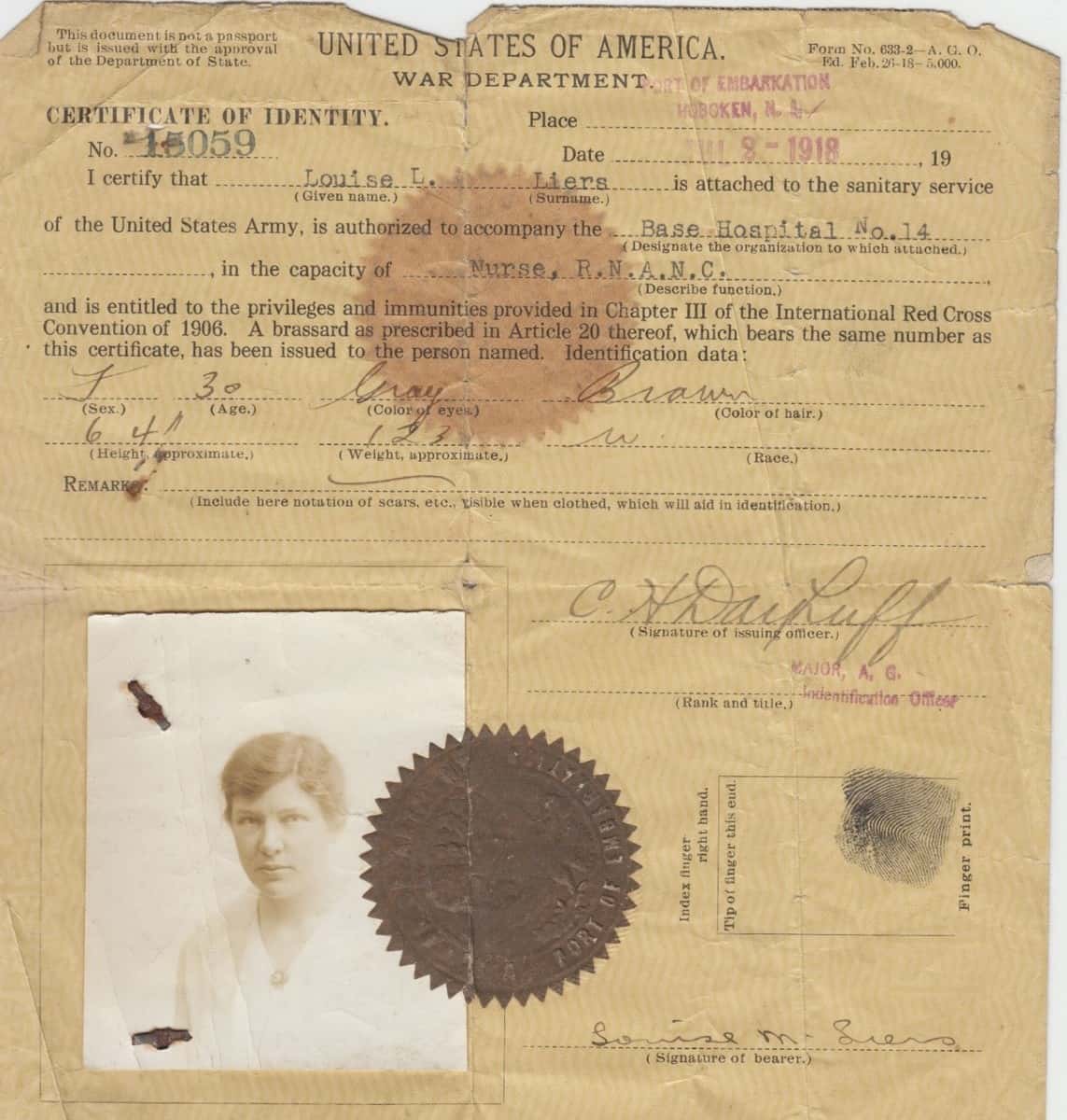
Louise Liers’s war identification. Louise Liers Papers, Iowa Women’s Archives, The University of Iowa Libraries, Iowa City.
Arriving in 1918, Liers was stationed in the French town of Nevers where she treated wounded soldiers. During this time Liers wrote numerous letters home to her parents and brother describing her duties and conditions of life during the war.
In a letter to her brother, featured below, Liers described her journey to France from New York City, with stops in Liverpool and Southampton.
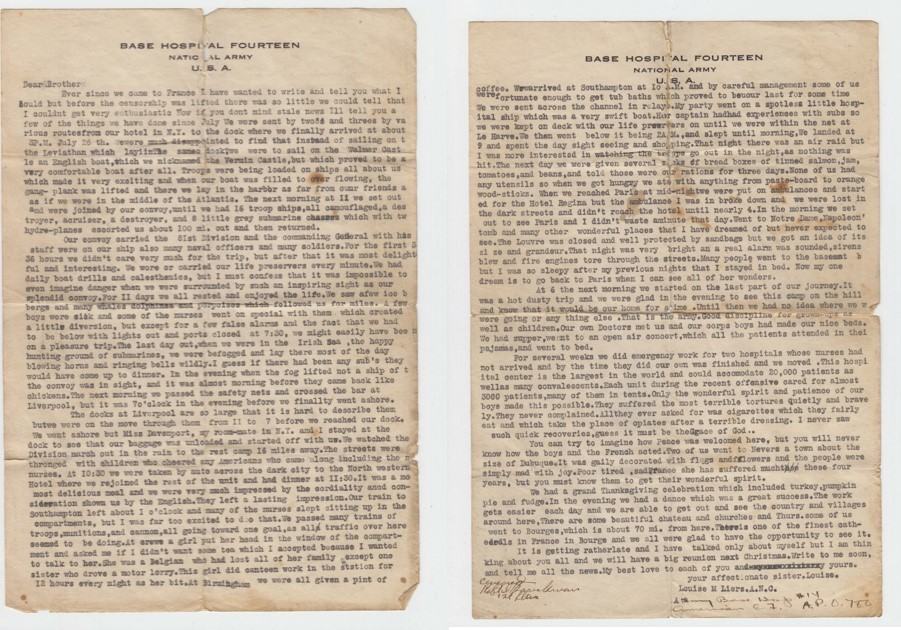
Louise Liers’s letter to her brother, describing her journey from Iowa to Base Hospital No. 14 in France. Louise Liers papers, Iowa Women’s Archives, The University of Iowa Libraries, Iowa City.
When Liers arrived in 1918, Nevers was only a few hours away from the Allied offensive line of the Western Front. She was assigned to a camp that served patients with serious injuries and those who required long-term care. Liers noted in a 1970 interview that, by the end of the war, as fewer patients with battle wounds arrived, her camp began to see patients with the “Asian flu,” also known as the 1918 influenza outbreak that infected 500 million people across the world by the end of the war.
In letters home, and in interviews given later, Liers described pleasant memories from her time in service, including pooling sugar rations with fellow nurses to make fudge for patients. Nurses could apply for passes to leave camp and Liers was thus able to visit both Paris and Cannes. In an interview Liers recalled that, serendipitously, she had requested in advance a leave-pass to travel into town for the 11th of November, 1918. To her surprise, that date turned out to be Armistice Day, and she was able to celebrate the end of the war with the citizens of Nevers.
“…devised such tortures and called it warfare…”
Along with her cheerier memories, however, Liers’s papers also describe the difficulties of caregiving during war. She described Nevers as a town “stripped of younger people” due to the great number of deaths accrued in the four years of war. In later interviews Liers offered many accounts of the grim surroundings medical staff worked under, from cramped and poorly equipped conditions, to unhygienic supplies, such as bandages washed by locals in nearby rivers, which she remembered as “utterly ridiculous from a sanitary standpoint…they were these awful dressings. They weren’t even sterilized, there wasn’t time.” Due to the harsh conditions and limited resources, nurses and doctors gained practical knowledge in the field. Liers recalled frustrating battles to treat maggot-infected wounds before the nurses realized that the maggots, in fact, were sometimes the best option to keep wounds clean from infection in a field hospital.
On a grimmer note, Liers wrote to her parents the following:
“As I have told you before, the boys are wonderful- very helpful. When I see their horrible wounds or worse still their mustard gas burns or the gassed patients who will never again be able to do a whole days work- I lose every spark of sympathy for the beast who devised such tortures and called it warfare- last we were in Moulins when a train of children from the devastated districts came down-burned and gassed- and that was the most pitiful sight of all.”
By the time the “final drive” was in motion, Base Hospital No. 14 was filled with patients to nearly double capacity, and doctors and nurses had to work by candlelight or single light bulb. Liers’ wartime service and reflections suggest a range of emotions and experiences had by women thrust into a brutal war, remembered for its different methods of warfare, inventive machinery, and attacks on civilian populations.
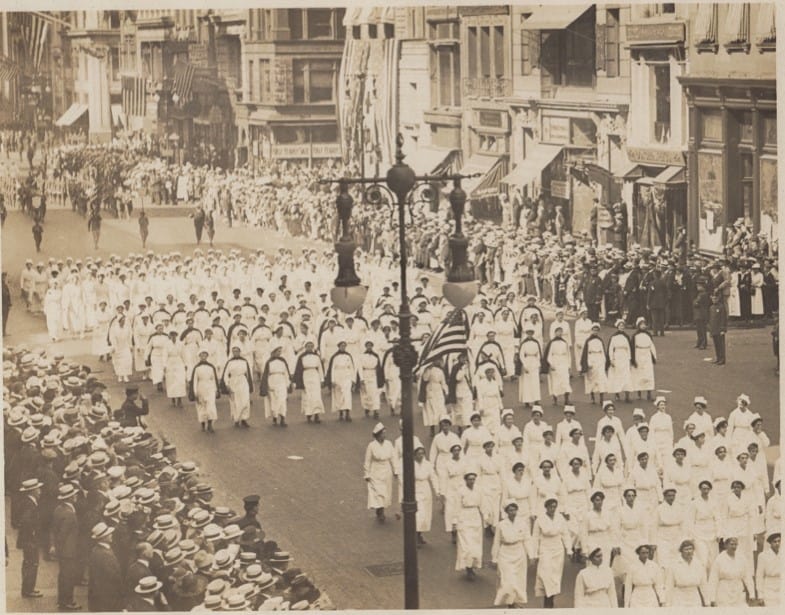
Army nurses on parade, c. 1918. Louise Liers papers, Iowa Women’s Archives, The University of Iowa Libraries, Iowa City.
Liers worked in France until 1920, and her correspondence with friends and family marks the change in routine brought on by the end of the war. With more freedom to travel, Liers and friends toured throughout France, and like countless visitors before and after, Liers describes how enchanted she became with the country, from the excitement of Paris to the rural beauty of Provence.
Following the war, Liers returned to private practice in Chicago, and later Elkader, where she was regarded as a local institution unto herself, attending over 7,000 births by 1949. She was beloved by her local community, which gifted her a new car in 1950 as a sign of gratitude upon her retirement.
Want more? Visit the Iowa Women’s Archives! We’re open weekly Tuesday-Friday, 10:00am to noon and 1:00pm to 5:00pm.
A list of collections related to Iowa women and war can be found here.
The importance of open access medical literature, by James Amos, MD
James Amos, MD, Department of Psychiatry at The University of Iowa, continues our celebration of Open Access Week with a guest post on the importance of free access to medical articles for patients and their families.
The importance of open access medical literature
James Amos, MD
As a consulting psychiatrist, I teach medical students and residents, I really appreciate open access medical literature. We have a weekly case conference called Clinical Problems in Consultation Psychiatry, a practical way to teach the Practice-Based Learning & Improvement Core Competency.
This helps develop the habit of reflecting on and analyzing one’s practice performance; locating and applying scientific evidence to the care of patients; critically appraising the medical literature; using the computer to support learning and patient care, and facilitating the education of other health care professionals.
Recurring topics are delirium and dementia. Our recommendations for patients, families, and colleagues depend on free, easy access to studies and reviews.
A poignant reminder was a recent CNN article about a man struggling to cope with early state Alzheimer’s disease. He said, “All we really are is our thoughts…” Ironically, mindfulness research tells us the opposite might be true. A paper in the Directory of Open Access Journals reviews the growing research literature on the role of mindfulness in moderating the suffering of those with dementia [1].
- Marciniak, R., et al. (2014). “Effect of meditation on cognitive functions in context of aging and neurodegenerative diseases.” Frontiers in Behavioral Neuroscience 8.
Happy Birthday, Alfred Nobel
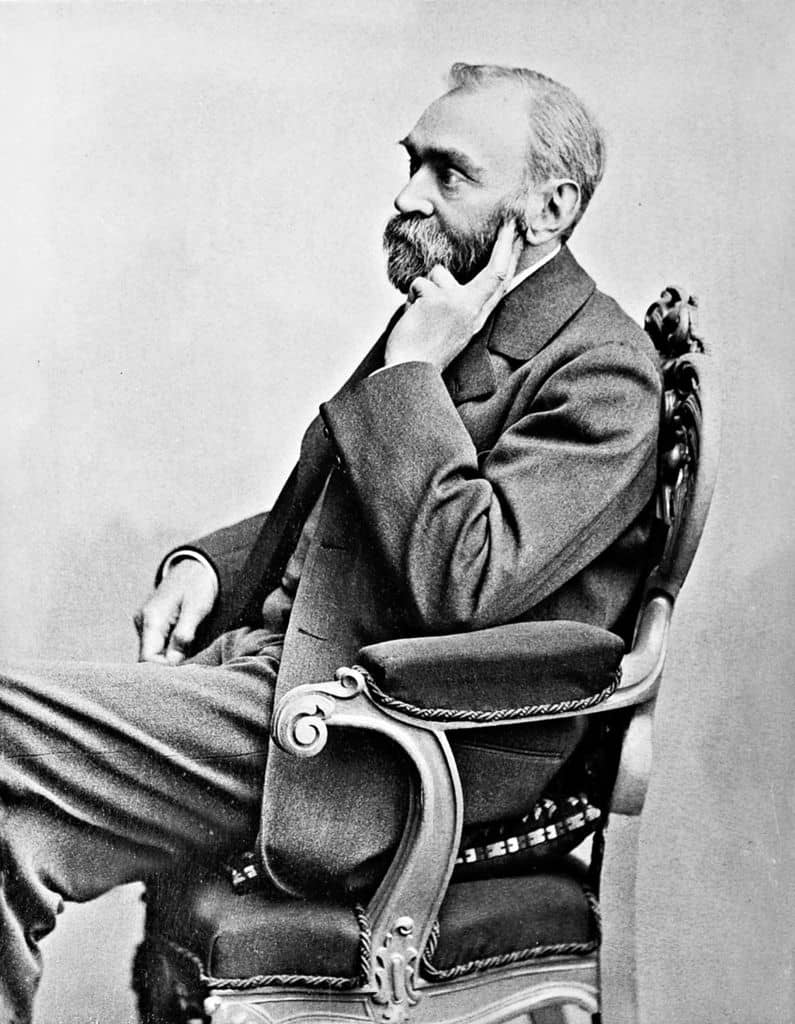
Alfred Nobel (October 21, 1833 – December 10, 1896)
ALFRED NOBEL
October 21st is the birthday of the late Alfred Bernhard Nobel who lived from 1833 to 1896. He was a Swedish chemist, engineer, innovator and manufacturer.
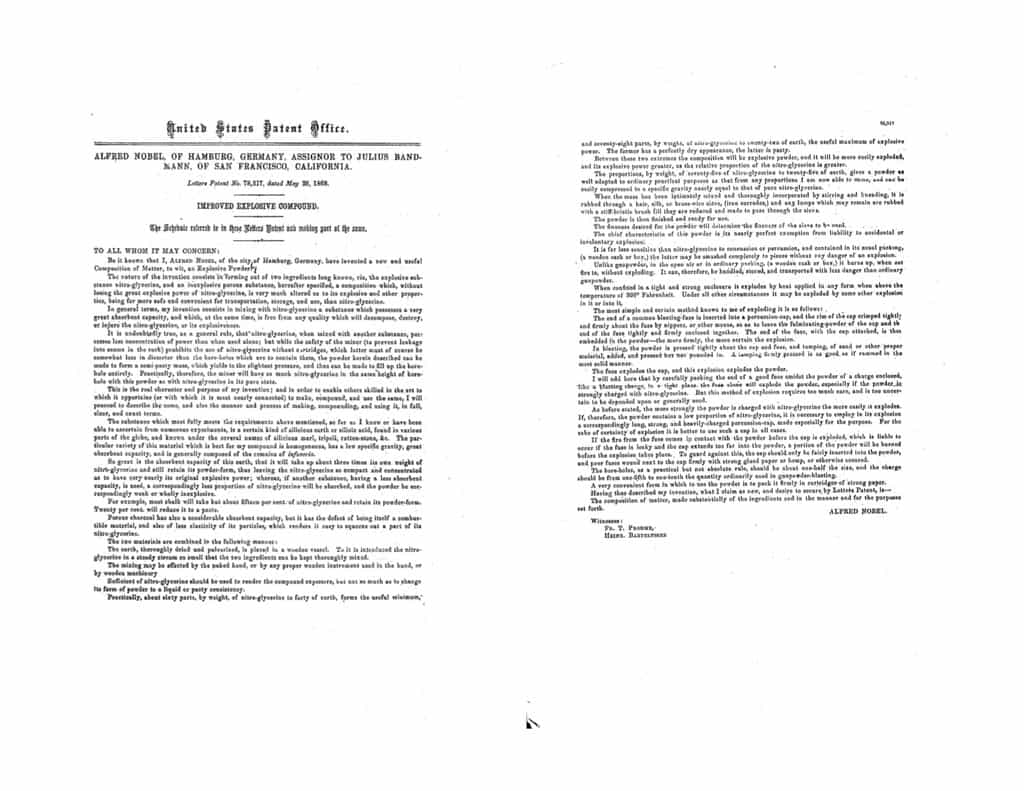
U.S. Patent 78317, November 26, 1868
In 1862, he started experimenting with nitroglycerin as an explosive material for oil mining. By the next year, at age 30, he obtained his first patent. A year later, he also developed and patented a detonator, or blasting cap, for triggering the explosive device. By age 40, Nobel had armament and explosives manufacturing companies around the world.
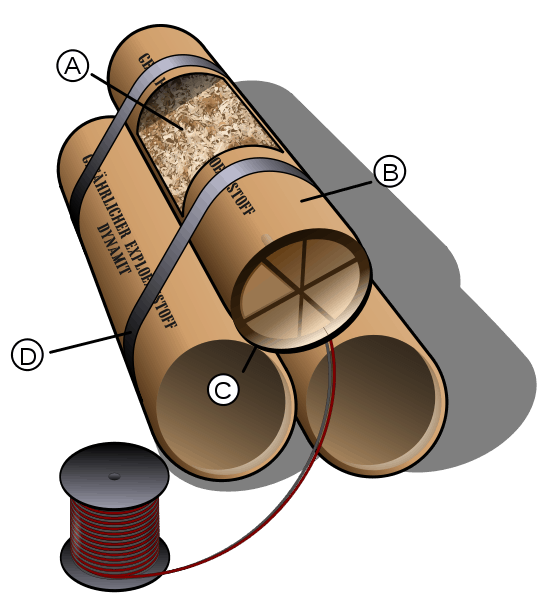
Diagram of dynamite. A. Sawdust (or any other type of absorbent material) soaked in nitroglycerin. B. Protective coating surrounding the explosive material. C. Blasting cap. D. Metal strips to hold the dynamite in place.
Ironically, in 1866, one of Nobel’s German manufacturing factories exploded. Resolved to improve the products’ safety, Nobel discovered that adding diatomaceous earth, a form of hardened algae as fine as powder, stabilizes the explosive material.
Although Nobel held over 350 different patents, his dynamite patent was his most notable invention. “Dynamite revolutionized the transportation industry by greatly facilitating the construction of roads and railways, tunnels and canals. It also played a crucial role in the modern mining industry.”¹
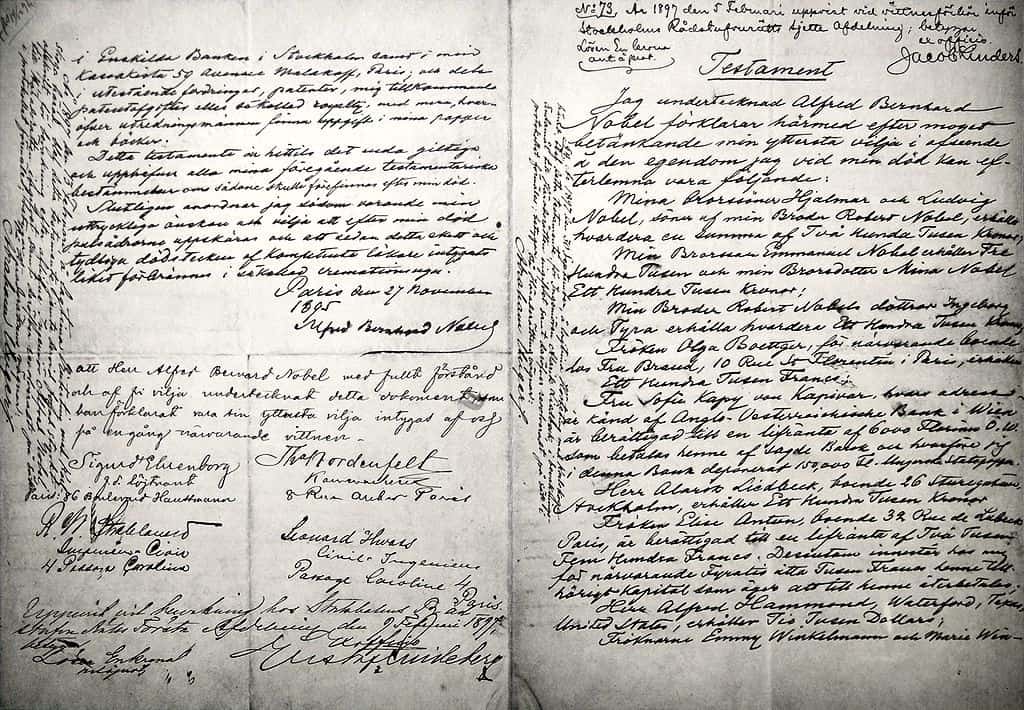
Alfred Nobel’s third and last Will & Testament, November 25, 1895
THE NOBEL PRIZE
Nobel’s wealth was derived from his manufacturing companies and from his investment in his two brothers’ oilfields along the Caspian Sea. Upon his death, Nobel left the majority of his wealth, $186 million, in a trust from which his fortune is posthumously awarded “to those who, during the preceding year, shall have conferred the greatest benefit on mankind.”²
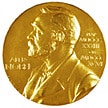
Nobel Medal
In 1900, The Nobel Foundation was established as a private organization to administer the trust, and, in accordance with Nobel’s wishes, “The prizes for physics and chemistry shall be awarded by the Swedish Academy of Sciences; that for physiology or medical works by the Karolinska Institute in Stockholm; that for literature by the Academy in Stockholm, and that for champions of peace by a committee of five persons to be elected by the Norwegian Storting. It is my express wish that in awarding the prizes no consideration be given to the nationality of the candidates, but that the most worthy shall receive the prize, whether he be Scandinavian or not.”² Up to three people may receive the award in any given field. For example, Eric Betzig, Stefan W. Hell and William E. Moerner jointly received the 2014 Nobel Prize in Chemistry “for the development of super-resolved fluorescence microscopy.”³
REFERENCES

A Most Damnable Invention by Stephen R. Bown
1. The Official Web Site of the Nobel Prize, http://www.nobelprize.org/alfred_nobel/biographical/articles/krummel/
2. The Official Web Site of Nobel Prize, http://www.nobelprize.org/alfred_nobel/will/
3. The Official Web Site of Nobel Prize, http://www.nobelprize.org/nobel_prizes/chemistry/laureates/2014/
4. Bown, Stephen R. A most damnable invention : dynamite, nitrates, and the making of the modern world. New York : T. Dunne Books, 2005. Engineering Library Q175.35 .B69 2005