Skip to content
Skip to main content

Black History Month: African American Women at University of Iowa

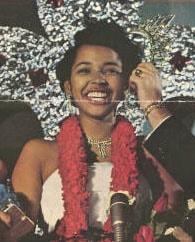
AAW dig lib - Adah (Hyde) Johnson copy AAW dig lib - Miss UI - Dora (Martin) Berry 1956 copy

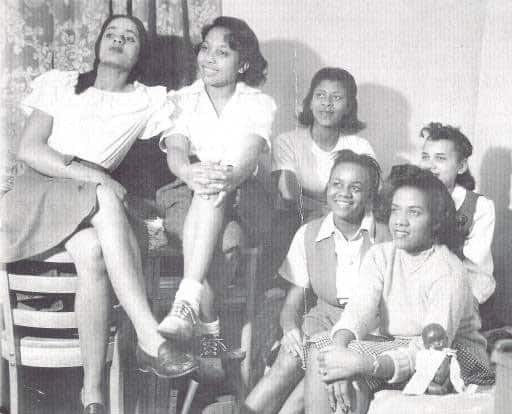
AAW dig lib - Currier 1946 copy

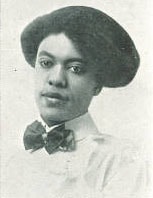
Photos of Ada Hyde Johnson (1912), Dora Martin Berry (1956), and students in the newly integrated Currier Hall (1946).

Though the University of Iowa was one of the first institutions to open admission to African Americans, these students often had to overcome other barriers to an equal education. Our digital collection on African American Women Students at The University of Iowa 1910-1960 charts the history of those barriers and the incredible women who battled and broke them. Through yearbook photos, articles, and oral histories, this online exhibit captures events like the formation of an off-campus boarding house for African American women in 1919, the integration of the University dormitories in 1946, the election of the first African American Miss University of Iowa in 1955, and much more!

Want to do a systematic review? Learn how to start a literature search with our free workshops this Spring.

This class will provide a framework for developing a literature search for a systematic review.
Topics will include the following:
  • standards and criteria to consider,
  • establishing a plan,
  • registering a protocol,
    developing a research question,
  • determining where to search,
  • identifying search terms,
  • reporting search strategies, and
  • managing references.
Our sessions this Spring:

Register for this or our related class online or by calling 319-335-9151.  If the scheduled classes don’t work for you, you can also request a personal session.

Book Intervention Types: A Construct of Five Types

Friday, February 6, 2015

Submitted by Gary Frost


InterventionsWhat are the consequential types of book intervention? Can the interventions found in books be allotted to some kind of categories?

We observe interventions of (1) production, (2) marketing and retailing, (3) interventions of users and owners, of (4) library re-fabrication and book processing, and interventions of (5) restorers and conservators. Given the range of these interventions it is even fair to ask if books have any unmodified state! Perhaps we should say that our study of book intervention really presents an overall examination of the physical evidence and characteristics of any book that comes to hand. So, in a spirit of reflexive and comparative study from philology legacy, let’s gather evidence and characteristics of each intervention type as we examine any book in any context.

One presumption here would be the construct itself; that is the taxonomy of five types of intervention. Such a presumptive construct has been used before in our Feral Seminar where study of the resilience of book transmission spans resources of six different disciplines. Again reflexive and comparative curiosity could ask how the construct of book intervention categories could possibly relate to cross-discipline transmission resiliencies. Such a bizarre idea can only be eclipsed by a surprising recognition; they relate together as cognitive properties and their investigation methods. This is philology at work. A given intervention of book repair does relate to precepts of library science and an owner’s inscription is related to methods of book studies.

For the moment let’s just list the intervention types observed in books! We will also add bibliographic references for each type to authenticate our premise of intervention as a basic book function. These are in a bibliography.

Five Types

(1) production

Setting aside production discrepancies and the in-press corrections of papermakers and printers our present examinations will be limited to bound books. Here we encounter tip-ins such as errata slips, page cancels and binding error corrections. Bespoke and commissioned binding can occur here or later at the book seller. Structural abbreviations or innovations are imposed in the initial production. Idiosyncrasies of nationalistic binding conventions and deviations of provincial work are noticed. And don’t overlook the battered, working reference books of production shops. Inked fingerprints on paper have been noticed for hundreds of years.

(2) marketing and retailing

Here agents mediate and transact between booksellers and book buying markets. Interventions range from deceptive sophistications of antiquarian book dealers to more innocuous temporary bindings. Among the deceptions for retail sale are outright forgeries and their outright re-fabrications in emulation of historical productions. There are also physical modifications and markings and applied encodings for retail display and sale. Customer profiling and retail trends provoke follow-up modifications of POD production and format features. Face out display, promotion and subliminal paratext takes precedence over reading.

(3) owners and users

More fabulous, strange and consequential interventions are those of owners and users. Here we discover a range of interventions from highlighting and excising of evidence of previous ownership to less defacing interventions such as inscriptions and book plating and more research worthy annotations. There is also the allure of soiled and finger worn pages or gutter accretions. Such evidences provoke bibliographic study. Users can also implement their own binding repairs and collation reconstructions. These owners’ repairs vary from folk recovering to practical toughening for some intensive use. Toughening of books with reformattings such as Sammelbuch tying together of multiple volumes are used to reinforce books for continued use or for voyages of expatriation.

Crossing the line from interventions of owners to interventions of scholarly study would be modern processes of textual criticism and their demanding stemmatic methods of study of multiple sources. Here an agenda of preference among sources of surviving texts, sometimes projecting a synthetic composite, is a modern philology including computer analysis. The interventive result is yet another “manuscript” re-transmission of the previous sources. Underlying is interventive agenda that a more comprehensive and scholarly comparative study can better approach if an “original” does not survive and cannot be authenticated from among variant sources.

(4) library re-fabrication

Library interventions are actions of collection management. There are results of marking and library identification. Of more consequence is a variety of drastic interventions resulting from processes of library re-binding and re-fabrication as well as from quick librarians’ repairs. A range of interventions is produced by circulation processing and vandalism response including well-promoted use of “5-minute” tape repairs. Immediate intervention to reattach a loose leaf is well justified. Another dominating feature of library intervention are the regimes of classified shelving. These extend to the drastic influence of high-density depository storage.

(5) book restorers and book conservators

Actions of those intent on renewal and preservation inevitably cause book intervention. Professional skills are applied to disguise and correct damages ranging from a dinged corner to broken sewing or loose pages or detached boards. The professional skills involved are quite flexible in application and are capable of effects from illicit to ethical as regards modification and status of the book artifact and can interfere with authenticity. Refinement of craft skills needed has inspired documentation of repair and restoration technique.

Summary

The range of interventions causing disruptions and transformations of a previous state is huge and curiously accumulated and compiled over time. The processes of intervention can extend for centuries or terminate suddenly with book shredding. Interventions beyond deteriorations of natural aging intrude the structure and appearance of a book. Happily this wide range of interventions and change in books is also well documented by the books themselves as well as by attempts to document practices. Practices of production, retailing, book use and book re-fabrication are presented in publications on book trades and bibliographic investigation. This resource does fall short of proprietary practice or “secrets” of daily trade routine and retail technique. But what is missing is not really missing if we continue close examination of surviving exemplars of interventions in books.

An Exchange

TB < So I see one great value of the class in teaching folks to determine “Is this artifact as originally made by crafts people during their own historical moment, or has it been messed with by other workers subsequently?” That’s a great skill. Knowing the answer helps them determine whether or not to “intervene” (treat) in the here and now.>

GF < Well put…i differ on the “messed with” connotation as I am engaging interventions as a fundamental cognitive function of books building their resilience of transmission and their meanings for us now.>‪‬‬‬‬‬‬

TB < OK. Maybe I am beginning to get a sense your thinking. A book is born by its makers in a moment in history but then as its life unfolds, there are various interventions that add to its story: Washed, Resized, Rebound, Trimmed, how many times? Used, transported, left on a shelf for 2 decades, then rebound again. Dust, stains; hair and lunch in the gutters. Certain pages get turned to again and again and the fingers used in the turning gradually leave a polish and/or slight soiling. People at different times write in the book, in different places. The book has a life of its own because of the interventions; its own story. A book is a book about itself. You just have to learn to read it, by ignoring the text and looking at the thing itself, carefully. Knowing how to read this story is a valuable skill because it can tell you about a book’s owners and users and the value placed on a book and the richness of a book’s life It can help a conservator discern: What to preserve, What types of treatment interventions are justifiable, What history needs to be recorded before intervening, Which books or book components are “as originally made”. Both the “as originally made” and the more heavily intervened with books are valuable to us as we study the history, lives and persistence of books. Is some of this your thinking?>

GF < Cool synopsis. I would add the further reach; that in the use books we encounter a rich material/cognitive function of books. This is stuff from Feral Seminar, but it is also grounded in methodologies such as philology (comparative study of texts), materialist book studies (examination of physical features of books) and book conservation (treatment based preservation). You are right that the whole premise hangs by the thread of a born “original” state of the made book (which is why there is so little purchase for interventions so early that they occur in the production phases). Many of the physical changes that you can observe in book papers (over centuries) are results of natural aging, usually retrograde changes. I am not considering these. I am looking at intentional interventions by human agents such as readers, owners or libraries. These kinds of interventions, in my view, are not necessarily retrograde and can be enhancements such as ordinary books annotated by a famous owner. I wish to emphasize the enhancement potential especially in conservation treatment because disruption and destructive potential is also present and conflicting social forces are at work including agendas such as cleaning and “disinfecting” or cosmetic re-fabrication.>

(This exchange is pasted from email texts.)
I came to mothers yesterday at noon and stayed until morning

Joseph Culver Letter, February 10, 1864, Letter 2, Page 1

Carlisle, Penna. Febr. 10th 1864[5]
My Dear Wife

I came to Mother’s yesterday afternoon & stayed until evening. Charlie was down at the Pagues’, but she was expecting him home so I went back to Harry’s & with Jennie to church.1 There was a concert in town, and the church was quite full and the meeting quite interesting.

There were about 15 or 18 forward for prayers and the interest seems to be general.

I remained all night at Harry’s & came out to Mother’s this morning. Gustie & Charlie were up this afternoon. All are well.

I saw Mrs. Caldwell this morning, and she inquired very kindly about you.2 To-morrow morning I shall go to Millers3 on business & to Pagues in the afternoon & come back to Mother’s Sunday morn [the 14th].

Bro. Harry [Cheston] is to preach to-night. I wish you could be here to hear him. Mother & I will go in.

Hannah is with Jennie but will be home to-morrow. Bro. Charlie has left College. His guardian says he will have no more money until Spring, but it is only an excuse, I think, as he has been urging him to stop for several months. Charlie has an idea of going to a Commercial College in the spring & intends to go to Illinois with Mother & Hannah if I get back in the fall. I want you to tell me candidly, are you anxious or willing to have them live with us? I never thought much about it, as I did not think they would come, but they seem so confident now that I wish to know your desires. Do not hesitate to tell me.

[The] Pagues have [their] sale on the 6th March.4 If I could remain a few days longer, I would like to see the place he has purchased, but I must hasten to the Regt.

The sleigh bells are ringing in every direction, & the sleighing is excellent. I have been feasting on Mother’s large apples. I wish I could send you one. I shall look anxiously for a letter to-morrow. Remember me in love to all. Kiss Howard for Papa. Marvin can walk quite well & say a number of words. The snow is so deep that I will not go to Frankie’s grave though I would like very much to have seen it. Write often. I want to receive letters soon after I reach the Regt.

May God bless & make you happy. Good Bye.

Your Affect. Husband
J. F. Culver

  1. Eighteen-year-old Charlie Culver was J.F.C.’s youngest brother, while his sister, Rebecca, was married to S. Augustus Pague and lived on the family farm in Middlesex Township.
  2. For biographical data on Mrs. Caldwell, see J.F.C.’s letter of September 14, 1863.
  3. John Miller, a prosperous Middlesex Township farmer, was married to J.F.C.’s half sister, Lucetta. In 1860 the Millers were living with their six children, four boys and two girls. Eighth Census, Cumberland County, State of Pennsylvania, NA.
  4. To settle the estate of J.F.C.’s father, it was necessary to sell the family farm on which the Pagues were living.

Stewart Stern, 1922-2015

Yesterday I walked into a meeting to discuss an upcoming exhibition we are putting together on World War II. On the book truck I pushed in front of me were several boxes from the papers of Stewart Stern. Stern was a World War II veteran, a survivor of the Battle of the Bulge, who went on to a long career as a Hollywood screenwriter (of films such as Rebel Without a Cause) and a teacher. My colleague who greeted me saw the boxes and said that Stewart had passed away, at the age of 92.

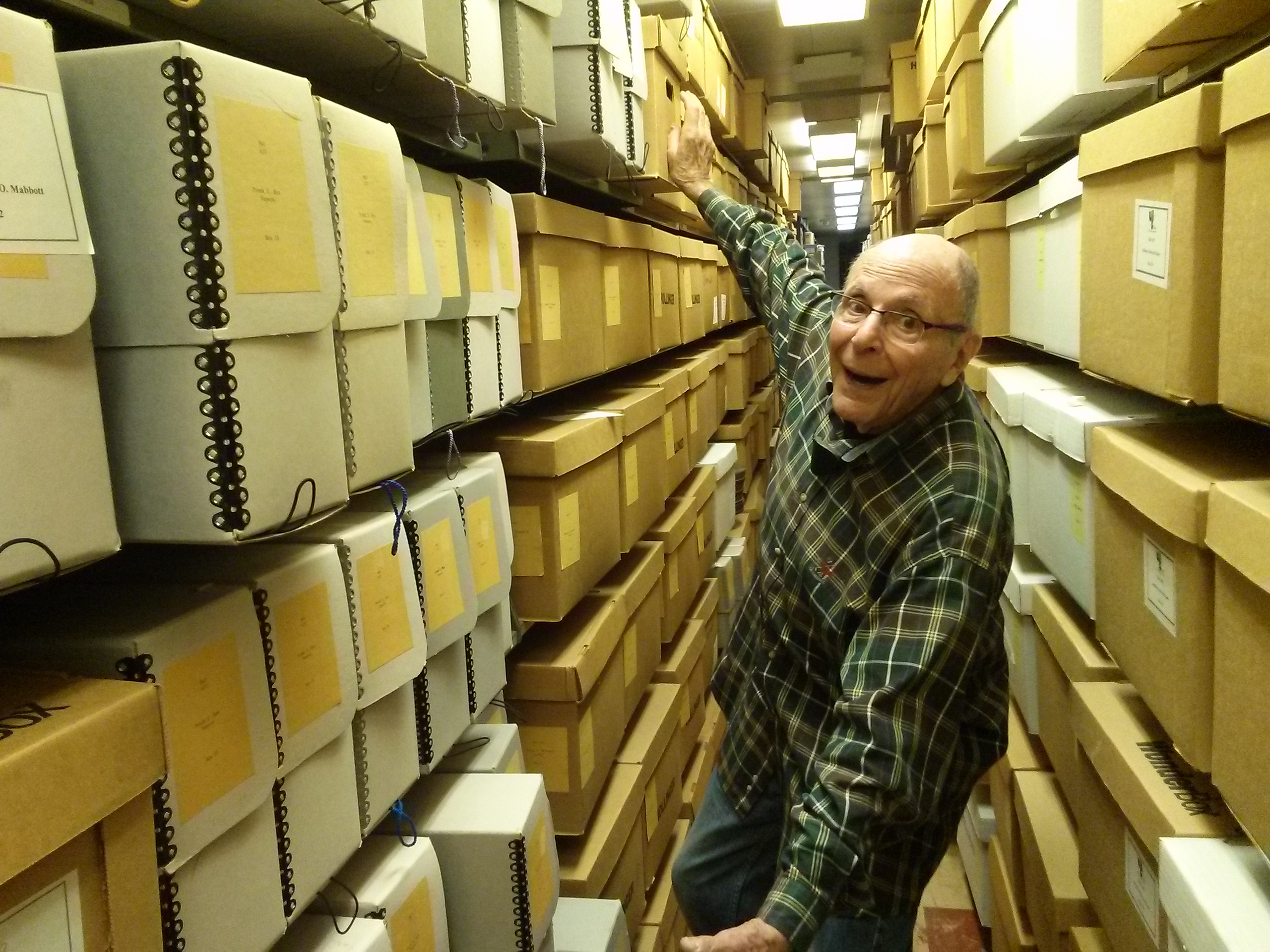
My heart immediately sank. Just this past summer Stewart had visited us from his home in Washington state, making the drive across the country with his wife. He came to visit us in the library where his papers are housed, to answer some lingering questions he had about his work that only his own papers could answer, and to see where his legacy was cared for. The visit with Stewart was the kind of occasion that makes this job among the most meaningful occupations a person could have—sitting with someone like Stewart, listening to his stories about Jimmy (James Dean), his days as an actor in theatrical productions at Iowa, about his friends from the war, experiences that still made him choke up so many decades later. He was thrilled to see his papers, and he was so full of life. When I asked if I could take his picture in the stacks as he surveyed his boxes, I thought I would get a nice shot of him smiling. Instead, as I pointed the camera, he sprang into action, sweeping his arms open to proudly display his life’s work. He laughed like a child.

After this meeting with Stewart, I thought about how enjoyable the experience was, and how much I looked forward to seeing him again. The sadness in knowing that will now not be possible is tempered by the knowledge that he entrusted us with his papers, and we have the ability, and the responsibility, to tell others of his accomplishments. This summer a piece or two from Stewart’s wartime papers will be on display in the University of Iowa’s Mobile Museum—please visit us if we are in your town, and help us remember the life of a fascinating man.

CAM00349

Stewart Stern in the stacks at the University of Iowa Libraries, August 2014

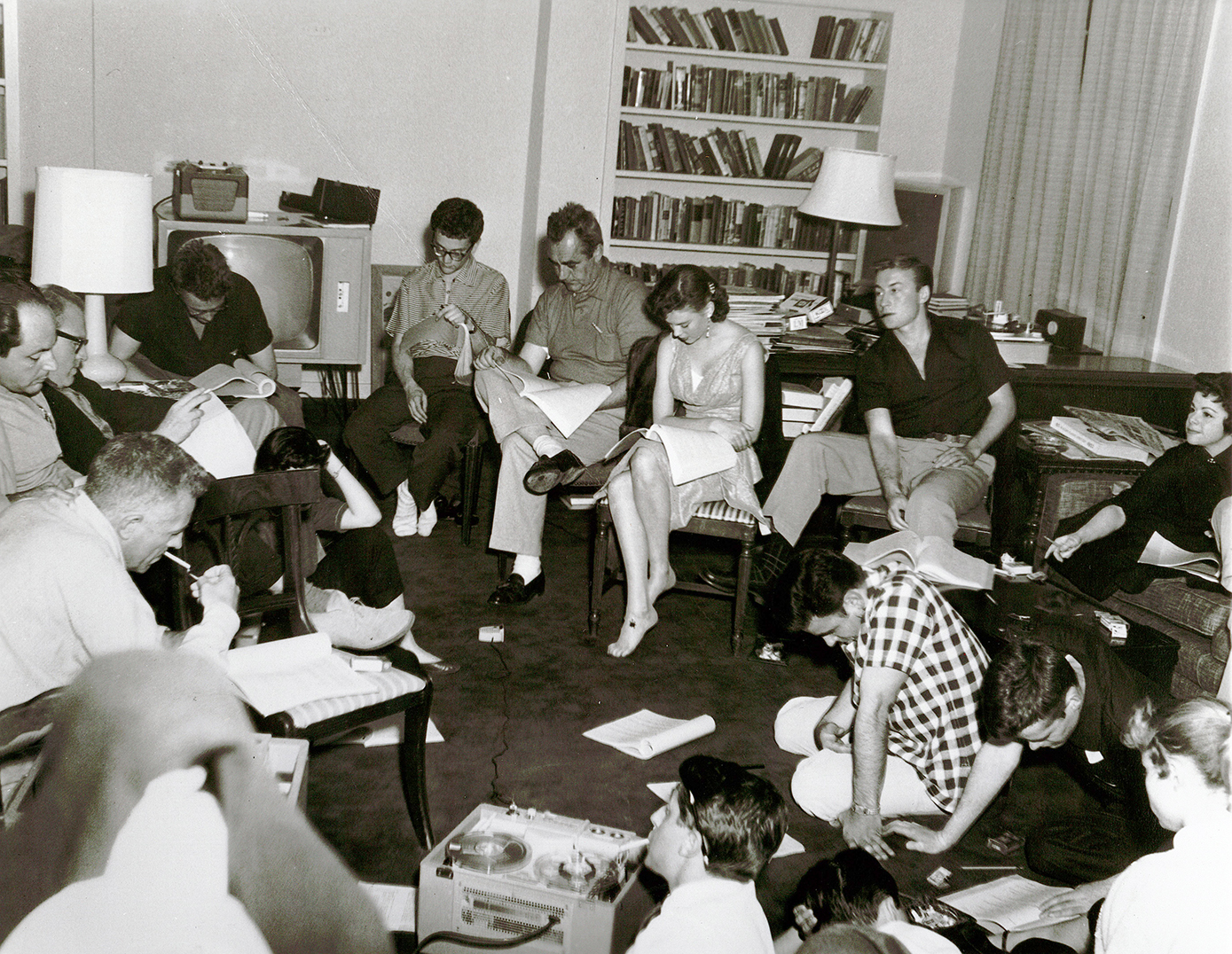
Rebel-Without-A-Cause-first-readthrough-sm

The cast of Rebel Without a Cause at the first read through of the script, written by Stewart Stern, who is seated at the far left, next to Nick Ray.

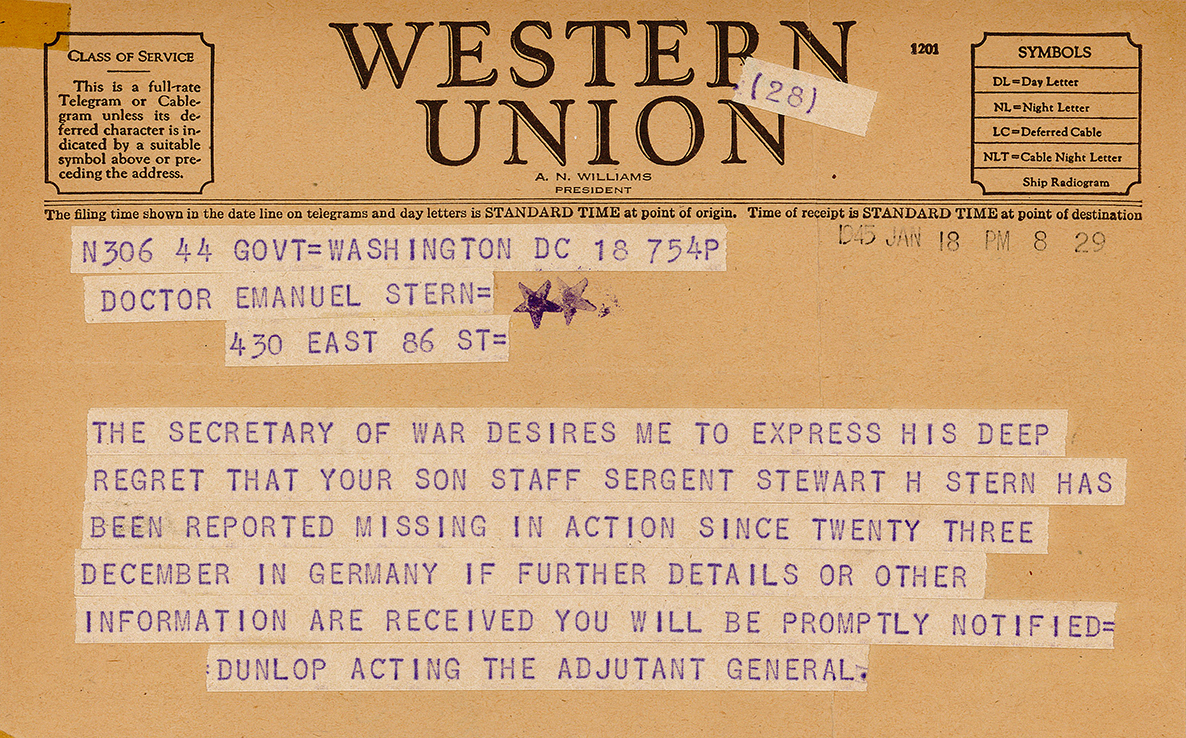
telegram-sm

The telegram informing Stewart Stern’s parents that their son had been listed as Missing in Action during the Battle of the Bulge. Stern was later located safe in a hospital, suffering from frostbite.


Student Work in the Public Sphere: A Learning Commons Workshop

studentworkinthepublicsphere
Time: Friday, February 20th from 1:30-4:30pm

Location: Main Library Learning Commons

Students look at and treat assignments differently when those assignments culminate in the dynamic presentation of their work in a public space. Faculty can use assignments and projects to encourage students to engage with the spaces and people around them

This workshop hosted by the Main Library Learning Commons will provide instructors the opportunity to reimagine how their classes can perform or display student works in the Learning Commons space. Participants will

  • tour the Learning Commons facilities.
  • learn how faculty and campus partners have used the Learning Commons
  • have time to rework a current or previous assignment into something that can be displayed or performed in the Learning Commons.

Guest instructors will share their insights and experiences in using the Learning Commons to promote their student’s work. Participants will leave with a variety of project ideas for classroom use and will be well on their way towards reimagining a current or old assignment to be hosted in the Learning Commons. The institute is open to all faculty and instructors. There is no cost to attend, although pre-registration to the institute is required. Please register here.


Celebrate Valentine’s Day at the University of Iowa Main Library

Have you been searching for a good book to spend Valentine’s Day with? Want to use your card game skills to attract a mate? Looking for a rare book to discuss over dinner with that special someone? If you answered yes to any of these questions, then you should stop by the UI Main Library this week to check out some of our Valentine’s Day events!

Play with Hearts
Tuesday, February 10th
12:00pm-2:00pm

Come to Group Area D (across from Food for Thought Café) to learn how to play the game, Hearts. You can also enjoy some vintage baked goods made from recipes from special collections’ historic recipe collection. There will even be recipes available for you to plan your own Valentine’s meal!

Blind Date with a Book
Wednesday, February 11th
12:00pm-2:00pm

Stop by Group Area D to check out a book. But this time, there will be no judging by the cover.
We’ll set you up with a blind date that you get to take home with you for some Valentine’s reading. A Spinster’s Tale or Love in the Time of Cholera: Which one will you take home tonight?

Love in the Stacks
Thursday, February 12th
12:00pm-4:00pm

Drop into Group Area D and we’ll help you out with some Valentine’s gifts! View items from the University of Iowa Special Collections and University Archives while you make buttons from prints of our more romantic books, or send an e-card to your loved ones.

You never know where love will find you, but you do know where to find us. We’ll see you in Group Area D!

Looking for Love in the Library

Have you been searching for a good book with which to spend Valentine’s Day?  Want to use your card game skills to attract a mate?  Looking for a rare book to discuss over dinner with that special someone?  If you answered yes to any of these questions, then you should stop by the UI Main Library this week to check out some of our Valentine’s Day events!

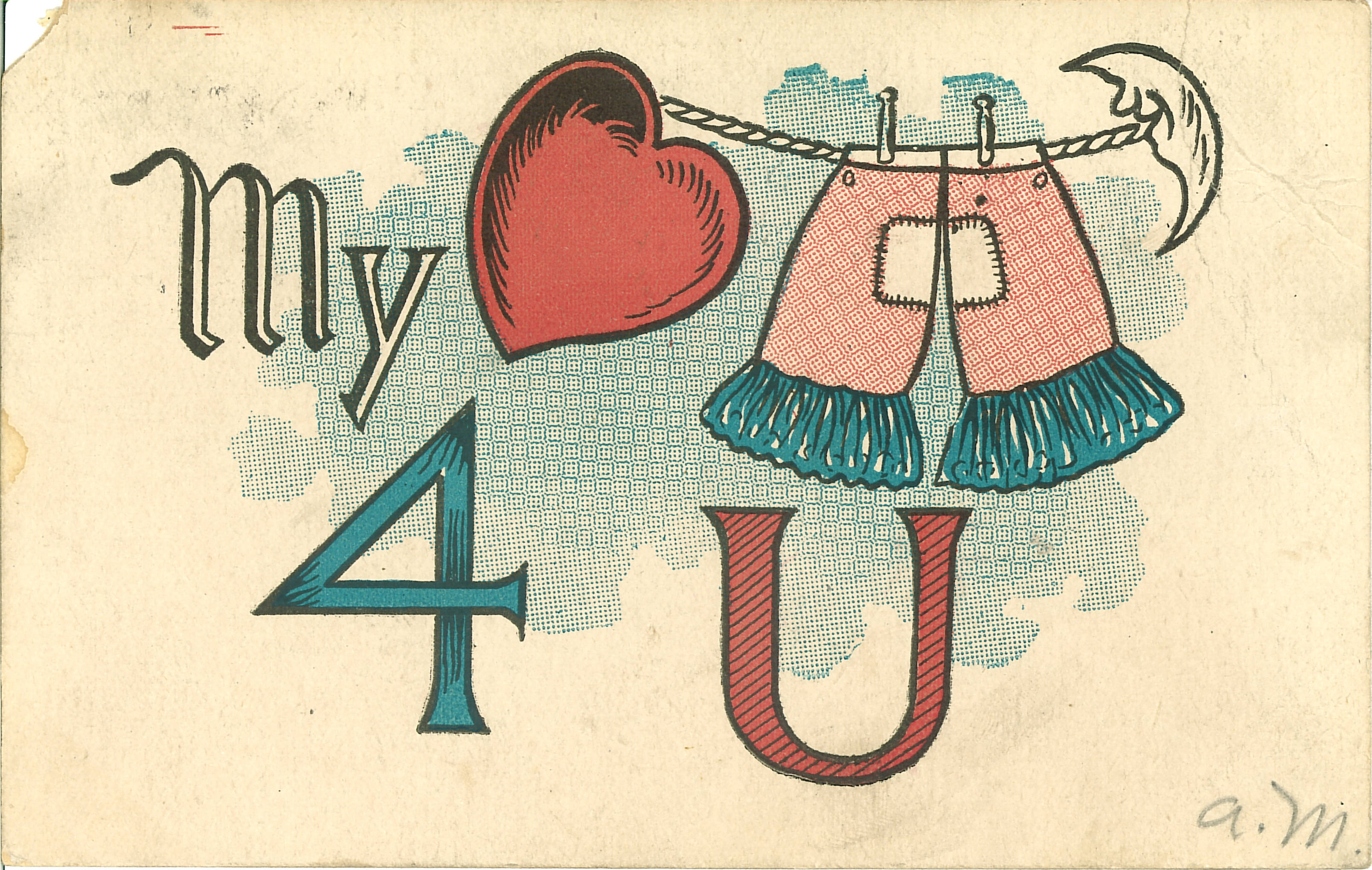
Pants 4 U "My heart pants 4 U," August 1, 1907

Pants 4 U
“My heart pants 4 U,” August 1, 1907

Play with Hearts–Tuesday, February 10th

12:00pm-2:00pm

Come to Group Area D (across from Food for Thought Café) to learn how to play the game, Hearts.  You can also enjoy some vintage baked goods made from recipes from special collections’ historic recipe collection.  There will even be recipes available for you to plan your own Valentine’s meal!

Blind Date with a Book–Wednesday, February 11th

12:00pm-2:00pm

Stop by Group Area D to check out a book.  But this time, there will be no judging by the cover.  We’ll set you up with a blind date that you get to take home with you for some Valentine’s reading.  A Spinster’s Tale or Love in the Time of Cholera: Which one will you take home tonight?

Love in the Stacks—Thursday, February 12th

12:00pm-4:00pm

Drop into Group Area D and we’ll help you out with some Valentine’s gifts!  View items from the University of Iowa Special Collections and University Archives while you make buttons from prints of our more romantic books, or send an e-card  to your loved ones.


You never know where love will find you, but you do know where to find us.  We’ll see you in Group Area D!


Learn to format references in APA Style with our free workshop @Hardin Tuesday, Feb. 10 1-2pm

Learn how to format your papers and references in American Psychological Association (APA) Style, version 6.

You will learn how to do basic formatting with APA style and how to apply APA formatting to journal, book, and web references.  Speed up your writing with our free workshop!

Tuesday, February 10th, 1-2pm, Information Commons East, 2nd Floor, Hardin Library for the Health Sciences

Register for this or any of our other workshops online, or by calling 319-335-9151.

apa 6

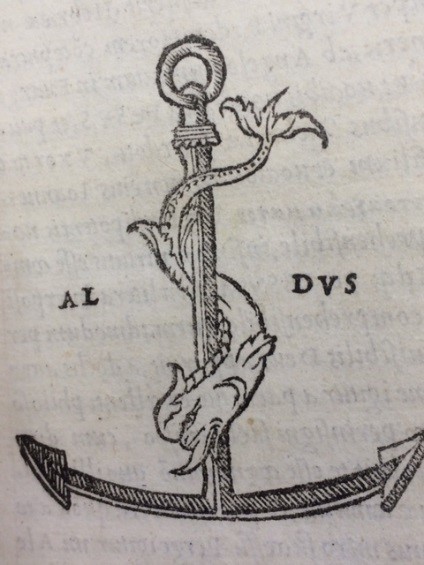
Aldus Manutius: A man with a plan, a printshop, and a pretty sweet colophon

manutius

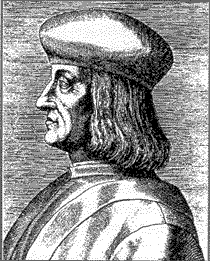
Aldus Manutius was born in Italy during the Italian Renaissance.  He became the leading printer of his time and is responsible for many literary accomplishments, including the invention of italic type for use in a printing press and the semicolon.  Most importantly, Manutius was one of the first people to publish small, pocket editions of books that more people could actually afford.  This month, we’ll be featuring a few of the books in our collection which were published by this incredible scholar on our Tumblr, so we thought we would give you all a little more background information.

Manutius’ goal was to preserve ancient Greek literature by printing personal, usable editions for everyone to own.  He accomplished this by organizing the famous Aldine Press.  Through the Aldine Press, Manutius was able to produce the first printed editions of many Greek and Latin classics.  These included works such as The Odyssey, The Iliad, and The Divine Comedy.  Aldus Manutius’ work is always recognizable by the colophon (or inscription, which gives details about the book, usually found at the end of a work), which pictures a dolphin wrapped around an anchor.

colophon


Here at the University of Iowa Special Collections and University Archives, we are honored to house such an incredible collection of his works.  Keep an eye out for posts about Manutius on our Tumblr, as well as other social media.  If you have any questions about these items, feel free to ask us on our social media, or email us at lib-spec@uiowa.edu.

-Kelly

*Photo of Manutius from www.aldussociety.com

**Photo of Colophon taken from the UI Special Collections and University Archives edition of The Odyssey