Skip to content
Skip to main content

I left home on the afternoon train

Joseph Culver Letter, February 13, 1865, Page 1

Harrisburg, Pa., Febr. 13th 1865.
My Dear Wife

I left home on the afternoon train and have to wait until 3 o’clock to-morrow morning for the N.Y. train. The Dr. says Mother has Erysipelas, but he thinks it will not be severe. Bro. Charlie & Sister Jennie both promised to write to you.

I called to see Mrs. Annie Van Horn Daires this evening & found the family well.1 Mr. Daires was not at home but is well. Annie played a few new pieces on the Piano for me. I left at 8 o’clock, & on my way back to the hotel came by a church where they were holding a revival meeting. I went in & remained until half past ten. They are having a good meeting, & I enjoyed it very much. There were fine ladies at the altar. It was a Winebrenenan Bethel, a denomination not much known in the West.2 I presume you would scarcely have enjoyed it as it was a very noisy meeting. But the Spirit of God was manifestly present.

I am in a study whether to go to bed to-night or not. It is nearly 11 o’clock & the train leaves at 3. I am not sleepy. I have been thinking much of Home. I wish I could spend the hours intervening with you. “When shall we meet again?”

I did not enjoy my visit [to Carlisle] as much as I anticipated. The only sleighride I had was from John Miller’s to Pagues’ & from there to Carlisle.3 The roads were so drifted that we could not drive off a walk. The sleigh bells are jingling merrily around the city to-night.

Sherman is still moving North.4 I cannot imagine where I will find the Regt. I look for a letter on my arrival in New York to-morrow morning. Kiss Howard for me. Give my love to all. May Our Father in Heaven bless you both. Do not fail in writing. With much love, I remain, as ever,

Your affect. Husband
J. F. Culver

  1. Annie Van Horn Daires by 1867 was a widow and dressmaker and was living on Harrisburg’s Canal Street, near Walnut. The Harrisburg City Directory 1867-68, compiled by William J. Divine (Harrisburg, 1867), p. 53.
  2. The Winebrenenan Bethel Church met on Fourth Street at the corner of Strawberry Alley. Ibid., p. 193.
  3. The Miller farm was in Middlesex Township, on the Sterretts Gap Road, six miles north of Carlisle.
  4. General Sherman had advanced into South Carolina. Ward’s Third Division of General Slocum’s wing had crossed the Savannah River into South Carolina, at the beginning of the New Year, at Screven’s Ferry, and had marched to Hardeeville, while General Howard massed his wing in and around Pocotaligo. On January 29 the 129th Illinois marched from Bethel Church to Robertsville, where it rendezvoused with the remainder of the XX Corps. Four days later, on February 2, the Third Division broke camp and started north. Near Lawtonville, the 1st Brigade was engaged by Rebel cavalry. The Confederates were bested, and the Federals continued to advance, having lost ten men in the skirmish. The XX Corps, along with Sherman’s other columns, pressed steadily ahead, crossing the Big and Little Salkehatchie, and on the 7th reached the South Carolina Railroad. The next 72 hours were spent wreaking havoc on the railroad between Graham’s and Williston. Meanwhile, Howard’s wing had reached the railroad at Midway. On February 11 the XX Corps left the railroad and started north toward Columbia. Destruction of the bridge across the South Fork of the Edisto caused a short delay. Fording the river on the 12th, the XX Corps forged ahead, and nightfall on the 14th found the troops camped at Tucker’s, 18 miles southwest of Columbia. Howard’s wing meanwhile had reached Orangeburg, as it converged on Columbia from the south. Grunert, History of the 129th Illinois, pp. 163-196; Cox, March to the Sea, pp. 168-70.

Database of the Week: Sports Business Research Network

Each week we will highlight one of the many databases we have here at the Pomerantz Business Library.

The database: Sports Business Research Network

“SBRnet provides extensive research related to consumer demographics, consumer behavior patterns, financial statistics, attendance and media usage trends for all three major sports market segments…fans, participants and sporting goods buyers” SBRnet

Where to find it: You can find it here, and under S in the databases A-Z list.

Use it to find:

  • Consumer expenditures
  • Sport participation
  • Fan market
  • Venue reports
  • Ticket prices
  • Social media data

Tips for searching:

  • Browse by sport: Archery to Football to Skiing to Wrestling
  • View the summaries on the home page:
  • Use the tabs across the top: fan market, participation, directories, sporting goods, sports venues, college sports, etc.
  • Try the site search at the bottom

SportsNet


Want help using Sports Business Research Network ? Contact Willow or Kim and set up an appointment.

Trial Subscription: Passport – World Market Analysis


Passport is Euromonitor International’s global market analysis software platform, which analyses the industry in countries around the world. It monitors industry trends and gives strategic analysis and a market size and market share database for products across all key countries.


The trial for this product ends March 20, 2015.  Please send additional comments to Kim Bloedel.


Passport – Trial ends 20 March 2015

Passport is Euromonitor International’s global market analysis software platform, which analyses the industry in countries around the world. It monitors industry trends and gives strategic analysis and a market size and market share database for  products across all key countries.

Please send additional comments to Kim Bloedel.

IDL highlights for Black History Month

The Iowa Digital Library is fortunate to host the college scrapbooks of three University of Iowa students from the 1920s and 1930s, which provide views of the African-American community during their time on campus.


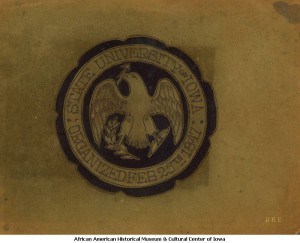
Althea Beatrice Moore Smith scrapbook cover, 1924-1928

Althea Beatrice Moore Smith scrapbook cover, 1924-1928

The Althea Beatrice Moore Smith scrapbook was added to the Iowa Digital Library thanks to a collaboration between the African American Museum of Iowa and the Iowa Women’s Archives.

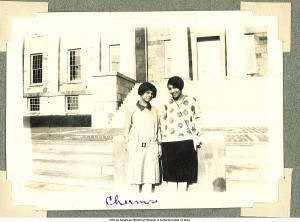
Althea Moore and friend on steps of Old Capitol, Iowa City, Iowa, between 1924 and 1928

Althea Moore and friend on steps of Old Capitol, Iowa City, Iowa, between 1924 and 1928


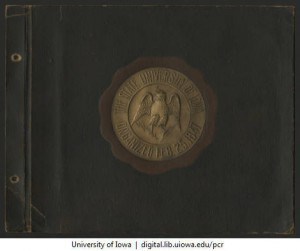
Patrobas Cassius Robinson college scrapbook cover, 1923-1928

Patrobas Cassius Robinson college scrapbook cover, 1923-1928

Hal and Avril Chase of Des Moines, Iowa, funded the purchase of this album for the University of Iowa Archives.

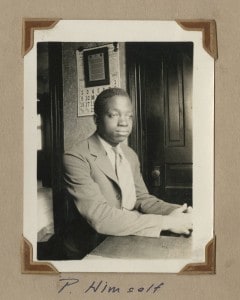
Patrobas Cassius Robinson

Patrobas Cassius Robinson


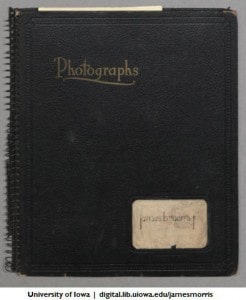
James B. Morris Jr. photo album cover, 1937-1941

James B. Morris Jr. photo album cover, 1937-1941

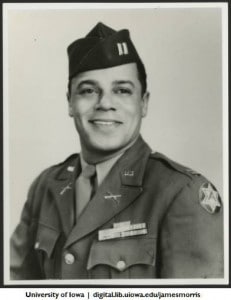
James Morris was the son of James Morris, Sr., a long-time publisher of the Iowa State Bystander, an African-American newspaper.  James Morris Jr. married Arlene J. Roberts Morris, the first African-American woman psychologist to be licensed by the Iowa State Board of Psychology.

Captain James B. Morris, Jr. 1944

Captain James B. Morris, Jr. 1944


Main Library Exhibition Space Renovation

The Main Library is currently in the process of renovating the first floor exhibition space. Over the next several months, the air handling, filtration, and lighting systems will be upgraded to museum environmental standards. For the first time we will be able to safely showcase our rare books, documents, photographs, artifacts and other items.  This renovation will provide a dynamic and interactive exhibition space that will provide new opportunities for the Libraries to engage with the campus and the community.

IRO highlights for Black History Month

Here are some highlights from our digital collections for black history month.

These three books are available as free PDFs online. They were published in the University of Iowa Press Singular Lives series.

Fly in the Buttermilk - coverFly in the Buttermilk: The Life Story of Cecil Reed
Cecil Reed
Priscilla Donovan

Born in 1913 in Collinsville, Illinois, Cecil Reed has lived all his life in the Midwest as a black man among whites. This self-styled fly in the buttermilk worked among whites with such skill and grace that they were barely aware of his existence—unless he wanted to get a bank loan or move into their neighborhood. Now, in his lively and optimistic autobiography, he speaks of his resilience throughout a life spent working peacefully but passionately for equality.

The Making of a Black Scholar: From Georgia to the Ivy League - cover
The Making of a Black Scholar: From Georgia to the Ivy League
Horace A. Porter

This captivating and illuminating book is a memoir of a young black man moving from rural Georgia to life as a student and teacher in the Ivy League as well as a history of the changes in American education that developed in response to the civil rights movement, the war in Vietnam, and affirmative action. Born in 1950, Horace Porter starts out in rural Georgia in a house that has neither electricity nor running water. In 1968, he leaves his home in Columbus, Georgia—thanks to an academic scholarship to Amherst College—and lands in an upper-class, mainly white world. Focusing on such experiences in his American education, Porter’s story is both unique and representative of his time.

The Making of a Black Scholar is structured around schools. Porter attends Georgia’s segregated black schools until he enters the privileged world of Amherst College. He graduates (spending one semester at Morehouse College) and moves on to graduate study at Yale. He starts his teaching career at Detroit’s Wayne State University and spends the 1980s at Dartmouth College and the 1990s at Stanford University.

Porter writes about working to establish the first black studies program at Amherst, the challenges of graduate study at Yale, the infamous Dartmouth Review, and his meetings with such writers and scholars as Ralph Ellison, Tillie Olsen, James Baldwin, and Henry Louis Gates, Jr. He ends by reflecting on an unforeseen move to the University of Iowa, which he ties into a return to the values of his childhood on a Georgia farm. In his success and the fulfillment of his academic aspirations, Porter represents an era, a generation, of possibility and achievement.

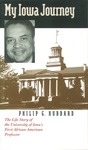
My Iowa Journey - coverMy Iowa Journey: The Life Story of the University of Iowa’s First African American Professor
Philip G. Hubbard

Philip Hubbard’s life story begins in 1921 in Macon, a county seat in the Bible Belt of north central Missouri, whose history as a former slave state permeated the culture of his childhood. When he was four his mother moved her family 140 miles north to Des Moines in search of the greater educational opportunity that Iowa offered African American students. In this recounting of the effects of that journey on the rest of his life, Phil Hubbard merges his private and public life and career into an affectionate, powerful, and important story. Hubbard graduated from the University of Iowa with a degree in electrical engineering in 1946; by 1954 he had received his Ph.D. in hydraulics. The College of Engineering extended a warm academic welcome, but nonacademic matters were totally different: Hubbard was ineligible for the housing and other amenities offered to white students. Intelligent, patient, keenly aware of discrimination yet willing to work from within the university system, he advanced from student to teacher to administrator, retiring in 1991 after decades of leadership in the classroom and the conference room. Hubbard’s major accomplishments included policies that focused on human rights; these policies transformed the makeup of students, faculty, and staff by seeking to eliminate discrimination based on race, religion, or other nonacademic factors and by substituting affirmative action for the traditional old-boy methods of selecting faculty and administrators. At the same time that he was advancing the cause of human rights and cultural diversity in education, his family was growing and thriving, and his descriptions of home life reveal one source of his strength and inspiration. The decades that Hubbard covers were vital in the evolution of the nation and its educational institutions. His dedication to the agenda of public higher education has always been matched by his sensitivity to the negative effects of discrimination and his gentle perseverance toward his goals of inclusion, acceptance, and fairness. His vivid personal and institutional story will prove valuable at this critical juncture in America’s racial history.

Love and Ferris Wheels Just Go Together

Love and Ferris Wheels just go together!

“…Look at our small town spinning around
We got our feet dangling high off the ground
Can you believe, baby, how good it feels
Falling in love on a Ferris wheel? Falling in love…”

Ferris Wheel, written by Michael Sarver. (C) 2010 Dream Records

February 14 is not only Valentine’s Day, but also National Ferris Wheel Day! It is the birth date of George W. G. Ferris, Jr. and he is credited for creating the first large, steel amusement ride – the Ferris Wheel.

chicagoFerriswheelImage

The 1893 Ferris Wheel

That first Ferris Wheel was unveiled in the summer of 1893 at Chicago’s World Columbian Exposition. It was the first international exposition held in the United States and the committee wanted an engineering marvel that would overshadow France’s Eiffel Tower. Having recently ridden a fifty-foot wooden “observation roundabout,” which had been built and soon would be patented by William Somers, Ferris was inspired to enter the competition with his paper-napkin drawing of an enormous park ride. The constructed 45-foot axle-wheel powered by two 1,000 horsepower steam engines was supported by two 140-foot steel towers and it carried thirty-six wooden cars 264 feet high into the air – taller than any existing buildings!

Since the original Ferris Wheel, the world has continually been trying to out-do it. In 1897, a copy of the original was erected in Prater Park, Vienna , Austria and became the longest running Ferris wheel in history.  In 1904 the Ferris wheel was again the centerpiece of the World’s Fair, this time in St. Louis. The Texas Star was built in Italy and shipped to Dallas, Texas in 1985. It was, at that time, the tallest operating Ferris wheel at 213 feet (that is 52 feet shorter than the original 1893 wheel).

The London Eye, at 443 feet, opened to the public in 2000. The Singapore Flyer, at 541 feet, became the tallest Ferris wheel in in the world in 2008. The 682 foot tall Beijing Great Wheel was supposed to be built in 2009-2010, but the parent company went into receivership and it was never completed.

High_Roller_FerrisWheel

The original Ferris Wheel had 36 cabins and each one was able to carry 60 people for a total of 2,160 people per ride. There were fancy wire chairs for 38 passengers and five large plate glass windows. The cabins were 24 feet long, 10 feet high and weighed 26,000 pounds. A conductor rode in each cabin to allay fears and answer questions.

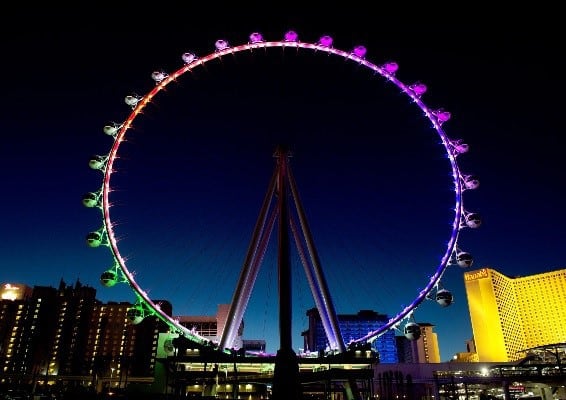
Currently, the world’s largest Ferris wheel – or Observation Wheel – is the High Roller in Las Vegas across from Ceasars Palace. It is 550 feet tall, 107 feet taller then the London Eye. In contrast to the original Ferris Wheel each of the 28 cabins is 225 square-feet and weighs approximately 44,000 pounds. Each cabin has a diameter of 22 feet and includes 300 square feet of glass. It also has 8 flat-screen televisions and an iPod dock. The High Roller is lit by 2,000 LED lights which have multiple lighting options.  Looking for that special Valentine’s Day destination wedding? You can book a VIP cabin on the High Roller and have the wedding of your dreams!

Find the nearest Ferris Wheel and maybe, just maybe, fall in love?


References:

Circles in the Sky: The Life and Times of George Ferris. ENGN TA 140 .F455 W45 2009

Circles in the Sky

LINQ Hotel and Casino, High Roller FAQ ; http://www.caesars.com/linq/high-roller/faq/

Wikipedia, High Roller (Ferris Wheel) ; http://en.wikipedia.org/wiki/High_Roller_%28Ferris_wheel%29

Hyde Park Historical Society Newsletter, “The Big Wheel,” Spring 2000 ; http://www.hydeparkhistory.org/newsletter.html


Standards

In 1978, the American Society for Testing Materials (ASTM) formed the F24 committee to create standards for the design, testing, manufacturing, and operation of amusement park rides. http://purl.lib.uiowa.edu/ASEDL

EndNote Fully Supported by the Libraries

By pooling central and collegiate resources, and with the support of CCOM, CLAS, and ITS, the University has acquired a campus-wide license for EndNote, a popular and powerful citation management program for organizing, sharing, and formatting citations for publication. There are two versions of EndNote: EndNote Basic (web-based version, available for free to all UI students, faculty, and staff) and EndNote Desktop (client-based version, available for free to UI graduate students, faculty, and staff). The two versions work synchronously so you can access your references from any device with an Internet connection. EndNote is fully supported by the Libraries, and documentation, workshops, and individual assistance is available.

Endnote Basic Xpress Class Today!

This is an introduction to an online citation management system that is free for everyone at the University of Iowa. It will help you manage all your references for a paper (or many papers) as well as create the incite citations and bibliographies in a wide variety of formatting styles.

Today, 2:30 p.m., 20o01C Seasmans Center Library Computer Classroom, 30 minute class.

Taught by Steve Ostrem, Research & Instruction Librarian, Main Library.

The web version of Endnote Basic will be taught: not the full client version!

LIB_Feb_12_Endnote