Skip to content
Skip to main content

Sunday school is not as good as it was when you were hear

Joseph Culver Letter, March 8, 1865, Page 1March the 8 1865 Pontiac Ill
Dear Friend

your kind letter of February last, was received this morning and in compliance with your request, no less than with my own wishes, I hasten to answer it I was glad to hear from you and glad to hear that you had got well I wish that you and Mr Catten would come back, the Sunday school is not as good as it was when you were hear. There dose not as as many come as did when you were hear. the Band has had a Consert and is to have an other in April, the prisbyterians is a talking about having one to, to day was quartrlimeting. Lara Russell told me to tell you that you must write to her. Mother has just got back from Ohio she said she saw some Rebles their you for got that this was 1863 instead of 1860 they have got the quire started again in the Methodist Church we have not had one Missionary meting sens you went a way they said that they must organise again. Mr Gray has had the Smallpox, tell Mr Gaff that I received my song that he sent me, Mary Night talks so mutch about Mr Culver you had aught to hear her say her verses write some in my next letter for the Sunday School they like to hear from you as well as evry one of us Fanny says that she wishes that you would come back, we have got one of the greatest day schools that you ever saw Mr Ketchum is our teacher. our Christmas tree is over if you had bin hear you would have got some thing nice. Mr Culver you must come up and thin out the Rebels up hear for there are plenty of them heare mother says if you will come up she will coock you some chicken and some cabbage

Hattie said for me to write and tell you that you must write to he you must write a longer letter next time when Mrs Murphy come home and gammy brought the letters to the school house every one asked if Mr Culver dident send them one no more at present write soon from

Mary Engle to her Friend
Mr Culver
129 Reg Co A
Co A 129 Reg
From Mary Engle to her
Friend Mr Culver
Co A 129 Reg.

Almost two weeks have elapsed and we are still in Charleston

Joseph Culver Letter, March 7, 1865, Page 1

Charleston, S.C. March 7th 1865
My Dear Wife

Almost two weeks have elapsed and we are still in Charleston, with no better prospect of getting to our commands than when I last wrote.1 I am looking for some word from you by next mail. How long we may remain here, I am unable to determine.

My health has been excellent for which I have every reason to be thankful. We have been spending our time reading such books as we could get from the houses in the neighborhood and making a tour through the city each day seeking information of Sherman’s whereabouts.2 We recd. a small mail from New York on Saturday [the 4th] consisting of papers chiefly, the latest being of date the 23rd February. There is nothing new, and the place is as dull as you can possibly imagine.

I was at church on Sabbath morning and afternoon. The Sacrament of the Lord’s Supper was administered after the morning Service, & Col. Merrill & myself were partakers.3 I felt very much blessed. The congregations were not large, yet they seemed kindly disposed toward us.

The weather for the past few days has been very pleasant, and the gardens are being cultivated. There are peas, beans, onions &c. up in our garden, yet we do not anticipate remaining long enough to receive the benefit of them.

Schools have been opened for the negroes, and the streets are thronged with them about school hours. They seem to enjoy it very much.

We have been making good use of our piano and have a concert every day. Some new music would be very acceptable, however; we have repeated all we can remember so often that we are getting tired of them. I have just finished reading the 2nd volumn of “Queechy” & must hunt up something new to-morrow.4 The only excitement we have is an occasional fire. We had quite a large one last Sunday evening down town, three unoccupied buildings were burned.

The streets of Charleston are becoming quite lively. Stores are being opened up in those portions that have been vacated for the past two years on account of our shells.5 They are also patching up their houses where the shells in many places have entered. The city is garrisoned almost entirely by negro troops.6 I have heard of no disturbance thus far. I have not been on the streets at night, and do not know whether the city is lighted up or not. The part we occupy is very quiet and two blocks from the business portion of the city. The citizens are flocking to the Provost Marshall’s Office to take the oath [of allegiance]. They cannot open a store or get a letter out of the office without showing their papers having taken the oath. It seems rather hard but it will undoubtedly do good.

We are still getting along very comfortably here, though we cannot wholly escape the “Blues.” We might be in a much worse condition, however. My Leave of Absence will expire in 13 days more, & then I will be in the same boat with the rest. I feel sorry that I did not spend another month in Pontiac regardless of Public Opinion;7 but I doubt not all will yet be well.

Dr. Bennett had a conversation with a Rebel Surgeon to-day who told him that he thought there would be no fighting.8 Yet it looks very probable that there will be a battle somewhere before the war ends. Many here are of the opinion that they [the Confederates] will evacuate Petersburg & Richmond & retreat in the direction of Lynchburg.9 I hope no more fighting will be necessary, yet cannot realize so happy a termination of the war.

Burk is upstairs playing “Home Sweet Home,” & I can almost imagine myself there at times.10 I dare not think too much of it for fear of the Blues. I have neither seen or heard anything worthy of note.

This is my fifth letter from Charleston. How happy I would be to hear from you & Howard to-night. Remember me in love to all the friends. I must try & write to the boys soon. I fear I am very, very lazy; don’t you think so? I have written but two letters, except to you, since I am here — one to Mother and one to the [Pontiac] “Sentinel,” but I will try & do better.

May Our Father bless and make you happy. Col. Merrill & Dr. Bennett insist on my reading my letter, so that they may gather items for a letter home. They offer three cents in money & a sentence each to fill out the sheet, but I could not accept such a proposition. There is sufficient evidence of nothing to write about. Write often. Direct to the Regt. Good night.

Your affect. Husband
J. F. Culver

  1. The occupation and destruction of Columbia by Sherman’s army on February 19 compelled the Confederates to evacuate Charleston. Employing the Northeastern Railroad, General Hardee moved his troops to Cheraw, where great quantities of stores, both public and private, had been previously sent. Cotton, which was stored in the city in large quantities, was burned in the warehouses, and the fire, spreading, caused much damage. A powder magazine caught fire and exploded, killing about 200 civilians. Union forces led by Rear Admiral John A. Dahlgren and Maj. Gen. John G. Foster that had been blockading the harbor and bombarding the city and its defenses from James Island occupied Charleston on February 18, the morning after it was evacuated. Cox, March to the Sea, pp. 178-79. Since arriving in Charleston in the fourth week of February, J.F.C. had written four letters to his wife, but these are missing from the Culver Collection. This is unfortunate, because in these letters he would have described the voyage down from New York, the receipt of news of the fall of Charleston, and identified where he was quartered.
  2. Sherman’s columns had resumed their advance through South Carolina on February 19. Evacuating Columbia, the army marched north. Slocum’s wing, traveling by way of Winnsboro, crossed the Catawba River near Liberty Mills on Washington’s birthday, camped in and around Chesterfield on March 3, and advanced into North Carolina the next day, the 129th Illinois going into camp in a forest of young pines. General Howard’s right wing had occupied Cheraw the previous day, after a slight skirmish. On the 7th the XX Corps crossed the Great PeeDee at Cheraw, and, after making a 17-mile march, halted for the night near Laurinburg, a station on the Wilmington, Charlotte & Rutherfordton Railroad. Grunert, History of the 129th Illinois, pp. 197-207.
  3. Samuel Merrill was mustered into service on Aug. 1, 1862, at Indianapolis, Ind., as captain in Company K, 70th Indiana Infantry. He was promoted to major on April 11, 1863, and to lieutenant colonel eleven months later. Colonel Merrill on Jan. 8, 1865, having received a 30-day leave, left his regiment at Hardeeville, S.C., and rejoined his command in late March. Compiled Service Records of Union Soldiers, NA.
  4. A popular novel, Queechy, by Susan Warner was first published by G. P. Putnam of New York City in 1852.
  5. On August 22, 1863, the Federals had opened fire on Charleston with a 150-pounder Parrott (The Swamp Angel), emplaced in the Marsh battery, near Morris Island. Although the Swamp Angel burst on the 24th round, it was replaced by other heavy-rifled guns. Additional batteries were erected on Morris Island, armed, and the bombardment of downtown Charleston continued. Warren Ripley, Artillery and Ammunition of the Civil War (New York, 1970), pp. 118-22.
  6. On February 28, 1865, the Charleston area was garrisoned by the following black units: 54th and 55th Massachusetts Infantry Regiments; and the 21st, 33d, and 35th U.S. Colored Troops. White units posted in the area were: the 54th and 56th New York Infantry; 52d Pennsylvania Infantry; Battery B, 3d New York Light Artillery; and the 1st Battalion, 3d Rhode Island Heavy Artillery. O.R., Ser. I, Vol. XLVII, pt. II, p. 626.
  7. Apparently, a number of the neighbors had complained about J.F.C.’s long absence from his unit.
  8. It has been impossible to further identify Dr. Bennett.
  9. Those holding this opinion were correct. On April 2-3, following the battle of Five Forks, General Lee’s Army of Northern Virginia evacuated Petersburg and Richmond and, with the Armies of the Potomac and James in close pursuit, started for North Carolina and a hoped for junction with the Confederate armies led by General Joseph E. Johnston.
  10. It has been impossible to further identify Burk, other than that he was a member of the brigade band.

Database of the Week: ImportGenius

Each week we will highlight one of the many databases we have here at the Pomerantz Business Library.

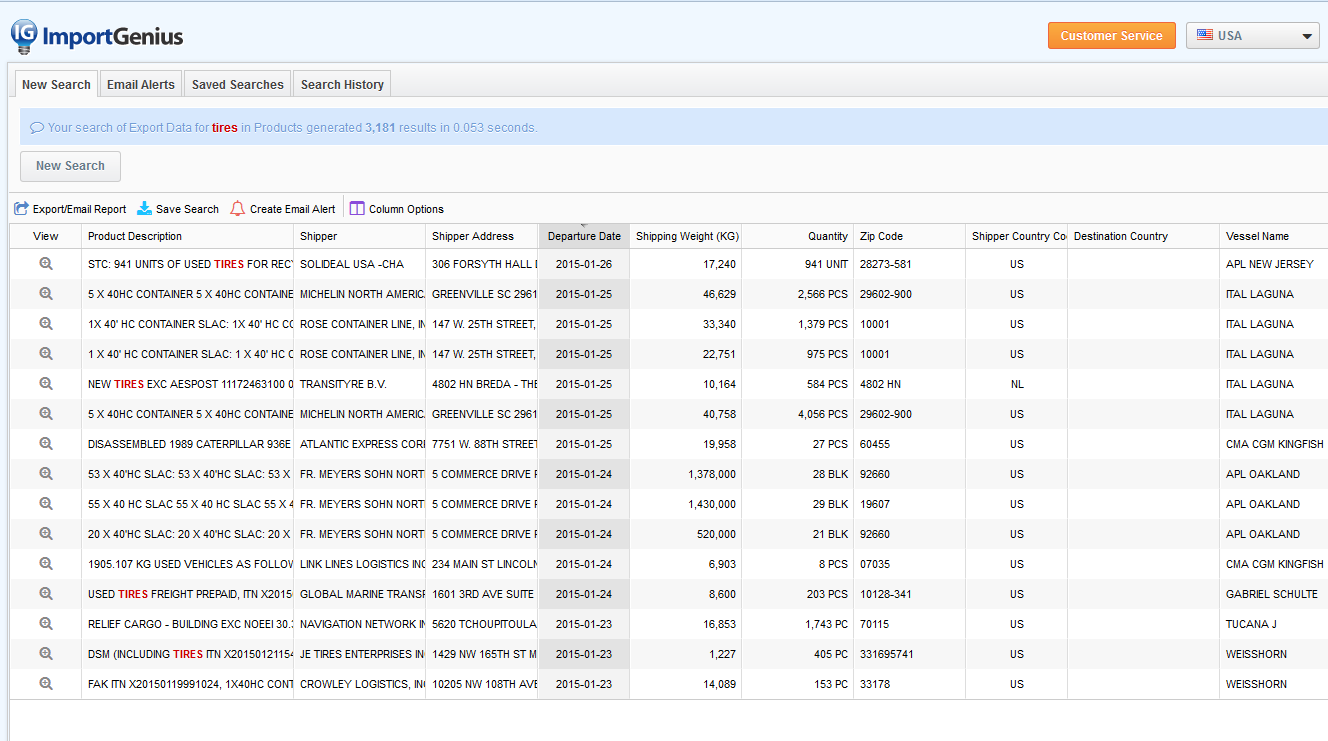
The database: ImportGenius import_genius

Where to find it: You can find it here, and under I in the databases A-Z list.

Use it to find:

  • US Export Data  – U.S. export data dating back to January 1, 2014.
  • Complete US Shipping / Import Data – nearly 100 million shipping records going back to November 2006
  • Data includes: product, shipper, departure date, weight, quantity, vessel, ports, container number, etc.

import_genius_dataTips for searching:

  • Search for import data or export data
  • Use the drop down menu to Search by: product, shipper, shipper address, destination country, foreign port, vessel name, container number, bill of lading, distance from zipcode, zipcode range.
  • Adjust date range
  • Export / email data

View ImportGenius demos here.

Want help using ImportGenius? Contact Willow or Kim and set up an appointment.

Ninety-nine Years of BMWs

Ninety-nine years ago on March 7, 1916, BMW was officially incorporated. Originally launched to make aircraft engines for Kaiser Wilhelm’s war machine during World War I, the company switched to making motorcycles in the 1920s and started producing cars in the 1930s. The first plant outside of Germany, located in Spartanburg, South Carolina, wasn’t built until 1992. BMW stands for Bayerische Motoren Werke or Bavarian Motor Works. It has often been said, however, that BMW stands for “Beauty. Money. Wealth.” And, BMW advertising executives have said that BMWs are meant to convey “unpretentious exclusivity.” They are also considered to be “the ultimate driving machine.”

If you aren’t quite ready to head out and put a new BMW in your garage, you can dream while paging through The BMW Book.  It is 303 pages of full-color photos of BMW vehicles. It is also packed with information about everything from motorsports, motorcycles, Heritage and Icon BMWs from the past, to the concept vehicles of the future. BMW has two electric cars on the market right now: the BMW i3 and the BMW i8.

BMW Isetta or "Bubble Car"

BMW Isetta or “Bubble Car”

One of the Heritage BMWs you’ll see in The BMW Book is the Isetta. The Italian firm, Iso SpA, which was known for building refrigerators, motor scooters and small three-wheeled trucks expanded in 1952 and built the Isetta, a small, egg-shaped car. BMW bought the license and the complete body tooling from Iso SpA, and then made the Isetta its own, re-engineering much of the car. The first BMW Isetta appeared in April 1955. That same year it became the top-selling single-cylinder car in the world. The “bubble car” had a single seat for driver and passenger and a front mounted door. The heater was optional and, in the event of a crash, the driver and passenger were expected to exit through the canvas sun roof.

Check out this youtube video to see an Isetta in action!

http://goo.gl/PtY8yP

Factories_DVD!

National Geographic’s Ultimate Factories DVD Collection


Want to go inside a BMW factory and see how the”ultimate driving machines” are manufactured?
Check out National Geographic’s Ultimate Factories Collection on DVD. You’ll be able to witness first-hand what it takes to build the powerful, high-performance cars and motorcycles. This 4-disc collection, available in the Engineering Library, will take you behind-the-scenes of many different types of factories, including factories for fire trucks, M-1 Tanks, Budweiser and others.


BMW doesn’t just build cars that look great on the highway or in your driveway. They are expanding their line of cars within the BMW Sports Trophy Customer Racing program – this line is said to have “strong motorsport genes.” The BMW M4 DTM race car is a strong contender in the DTM racing circuit (Deutsche Tourenwagen Masters) which is considered by some to be some of the highest GT racing in the world.  BMW motorcycles have been winning championships since 1924 and have included, among others, sidecar racing (17 championship titles in a 20-year span), nine consecutive German championships, and the the US Superbike Championship.


References:

The BMW Book

The BMW Book


For More Information:


PubMed Xpress Class Today, March 5!!

PubMed contains over 19 million citations for biomedical literature from MEDLINE, life science journals, and online books.

Today, 2:30 p.m., 2001C Seamans Center Library Computer classroom, 30 minute class.

Taught by Liz Kiscaden, Head of Hardin Library Services, Hardin Library for the Health Sciences.

LIB_March_5_PubMed

Try Out ScienceDirect’s Reference Module in Biomedical Sciences

ScienceDirect’s Reference Module in Biomedical Sciences contains trusted, peer-reviewed, comprehensive content from ScienceDirect’s reference works as curated by an editorial board led by Editor-in-Chief, Michael Caplan. Valuable for interdisciplinary research, it is designed for faster, more relevant browsing within the subject and beyond, with featured articles for quick, clear overviews, subject hierarchies to put everything in context, and guidance to lead researchers to related knowledge.  The trial runs until March 24, 2015.

Please send comments to Janna Lawrence.

CINAHL, DynaMed and Other EBSCO Databases Unavailable from Off-Campus

Unfortunately, DynaMed, CINAHL, and other EBSCO databases are currently  unavailable from off-campus.

We are hopeful that this issue will be resolved quickly, but in the meantime, here are some suggestions for alternate databases.

For DynaMed, trying other similar resources like ClinicalEvidence, ACP Smart Medicine, or UpToDate. All of these resources can be found on our Evidence-Based Practice Guide http://guides.lib.uiowa.edu/ebp/ebpdatabases

For CINAHL, you might try using PubMed which is linked from our A-Z list http://guides.lib.uiowa.edu/hardinaz

You can also contact your liaison who can recommend resources and run searches for you since the databases are still functioning on-campus.

If you have questions or comments, please don’t hesitate to contact us.


New Life Sciences Preprint Server: BioRxiv

From Science 14 November 2014:
Vol. 346 no. 6211 pp. 792-793
DOI: 10.1126/science.346.6211.792                        

BioRxiv at 1 year

“A year after its launch, a new preprint server for life sciences is off to a healthy start, its creators say. BioRxiv, a free site sponsored by the Cold Spring Harbor Laboratory (CSHL), has attracted more than 800 papers (see graph). Submissions span many disciplines—such as cell biology and cancer research—in which preprint sharing hadn’t been routine. About 28% of authors, who come from 44 countries, have revised their papers, presumably after getting feedback from readers, says John Inglis, executive director of CSHL Press. For scientists who might worry that posting a preprint will jeopardize its chances at a journal, Inglis points out that one-fourth of bioRxiv’s papers have later appeared in journals including Science, Nature, and Cell. http://scim.ag/bioRxiv1yr

BioRxiv is indexed in SciFinder, but not Web of Science, Scopus or PubMed. If you have any questions or if you’d like a demonstration of this database, please contact the Sciences Library.