Skip to content
Skip to main content

Life photographer Alfred Eisenstaedt’s 1961 visit to campus

A few months ago, I saw a photograph (not in our collection) taken by Alfred Eisenstaedt for Life magazine of students drawing a live nude model. The photo is undated other than 1961. Looking through the Daily Iowan archive, it was easy to determine that he visited campus in May 1961. DI reporter Anne Stearns, wrote in the May 12, 1961 issue:

A pleasant surprise for a journalist during the Wednesday morning presentation was photographer Alfred Eisenstaedt of Life Magazine, who commandeered ladders, tree branches and people (notable or students) and arranged them for his pictures. Named Photographer of the Year in 1950, Eisenstaedt noted his 25th anniversary as a photographer in 1954, and is known for his superb portraits and for his sensitive news pictures. The voice of authority was speaking when he ordered Paul Engle and Donald Justice to move their class to another spot on the riverbank for a shot.

The May 16 issue has a much longer piece by Dianne Grossett and Jerry Parker.

Eisenstaedt, 63, left the SUI campus Saturday after a two-week stay on assignment with Life reporter Elizabeth Baker. The team was here “to re-create in pictures the life of graduate students in the creative arts at SUI,” Miss Baker explained.

Their interest is in more than the conventional classroom situation, she added — in how students relax, where they live, their work, pasttimes, parties. They have visited several students’ homes, browsed about the Art, Theatre and Music Buildings, and have even been to Kenney’s.

Eisenstaedt pointed out that they do not know the publication date of the story — or even that it will be published. SUI was chosen for the possible feature, Miss Baker said, “because of its varied and active creative arts program which has national reputation.” She mentioned outstanding persons such as Mauricio Lasansky and Paul Engle.

The full text of both articles can be read in the links above and has been excepted here. Kenney’s was a bar on the west side of Clinton St. which was popular with the Writer’s Workshop participants. The Iowa City Public Library Digital History Project has a picture of Kenney’s which is posted in the Iowa City Past Tumblr. As far as I know, the article was never published. I also have not seen any other pictures from Eisenstaedt’s time on campus.

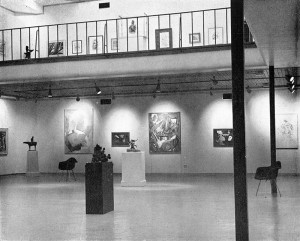
1961 Art Festival p.9During the time Eisenstaedt was on campus, the Gibson A Danes, Dean of the School of Art and Architecture, Yale University, spoke at the opening of the annual Festival of the Arts and the dedication of the expanded art gallery (May 9, 1961) . The text of his speech as well as pictures from the festival are also available in our collection.
Spring musings

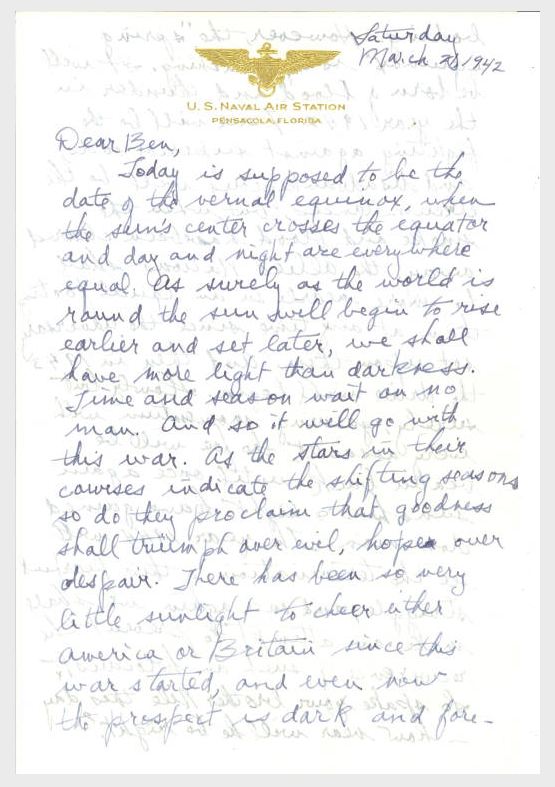
Today is the vernal equinox – the first day of spring.  72 years ago, Nile Kinnick reflected on its meaning from the U.S. Naval Air Station in Pensacola, Florida.  His words about the trajectory of the ongoing war are startlingly prescient, before turning his thoughts to springtime at home.  Thanks to DRP’s Wendy Robertson for finding this letter today, and to the DIYHistory participant/s who transcribed it.

Nile Kinnick letter to his brother, Ben, March 21, 1942

“…today is supposed to be the date of the vernal equinox, when the sun’s center crosses the equator and day and night are everywhere equal. As surely as the world is round the sun will begin to rise earlier and set later, we shall have more light than darkness. Time and season wait on no man. And so it will go with this war. As the stars in their courses indicate the shifting seasons so do they proclaim that goodness shall triumph over evil, hope over despair. There has been so very little sunlight to cheer either America or Britain since the war started, and even now the prospect is dark and foreboding. However, the “spring equinox” is approaching. It will be born of blood and thunder in the year 1942. Fierce will be the fighting against superior odds, and disadvantageous will be the circumstances, but when the smoke and blood have been cleared away, the Allied Nations shall be more nearly on an equal footing than at any time since the adversary set upon them. And then in 1943 the drive will begin. Slowly but surely, gaining momentum with every assault, the foe will be beaten back until once again sunshine & light have gained dominion. The year 1944 will see the termination of this fearful struggle, and once again we shall make an attempt to prevent the recurrence of such an holocaust.”

“But enough of figurative speculation, and on to lighter things. Spring in the midwest, oh, that is a glorious season! Soon the countryside will be green and fresh, the heavy hand of winter will be shaken off – and, yes, the grass will be a grab and a half high, and picnics will displace the afternoon schedule.”

*******************

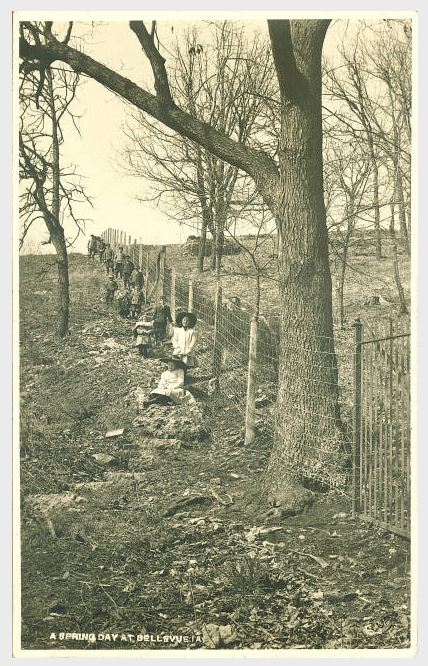
This year, spring looks about as colorful as this photo, A spring day at Bellevue IA, 1910s, from the Mary Noble Photograph collection.  Click the photo and zoom in, and you’ll still see some smiling faces.  Both the Noble and Kinnick collections are part of the Iowa Digital Library.

"A spring day at Bellevue IA," 1910s
“A spring day at Bellevue IA,” 1910s


Remembering Shirley Temple Black

Child star Shirley Temple died yesterday (Feb 10, 2014). After retiring from theater, she became active in the Republican Party at which time she attended various fund raising events.

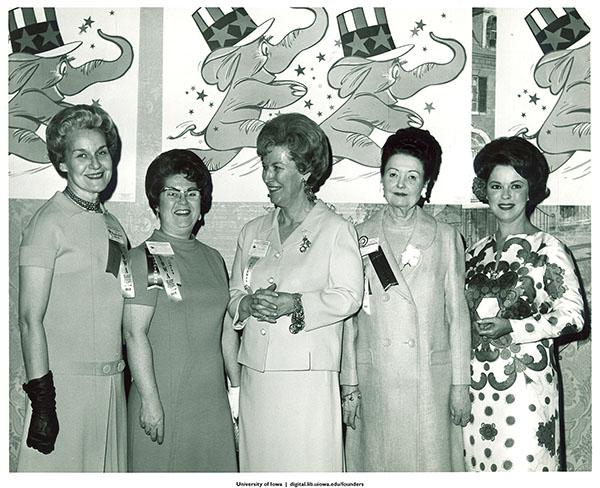
Mary Louise Smith, Pat Pardun, Mary Brooks, Lois Reed, and Shirley Temple Black at the Republican Women's Conference, Washington, D.C., 1968
Mary Louise Smith, Pat Pardun, Mary Brooks, Lois Reed, and Shirley Temple Black at the Republican Women’s Conference, Washington, D.C., 1968.
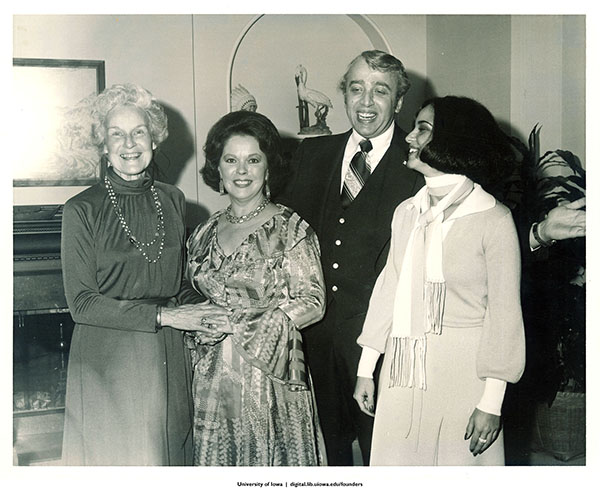
Mary Louise Smith, Shirley Temple Black, Jerry Mursener, and Paula Travis at party fund-raiser, Iowa, November, 1977
Mary Louise Smith, Shirley Temple Black, Jerry Mursener, and Paula Travis at party fund-raiser ($100 per person reception, speech & buffet), Iowa, November, 1977.

She also served as U.S. Ambassador to Ghana from 1974–1976, was Chief of Protocol of the United States from 1976–1977, and was U.S. Ambassador to Czechoslovakia from 1989–1992.

A Monument Man at SUI

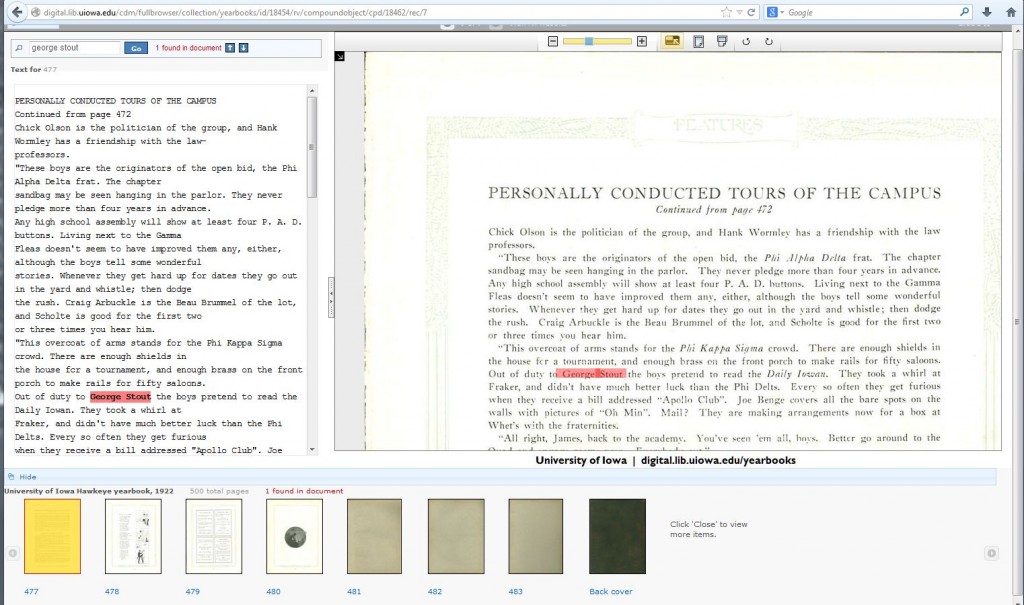
Two collections in the Iowa Digital Library, University of Iowa Alumni Publications and University of Iowa Yearbooks include over 40,000 pages of campus history.  Locating a specific name or event would be a challenge, but Optical Character Recognition (OCR) technology allows the collections to be full text searchable.

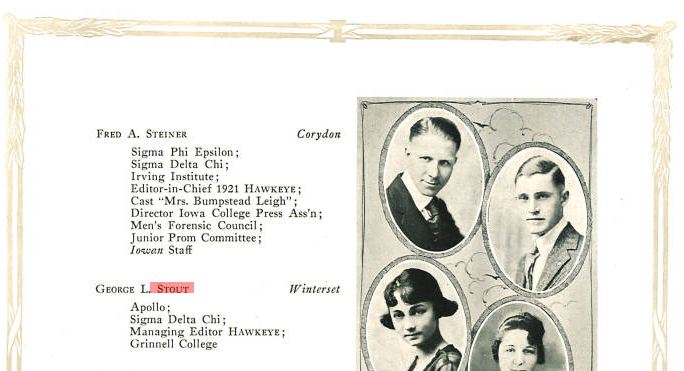
The name George Stout has been in the news a lot lately as the basis for the lead character in the movie Monuments Men.  A 1921 graduate of what was then the State University of Iowa (SUI), he also makes several other appearances in the both the yearbooks and alumni publications.

George Stout, Hawkeye Yearbook, 1921

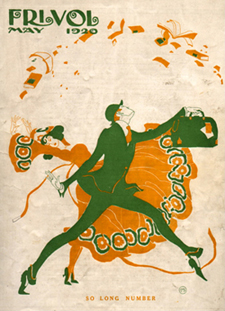
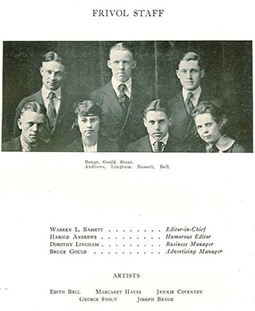
Stout is listed among the artists of the humor publication Frivol, which while unfortunately not digitized, is available in the University Archives’ Student-produced Publications and Newsletters Collection.

Frivol 1920
Frivol, 1920
Stout - Frivol
Frivol Staff, 1921

Stout is also mentioned in the March 1921 issue of the Iowa Alumnus for delivering a short address for Foundation Day, the UI’s 74th birthday.  While there’s no accompanying picture for this event, the IDL collection Iowa City Town and Campus Scenes includes several photographs from earlier Foundation Days.

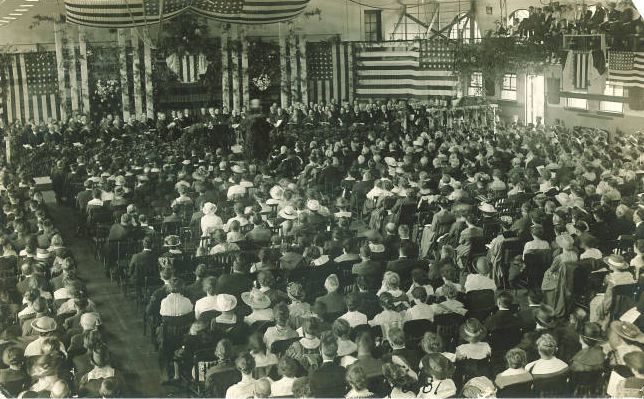
Foundation Day speech, The University of Iowa, 1910s?

Finding information in Iowa Digital Library text collections is made simple through OCR and word highlighting.

Iowa Digital Library Image & Text Viewer

Enjoy more than a million digital objects created from the holdings of the University of Iowa Libraries and its campus partners. Included are illuminated manuscripts, historic maps, fine art, historic newspapers, scholarly works, and more. Digital collections are coordinated by Digital Research & Publishing.

Women on the Chautauqua Circuit: Winsome Lasses and Ardent Advocates

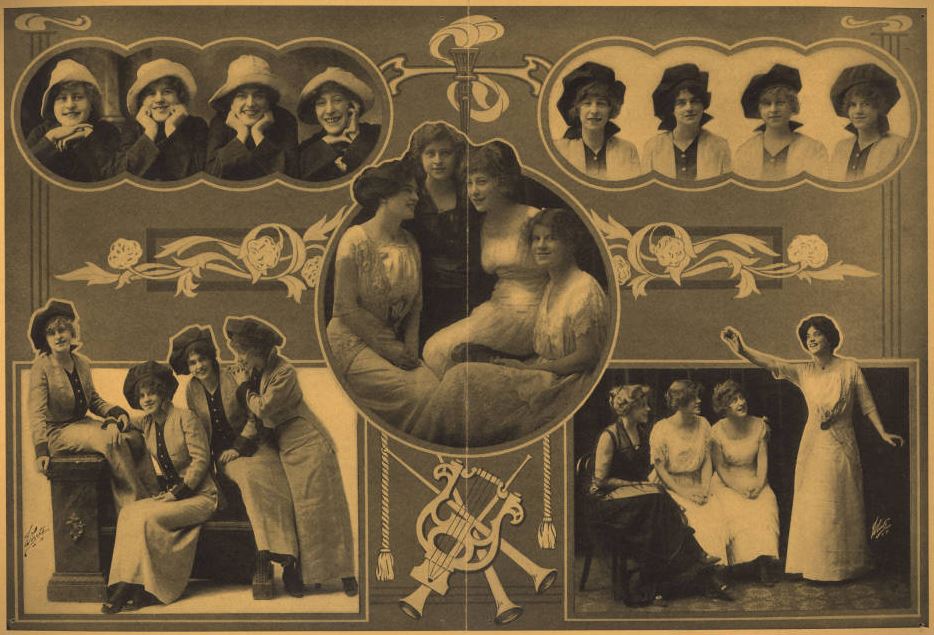
The Marigold Quartette brochure | Traveling Culture - Circuit Chautauqua in the 20th Century
The Marigold Quartette brochure | Traveling Culture – Circuit Chautauqua in the 20th Century

This essay by Kären Mason, Curator of the Iowa Women’s Archives, was originally written for Akashic Books.

Chautauqua was an eagerly anticipated event in towns across the United States in the early 20th century. Huge tents were erected and a variety of speakers, performances, and children’s activities took place over the week the Chautauqua was in town. Red Oak, Iowa even constructed a permanent Chautauqua Pavilion in 1907, which is still standing and reputed to be the largest covered pavilion west of the Mississippi.

Many women lectured or performed on the Chautauqua circuit. Some, like Marian Elliot Adams, the main character of Unmentionables, lectured on women’s reform issues. Women’s suffrage was a popular topic in the years leading up to 1920, when the 19th Amendment at long last gave women the vote. Chautauqua provided an important venue for reformers to reach audiences all across the country.

Read the full essay at the Iowa Women’s Archives blog