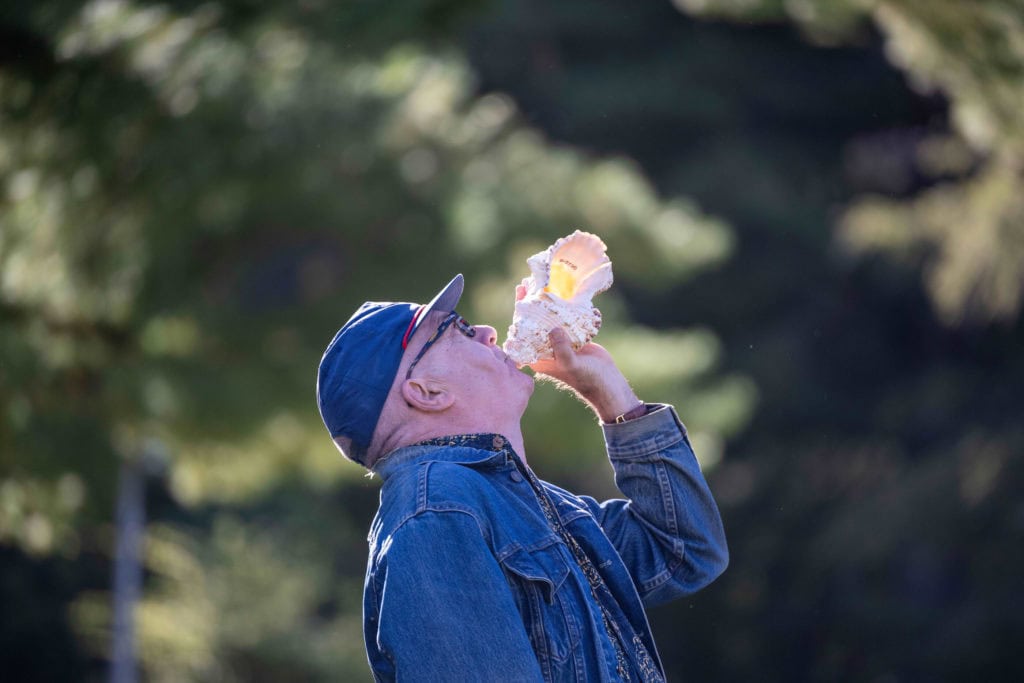
Steve Schick blows into a conch shell to start John Luther Adams’s INUKSUIT—featuring over 100 percussionists dispersed throughout Iowa City’s City Park and along the banks of the Iowa River—as part of the Steven Schick Artist Residency on Oct. 6, 2024.
In October 2024, world-renowned percussionist Steve Schick returned to his home state of Iowa for a residency at his alma mater, the University of Iowa. This week-long engagement was full of music, conversation, reminiscences, and the making of new memories, such at the performance of John Luther Adams’s INUKSUIT in City Park with over 100 percussionists.
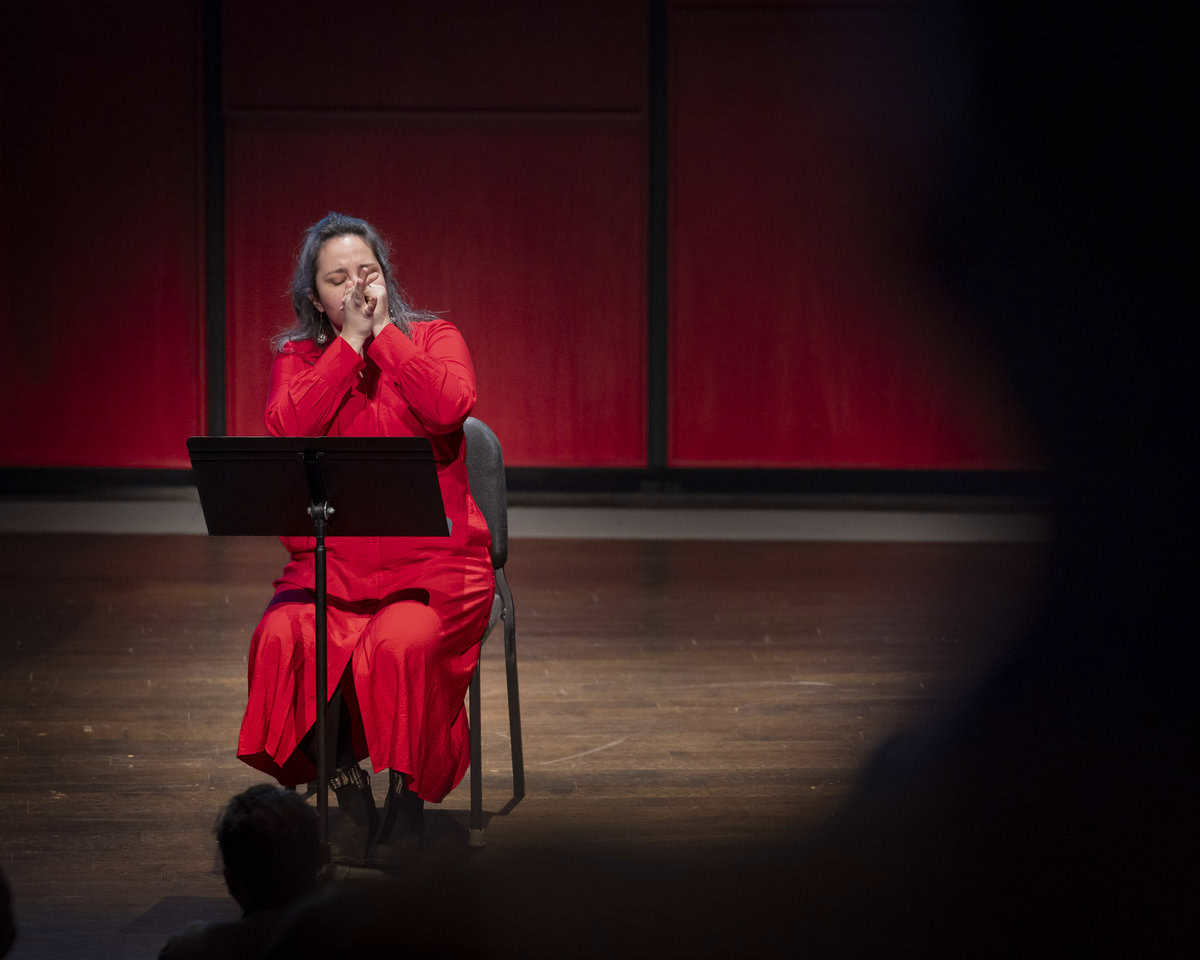
Anika Kildegaard, soprano and University of Iowa alum (MA ’20) of The Crossing performs in the Voxman Music Building Recital Hall.
The Crossing
In February 2025, The Crossing chamber choir visited the University of Iowa School of Music to collaborate on residency events and a concert with the University of Iowa Kantorei choir and three additional events.
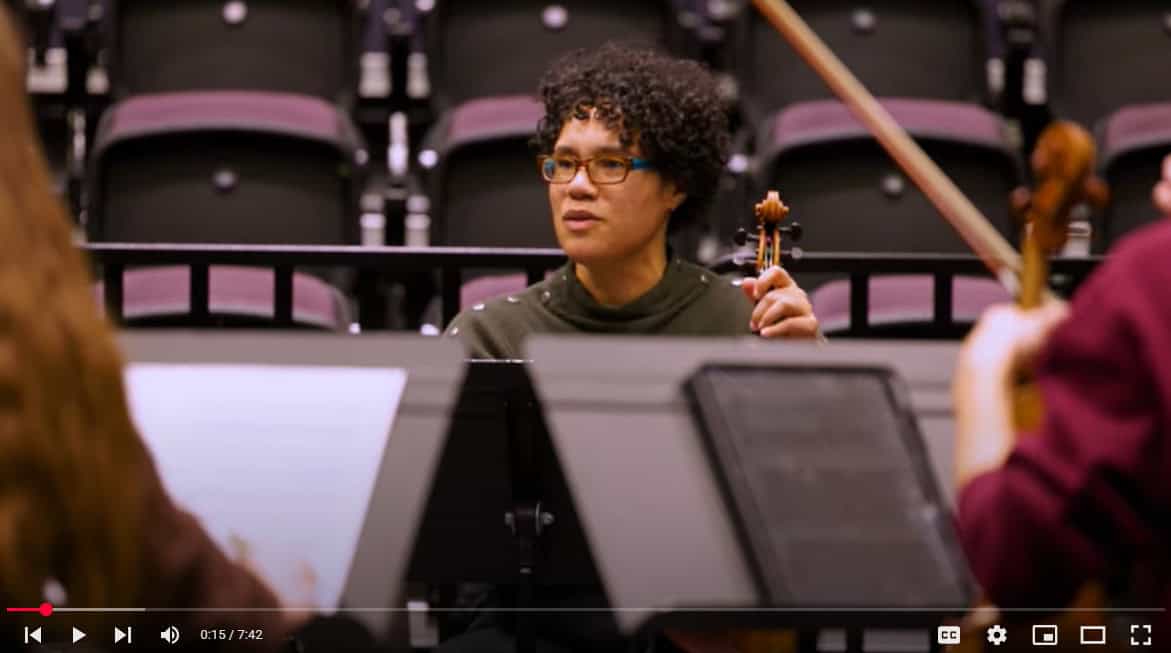
Jessie Montgomery leads the chamber music rehearsal, Stark Opera Studio, University of Iowa School of Music.
Jessie Montgomery
As part of Hancher Auditorium’s 2024–25 Composer-In-Residence program, acclaimed composer Jessie Montgomery spent an incredible year working side-by-side with UI music students. Through workshops, one-on-one coaching, masterclasses, and more, over 200 students had the unique opportunity to learn, perform, and grow through her music.
A title screen starts the “Music and Medicine on Monday” YouTube video.
Music and medicine
Access the “Music and Medicine on Monday” video / podcast series, created in collaboration with the UI Roy J. and Lucille A. Carver College of Medicine. The series matches student musicians and music faculty with healthcare and research professionals to present musical performances along with commentary about how to care for the health of their primary instruments: their bodies.
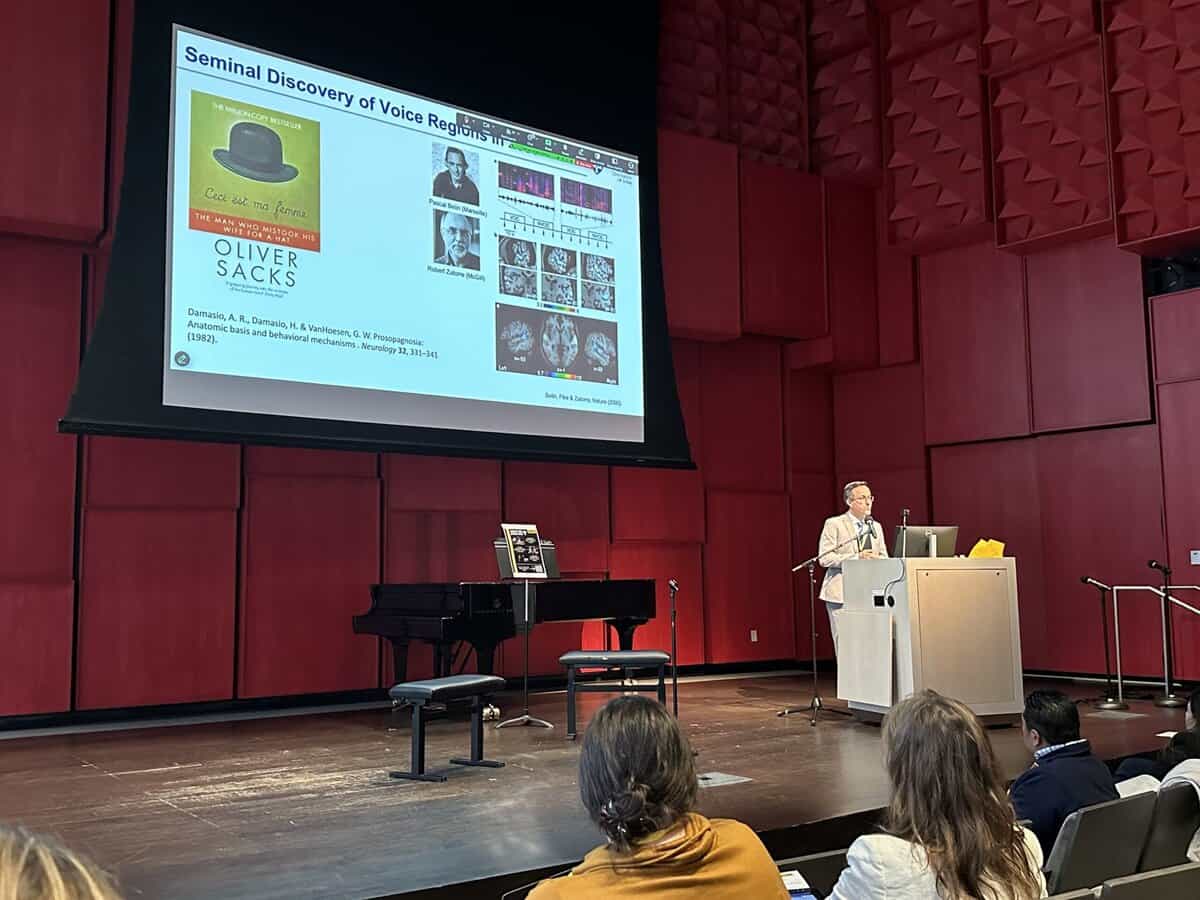
Dr. Chris Petkov presents on the “neurobiology of voice perception” at the 2024 Midwest Voice Symposium.
Midwest voice
The inaugural, interdisciplinary conference showed off the work of UI researchers and practitioners, as well as showcasing interdisciplinary collaborations in the UI College of Liberal Arts and Sciences.
Each spring at the University of Iowa, Iowa City becomes New Work City: a place where new works are being premiered all over campus as our graduate students in the performing arts present their creative projects to the public—often for the first time ever. Join us on campus from now until commencement for #NewWorkCity, the spring initiative by #PerformingArtsAtIowa to highlight new work created by our talented graduate students in the performing arts.
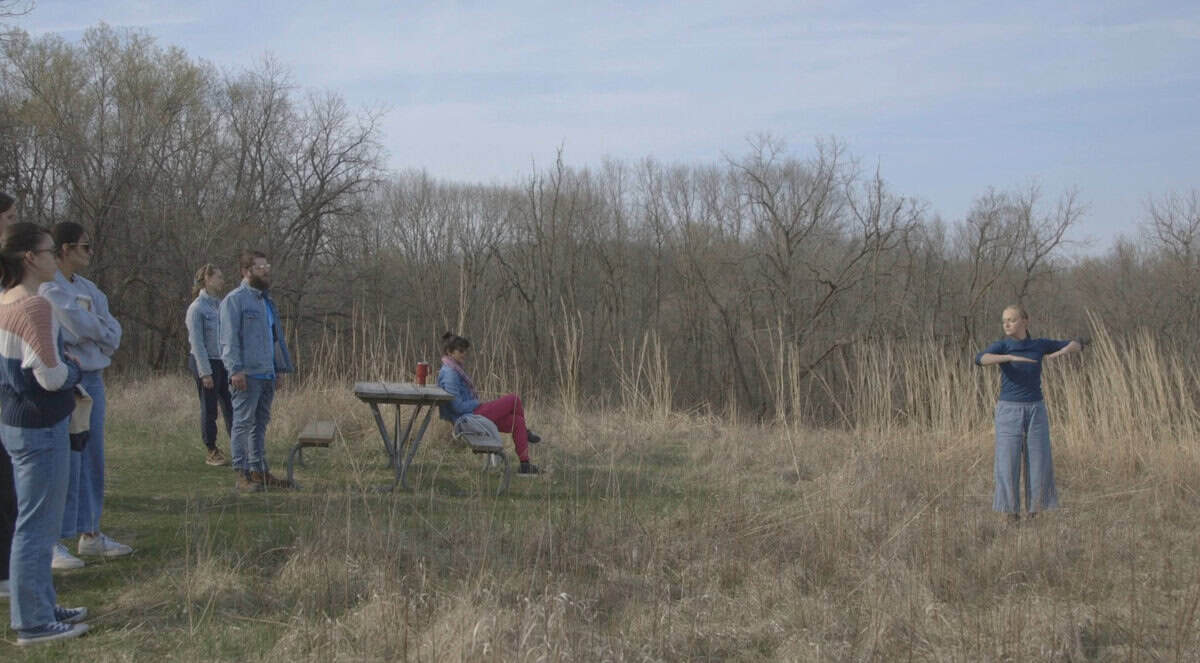
Emily Pyburn peforms as Solidago canadensis in Here with the Tallgrass, a dance thesis by Sophia McLaughlin.
Here with the Tallgrass
Dance MFA student Sophia McLaughlin’s thesis composition, Here with the Tallgrass, premiered at Hickory Hill Park as part of #NewWorkCity. On April 13, 2025, community members flocked to the park to experience the new work and immerse themselves in dance and nature.
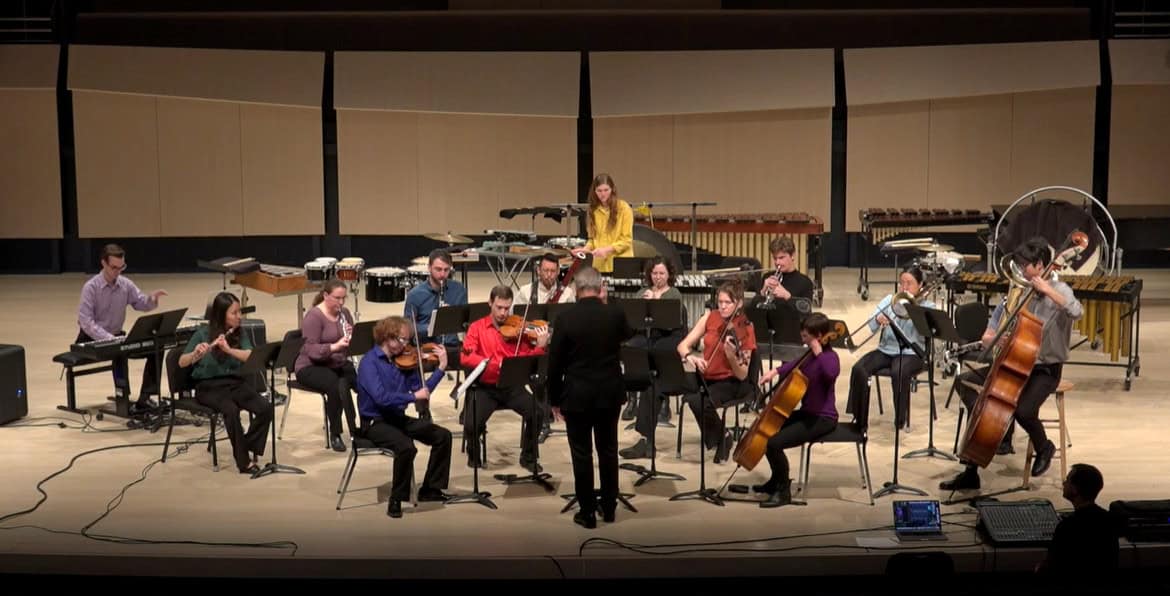
Center for New Music performs not-being-us by Ramin Roshandel, March 9, 2025 in the Voxman Music Building’s Concert Hall.
Center for New Music
Watch performances from the Center for New Music’s most recent concerts, including a memorial concert for emeritus faculty member Larry Fritts, works by student composers, and works by recent alumni.
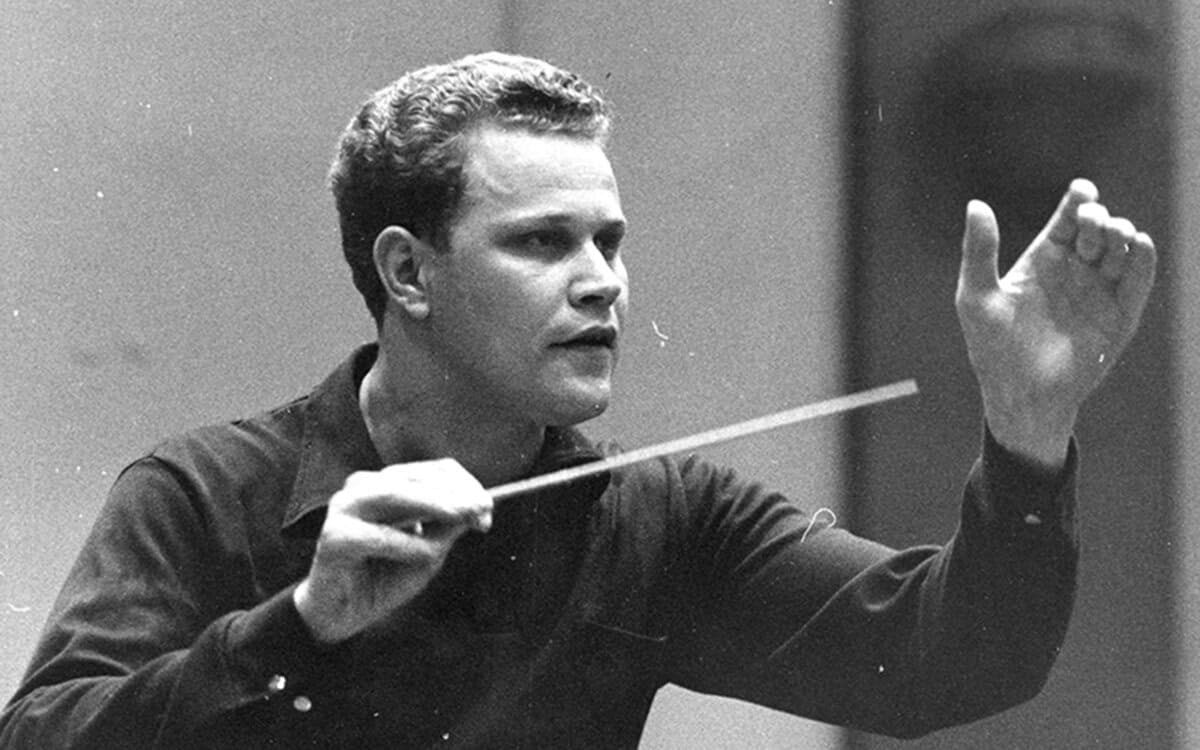
Orchestrating Community: The Public Services of Iowa Conductor James Dixon
An Iowa native and a Hawkeye, conductor James Dixon (1928-2007) was instrumental in building orchestras at the University of Iowa, in the Midwest, and abroad. Through a look at Dixon’s adventurous international career, this exhibition provides a “behind the podium” look at how orchestras of all sizes connect with their communities and become crucial to sustaining them. Co-curated by Sarah Suhadolnik and Katie Buehner, Orchestrating Community: The Public Service of Iowa Conductor James Dixon uses materials from Special Collections and Archives and the Rita Benton Music Library at the University of Iowa Libraries to share the important work of orchestras through the lens of Dixon’s life.
Dr. Ksenia Nosikova, Professor of Piano and piano area co-head,was awarded the 2024-25 College of Liberal Arts and Sciences (CLAS) Collegiate Teaching Award, presented each year by CLAS to faculty who demonstrate outstanding performance in the classroom, laboratory, or studio. Read more >
Dr. Abbey Dvorak, Associate Professor of Music Therapy, was named the 2025 Williams-Cannon Faculty Fellow through the Iowa Neuroscience Institute. Read more >
This summer a brand-new Steinway D concert grand piano arrived at the School of Music Recital Hall. Watch a video of the delivery >
World-renowned bass-baritone vocalist Simon Estes (BM ’86) has received the University of Iowa Distinguished Alumni Award—the University of Iowa’s highest honor! See more in this short video shown at the awards ceremony. Watch the Simon Estes: Opera Star & Humanitarian video >
Jason Lee (BM piano performance ’24), received first prize for his arrangement of the Iowa Fight Song submitted to the Big Ten Academic Alliance Piano League for their Fall 2024 fight songs competition. View Jason’s rendition >
Why is Grammy-nominated alumna Alicia Rau called the “Trumpet Chick” at RAGBRAI? Learn more >
Sun Joo Lee, who graduated with a PhD in music therapy in 2025, was featured in Iowa Magazine this spring. Learn more >
Did you know that our Hawkeye Drumline Captain Peyton Flynn is the voice of the latest UI gameday commercial? Learn more >
In memoriam
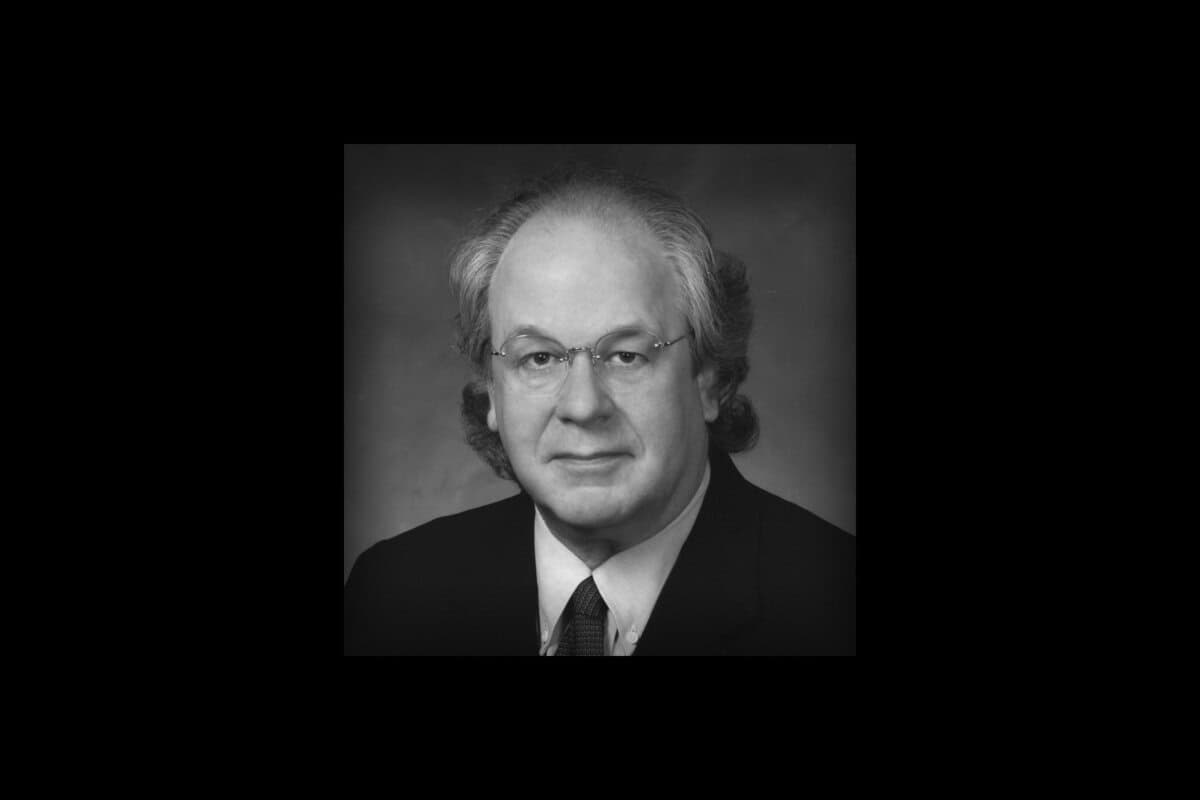
Larry Fritts (1952–2025)
Larry Fritts was the professor of composition at the University of Iowa (1994–2019), during which time he was director of the Electronic Music Studio and created the Music Instrument Samples Database, alongside many compositions for traditional instruments, voice, and electronics.
Wally Chappell was the director of Hancher Auditorium from 1986 to 2001; executive director of the American Ballet Theatre and the Paul Taylor Dance Company; and board member of the Kronos Quartet, Englert Theatre, and Riverside Theatre.
This spring the University of Iowa released a special video called “Iowa: Your Destination for the Performing Arts,” all about our vibrant, collaborative arts campus in the greatest small city for the arts.
Sean Harken, a bass-baritone vocalist pursuing his B.M. in Voice Performance, composed the music for the new Performing Arts At Iowa video, under the supervision of Jazz Studies Associate Professor Dr. William Menefield.
Hawkeye Marching Band alum Amanda Stout (2017 BA), and current HMB member Mae Dunning brought the Alumni Band Herky to life this summer for Herky On Parade, celebrating Herky the Hawk’s 75th birthday.
This year the School of Music launched a new series called “Music and Medicine on Monday,” a special video / podcast series created in collaboration with the UI Roy J. and Lucille A. Carver College of Medicine.
The University of Iowa’s Learn more about the peculiar history of Iowa’s many school songs, including “Old Gold,” “On Iowa,” “The Iowa Fight Song,” “Roll Along, Iowa,” and “Alma Mater, Iowa.”
The Hawkeye Marching Band has welcomed guest artists throughout its storied history. Check out highlights from these collaborations, from the band’s earliest days to today.
Want to know more about the HMB’s storied history? Look no further than Dr. Samuel Carter Biggers Jr.’s 2013 dissertation, “On Iowa! a history of The University of Iowa Marching Band, 1881-2012” which tracks the band from its early days as a military ensemble to the bowl games, Golden Girls, drum majors, and directors of the 20th and into the 21st century. This document is available open access through Iowa Research Online, the University of Iowa’s institutional repository.
“Fierce” embodied the collaborative spirit at Performing Arts At Iowa and showcased the tremendous talents of our music faculty and students! Produced by the School of Music, the Performing Arts Production Unit, and Hancher Auditorium, “Fierce” demonstrated the power of creative collaboration for students, faculty, and staff at the University of Iowa.
Watch our video to see how “Fierce” came to life at the University of Iowa.
Just two years after Dr. William Menefield joined the UI music faculty in 2020, his first opera composition, Fierce, premiered in Cincinnati. He never imagined two of his new colleagues, School of Music director Tammie Walker and Hancher executive director André Perry, would be sitting in the audience, dreaming up plans to bring the production to Hancher.
Kara Metzger conducting for the “Welcome to the Show” hype video
2024 DMA grad Kara Metzger—along with students HMB co-manager Jake Greenlee on trombone, fellow co-band manager Nick Kamp on tuba, Avery Arens on our majestic Klais Organ, oboist Sam Hoying (HMB alto sax), and Ani Perez-Brennan (HMB Drumline)—all shown in the Concert Hall of Voxman Music Building in the Iowa Women’s Basketball team’s “Welcome to the Show” video.
Christian Frankl, drum major. Michigan State v. Iowa, Sept 30, 2023
2024 PhD grad Ramin Roshandel collaborated with Associate Professor Dr. Jean-François Charles to record an album called Jamshid Jam, a collision of Persian classical music and live electronic sampling and re-mixing.
Naomi Davis (MA, Music Therapy, 2024)
(2024 MA, Music Therapy) was featured in the UI’s “Dare to Discover” series on student research. Read about Naomi’s research using music therapy to provide arts-based mental health and wellness services for high school students of color
Becca Swanson (2022 BA in Music Education) worked with Dr. Mary Cohen in the Iowa Medical and Classification Center (better known as Oakdale Prison), and called that experience the most meaningful part of her education. In December 2019, they performed a concert at Oakdale titled “Remember: Be Love,” which was named after a song she composed alongside an incarcerated individual.
After joining the School of Music as a visiting professor in 2021, Sam Young was literally a rock star. Read more about Sam’s life as a rock musician before the University of Iowa.
Is adding collaborators or guest performers to a Hawkeye Marching Band (HMB) halftime show one step too far? Can there be too much of a good thing? The HMB has always had a collaborative streak in its DNA, from its longtime association with the Scottish Highlanders to several impressive performers and conductors. Here are a few examples of how the HMB has invited other teams and performers into Kinnick Stadium and helped the rafters ring just a bit louder than usual.
Early days: Forming up for the opposing team
When the HMB first started performing for football games, they would march onto the field, much as they enter the field today, followed by a flag raising ceremony, and then they would not only play the opposing team’s fight song; they would also perform drill to accompany. Both the fight songs and drill were homemade—they didn’t borrow charts or drill from visiting teams, as that would have been extremely difficult in the 1950s—and a fair amount of care and welcome was placed on the practice.
Of course, this salute concluded with recognizing the home team, with “On Iowa” and later, “The Iowa Fight Song” at full volume with a large block or pennant IOWA formation.
When he composed “The Iowa Fight Song” in 1950, Meredith Willson was known as one of Iowa’s greatest musicians, from his flute playing days with John Philip Sousa’s band and the New York Philharmonic to his work on national radio. However, when he was a guest conductor with the HMB in 1958, he was the composer and librettist of the hottest show on Broadway, The Music Man, based on his childhood days in Mason City, Iowa. In fact, the HMB’s last halftime show of the regular season (Notre Dame v. Iowa, Nov. 22, 1958) was a medley of tunes from The Music Man, and with Willson in attendance. The show concludes with Meredith taking the ladder and conducting the band in “The Iowa Fight Song.”
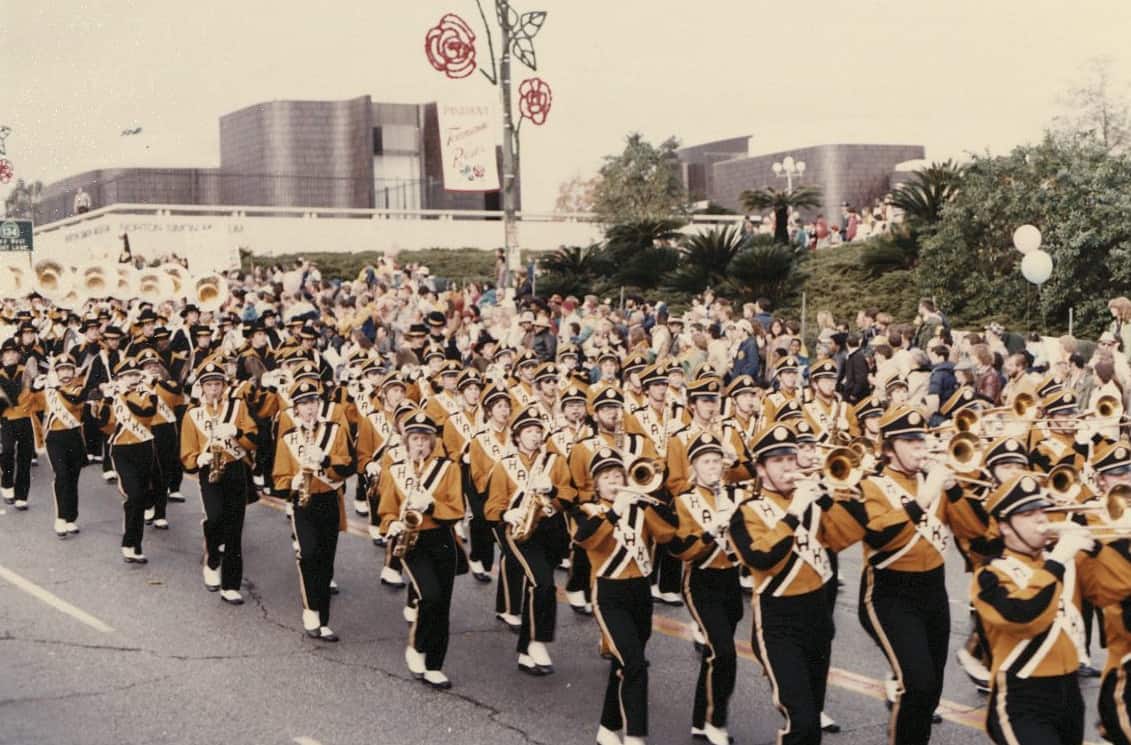
1958 was a great year for Iowa football, and the team was headed to the Rose Bowl for the second time that decade. Whether the HMB and the Highlanders would make the trip was in jeopardy, as they did not have the financial sponsorship required. At the game, Willson made a passionate plea on behalf of the band. “This is the finest university band in the nation and has the finest director I’ve ever met, in Fred Ebbs, and this band has got to be in California come New Year’s Day.”
The Santa Fe railroad answered the call and sponsored the HMB and Scottish Highlanders not only for transportation to the game, but several other destinations where the students could visit attractions and perform, including Kansas City, Albuquerque, Disneyland, the Grand Canyon, and Pampa, Texas. The HMB show saluted the railway’s support with a locomotive formation.
Meredith Willson conducting members of the Hawkeye Marching Band at the 1959 Rose Bowl.
Watch the 1958 Notre Dame v. Iowa Halftime Show featuring The Music Man
Notre Dame v. Iowa, Nov. 22, 1958, halftime show featuring music from Meredith Willson’s The Music Man with the composer in attendance.
1964: “Doc” Severinsen
Fred Ebbs brought a couple of guest performers in during his time directing the HMB, but of special note was the visit by upcoming trumpeter Carl “Doc” Severinsen in 1964. Doc was a trumpeter in the NBC Orchestra for the Tonight Show starring Johnny Carson, but still two years away from becoming that show’s iconic bandleader. According to the show script, his visit was sponsored by Getzen’s of Elkhorn, Wisconsin; a manufacturer of brass instruments. The show was designed to highlight Severinsen’s virtuosity on the trumpet, with songs like “Trumpeter’s Lullaby” and “Carnival of Venice.” The show closed with a “dazzling display of exciting rhythm and sound…a powerful foot stompin’ arrangement of ‘Two O’Clock Jump’.” Formations included the outline of a trumpet and the band spelling “DOC” on the field in all caps.
Doc Severinsen performing with the HMB during halftime on Oct. 3, 1964
Final formation of the show, spelling “DOC”Trumpet formation to accompany Trumpeter’s Lullaby
2018: Pat Green
In 2017, more than 70,000 football fans turned to the southeast corner of Kinnick Stadium to face the newly constructed Stead Children’s Hospital and lifted their arms in a mass gesture of hope. The Hawkeye Wave, lauded as “the greatest tradition in college football,” was born.
For the first game of the 2018 season, the University of Iowa Hawkeye Marching Band and the University of Northern Iowa Marching Band combined forces, along with country music artist Pat Green to perform his classic hit and then Hawkeye Wave theme song, “Wave on Wave.” Green was no stranger to his songs crossing over with athletics; “I Like Texas” has been used as the Texas Rangers’ victory song for twenty five years. He actually returned for a reprise performance on Sept. 7, 2019, during Rutgers v. Iowa, and to record a special version of “Wave on Wave” with the HMB.
Green poses with members of the HMBGreen points to the Stead Children’s Hospital
The Hawkeye Marching Band, Northern Iowa Panther Marching Band, and country music star Pat Green with his band in a special performance of “Wave on Wave,” the official song of the Iowa Wave.
2022: The Ohio State Marching Band
The University of Iowa has been a member of what is now called the Big Ten Conference since 1899. While football rivalries in the conference run deep and provide energy and entertainment to fans, seeing schools come together on the field can do the same. In 2022, the Hawkeye Marching Band traveled to Columbus, Ohio to perform alongside The Ohio State University Marching Band in “The Shoe”. The show was an Elton John spectacular, including hit songs “Goodbye Yellow Brick Road,” Saturday Night’s Alright for Fighting,” “Don’t Go Breaking My Heart,” “Crocodile Rock,” “Tiny Dancer,” “Rocket Man,” and “I’m Still Standing.” The show put around 500 marching band students on the field forming stars, hearts, and of course, pianos.
Elton himself gave both bands a shout out on Twitter, saying “What an incredible dedication and so much creativity!” Whether you were a Buckeye or a Hawkeye that day, the bands gave fans much to celebrate. As the saying goes, “The Band(s) Always Win!”
Iowa v. Ohio State, Oct. 22, 2022 “Tribute to Elton John” halftime show featuring The Ohio State Marching Band and the Hawkeye Marching Band.
“Songs of SUI have peculiar origins,” states The Daily Iowan in a 1962 article. “Old Gold” (1905); “On Iowa” (1917); “The Iowa Fight Song” (1950); and “Roll Along, Iowa” (1954) and “Alma Mater Iowa” (1947/1960) have all assumed distinct roles in campus life, and in the traditions of the Hawkeye Marching Band. This brief history, relying heavily on The Daily Iowan, the Hawkeye Marching Band Records, and yearbooks of yesteryear, traces how each song was adopted into campus life and their role in Hawkeye Marching Band (HMB) performances and practices today.
1905: “Old Gold”
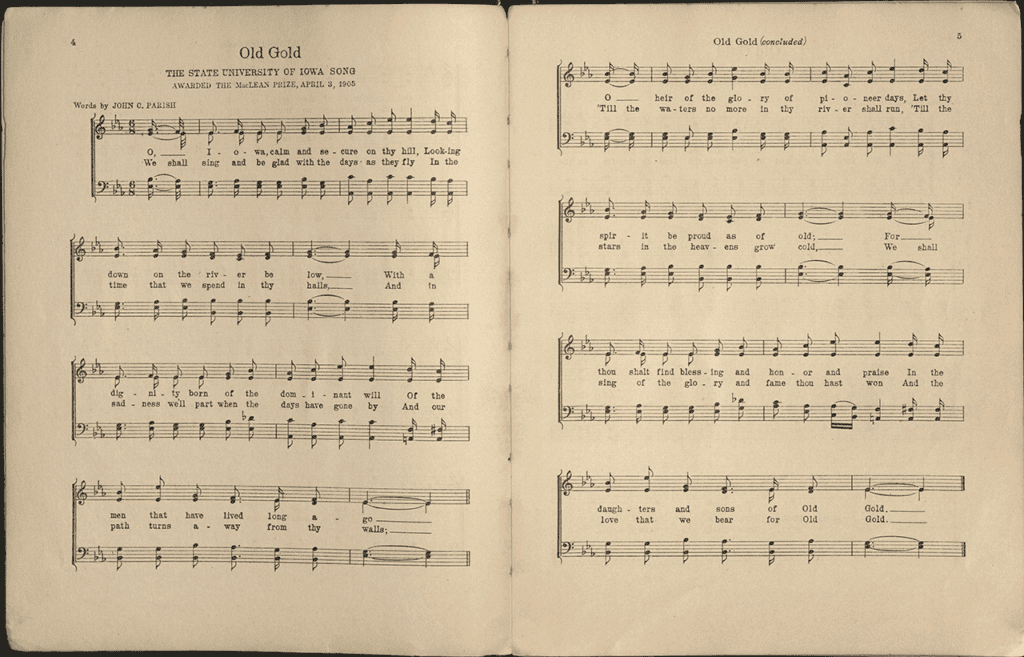
The first two of Iowa’s traditional songs were procured through contests. In 1905, President MacLean launched a competition with a twenty dollar prize for “the best song for the University of Iowa.”1 The song could be submitted as lyrics alone, or with words and music. The senate’s music board served as adjudicators and reviewing a total of seventeen entries. In April it was announced that senior John C. Parish’s “Old Gold” to the tune of “Fair Harvard” was the winner, with “Iowa,” “Alma Mater Iowa,” and “Hail to Iowa” receiving honorable mention. The committee reported that “All breathe a spirit of loyalty and enthusiasm for the university. In some it is a poetic thought, in others it is a rousing rhythm and music, and in others it is the freedom of the yell which conveys the appeal. We need all these forces, each in its place, and it is difficult to compare them.”2 This perhaps explains why Iowa would spend half the twentieth century in search of school songs of various temperaments. “Shall this song live? No one can tell,” declared The Daily Iowan.
University of Iowa Songs, compiled by Staff and Circle, honorary senior society for women. New York : Hinds, Hayden, & Eldredge, 1921. University Archives, M1958.I3 U55 1921
Today, “Old Gold” is no longer performed, having been superseded by Gene Mills’ “Alma Mater,” composed in 1960.
1916–1919: “On Iowa”
In 1916, the University launched a competition with a $250 prize, sponsored by the Alumni Club of Chicago, for the “best Iowa song.” Entries were to be submitted to President Jessup by Oct. 1, but the deadline was extended another four months because there were only 15 entries and the committee wanted a larger pool from which to choose. There was also concern raised in a Sept. 27 Daily Iowan article that not a single current student of the 3,000-member student body had written a song; most entries were from alumni. In the end, the pool doubled to 30 entries, including “one song…sent from Washington by a person in no way connected with the University.”3 A campus committee weeded out the “evidently unsatisfactory” entries, then sent the remainder to the Alumni Club to pick the winner.
Late in the Fall of 1917, The Daily Iowan reported:
Announcement is made today of the selection of an IOWA SONG by the University’s alumni association in Chicago. Whether the new song develops into ‘Marseillaise’ or ‘On Wisconsin’ or not, the enthusiasm of the Chicago men and women must be admired. We hope sincerely and believe that the selection which they have made is a good one, yet their good intentions could not be detracted if the song failed absolutely to deliver.
“AN IOWA SONG,” the Daily Iowan, November 10, 19174
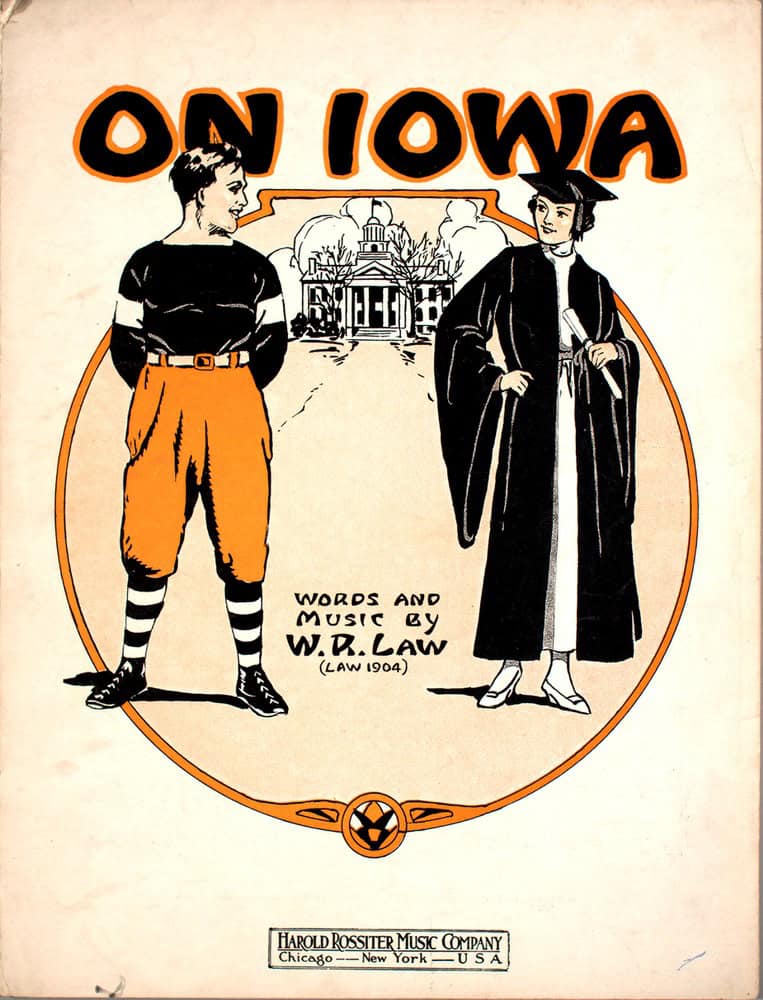
The song did indeed fail to deliver. “Iowa, University Iowa” by Hugh R. Newsom, an Oberlin graduate and composer living in Chicago, was deemed better for formal occasions but not suitable as a pep song. The university went back into the song contest entries and selected a song by Iowa alumnus and Waterloo attorney W. R. Law, “On Iowa.” Adoption of this tune is apparent in news items about school spirit, as mentions of the song are numerous. Harold Rossiter Music Co. of Chicago published an attractive copy of the song for sale, and in Iowa City it sold quickly. “On Iowa” also benefited from the support of a campus club, The Howling 300, whose mission was “promoting ‘pep’ and making the Iowa spirit a tangible, worth while thing,” and A.F.I., an honorary senior men’s society that arranged for sale of “On Iowa” sheet music at a Northwestern game in 1920, with proceeds going to the Athletics Department.5
Today, “On Iowa” is the first song of pregame and is played after Iowa scores a touchdown.
ON IOWA
Words and Music by W. R. Law (Law, 1904). Copyright 1919 by Harold Rossiter Music Co., Chicago

On Iowa proudly at the fore
On Iowa for evermore
Every loyal son will give a rousing toast to you
Ev'ry loyal daughter loves you true
On Iowa with your wealth untold
A heritage to us you did unfold
Love of family, love of friend,
Love of country, too
Makes us proud for what you stand,
Our dear Old Gold
Who, wah, wah; who, wah, wah,
Iowa! Iowa!
Who wah wah; who wah wah,
I-O-W-A.
Following World War II, the HMB completed a transition away from its Military Department roots and became a student organization focused on school spirit and performance at football games.
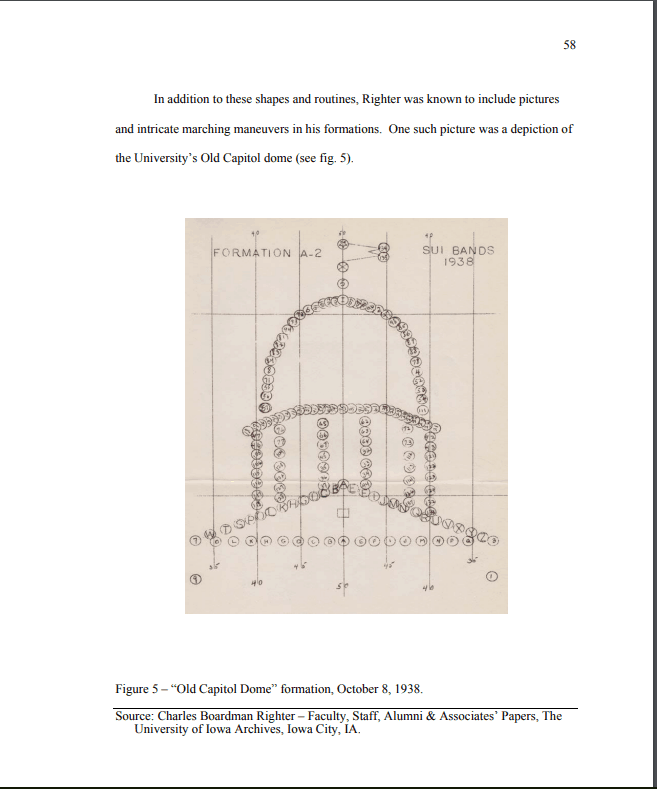
“On Iowa” was a great song for the band, it’s rare nowadays to find Hawkeye fans who also know the words, which are more in the mold of an alma mater than a football cheer. Perhaps that’s how “The Iowa Corn Song” wormed its way into the vernacular, much to the chagrin of the Hawkeyes. “The Iowa Corn Song,” written by the director of the Des Moines Shriner’s Band and premiered in 1921, was often played as Iowa’s fight song by opposing bands, despite repeated requests by HMB director Charles. B. Righter (1937-1953) for rival schools to not perform the song (see below). It was also played locally for university parties, to which The Daily Iowan commented in 1930, “…’On Wisconsin’ is played to represent Wisconsin, ‘Notre Dame Victory March’ for Notre Dame, ‘Go You, Northwestern’ for Northwestern. Why not ‘On Iowa’ to represent the University of Iowa? The use of the the ‘Iowa Corn Song’ to represent this institution is no more correct than ‘The Star-Spangled Banner’ for Annapolis or West Point.”6
“The Iowa Corn Song as played by Za-Ga-Zig Temple Band.” Des Moines, IA, 1921. Rita Benton Music Library Vertical Files, “Iowa Songs.”“DO NOT EVER PLAY THE IOWA “CORN SONG” on a University of Iowa Program” “Survey, Official College and University Songs,” ca. 1952. Rita Benton Music Library Vertical Files, “Iowa Songs.”
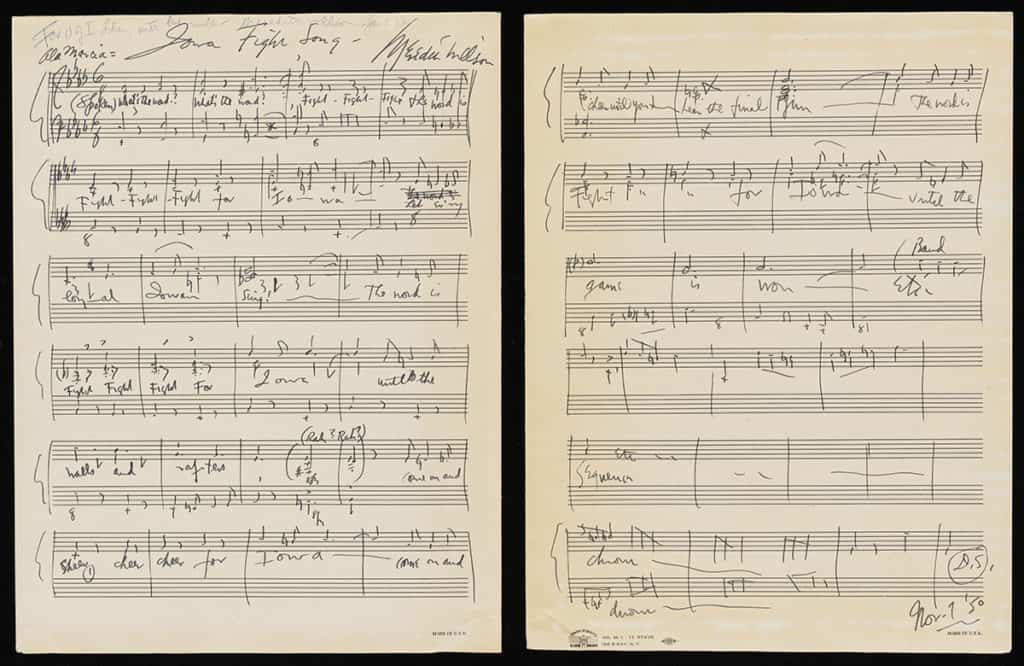
The discontent continued into the 1940s, and so local arts reviewer Les Zacheis suggested that Iowan Meredith Willson should attempt to pen a “better rouser than the rickety-tickety tune that fate wished on them.” When Willson composed “The Iowa Fight Song” in 1950, he was still six years from the premiere of his smash hit Broadway show The Music Man and had only a modest resume as a composer. No request could he deny his fellow Iowans, so he jotted off a tune with the note, “I hope the Iowa boys will like it. If not, I’ll try again.” Fans found the music rousing and the words easy to recall, and the UI had its second fight song.
Note in the manuscript, page 1, fifth line that Willson’s not quite sure what fans should shout after “halls and rafters ring.” He tentatively pencils in “Rah? Rah?” but early stadium performances used “Hoorah, Hoorah!” A 1962 DI article prints the lyrics as “Rah, Rah!” but today’s cheer, of course, is “GO HAWKS!” – Meredith Willson Papers, University of Iowa Special Collections, MsC0731, Box 1.
“The Iowa Fight Song” supplied the school with both a vibrant tune and lyrics that reflected the plucky, stick-to-it attitude of the Hawkeye State, reflected in the closing text, “…until the game is won.” However, even as late as 1958 the debate still raged over fight songs, as can be seen in Robert Claus’s letter to the editor in the Daily Iowan.
There are two kinds of people that personally gripe me to no end. One is the loud-mouthed but tight-fisted, nickle-nursing senior citizen who has refused to support the university, financially and morally—but who now blames the educational crisis on “good football”. This “citizen”…would not support the university when it had poor football, nor will he support it now that it has good football.
The second kind of person is the one who wants to ride to glory on a good football team and university band. He wants the Corn Song played everywhere the team and band go…sing the Corn Song…this solves all problems. His contribution to education and the state is to stand and sing this musical monstrosity.
I suggest that these two kinds of people shut up and get out of the way. And if we wish to be as proud of a piece of music that represents the state, as we are proud of our good teams and band, let’s sing the acknowledged “Music Man” Meredith Willson’s “Iowa” in the Rose Bowl and at home.
“Corn Song Citizens,” the Daily Iowan, November 25, 1958, p. 2. 7
Today, “The Iowa Fight Song” is the second song of pregame and is played when Iowa scores a field goal.
THE IOWA FIGHT SONG
Words and Music by Meredith Willson.

The word is "FIGHT, FIGHT, FIGHT for Iowa,"
Let ev'ry loyal Iowan sing.
The word is "FIGHT, FIGHT, FIGHT for Iowa,"
Until the walls and rafters ring (GO HAWKS!)
Come on and CHEER, CHEER, CHEER for Iowa.
Come on and cheer until you hear the final gun.
The word is "FIGHT, FIGHT, FIGHT for Iowa,
Until the game is won."
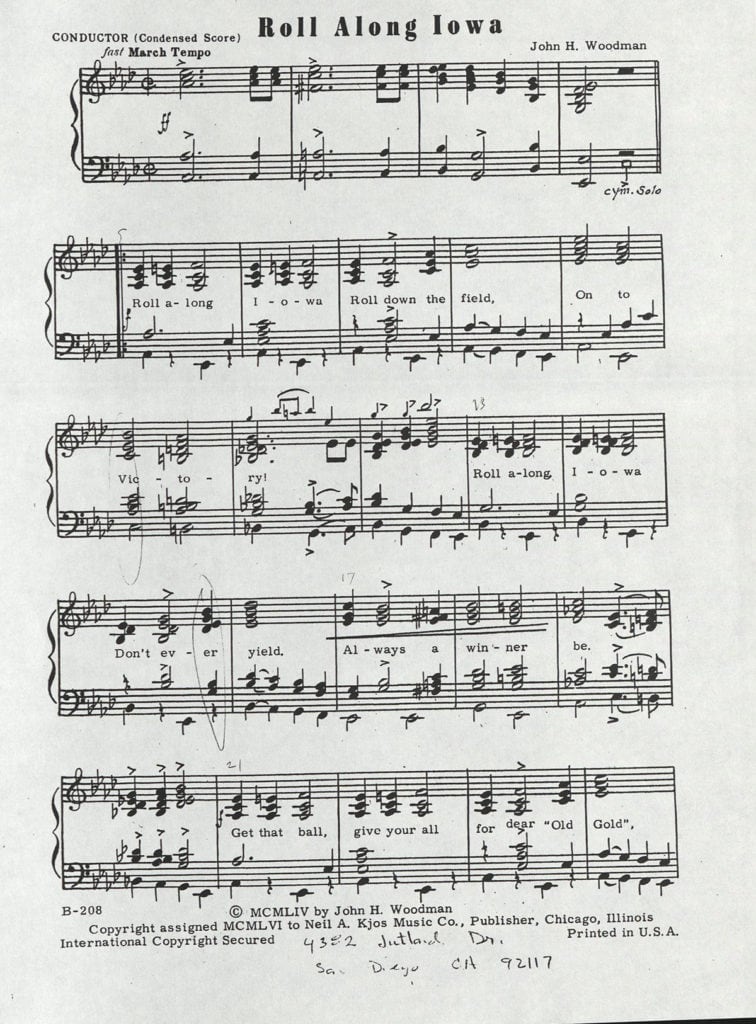
In 1954, Frederick Ebbs (1954–1966) became director of the Hawkeye Marching Band. His arrival coincided with an upswing in the fortunes of Iowa football under coach Forest Evashevski (1952–1960). The band traveled to the Rose Bowl in 1957 and 1959. Ebbs favored elaborate formations that made recognizable shapes, like hearts, animals, instruments, technology, and more. He also endorsed the addition of a third fight song to Iowa’s repertory in his first year, “Roll Along, Iowa,” by John Woodman (Commerce, 1921). Ebbs touted the new song, saying it was “rhythmically simpler than any of the other songs that we have. It was composed in ‘cut-time,’ a musical device which speeds up the tempo and makes it possible for a person to hear it only once and walk away whistling the tune.” Ebbs also pointed out that most college fight songs were composed in cut-time, which lends credence to the rumor that “Roll Along, Iowa” may have been an attempt for the school to have a tune more like University of Michigan’s “The Victors.” 8
The song premiered at halftime on Sept. 25, 1954, when no. 12 Iowa played no. 7 Michigan State, happily defeating the Spartans 14-10.9 The band performed a show titled “Story of Four Hats,” featuring a freshman beanie, mortar board, football helmet, and crown. “Roll Along, Iowa” was played at the conclusion of the show to the IOWA pennant formation. While there appears to be little written reception to the song following its introduction, it has remained part of the Iowa canon ever since.
Freshman BeanieMortar BoardFootball HelmetCrownFormations for Sept. 25, 1954 halftime show, preceding the premiere performance of “Roll Along, Iowa.” Hawkeye Marching Band Records, University Archives, RG RG06.0024.006, Box 1.
Today, “Roll Along, Iowa” is the third song of pregame, and is played in a longer version as a stand tune periodically throughout the game.
ROLL ALONG, IOWA
Words and Music by John H. Woodman (Commerce, 1921)

Roll along, Iowa
Roll down the field
On to victory!

Roll along, Iowa
Don't ever yield
Always a winner be.

Get that ball
Give your all
for dear "Old Gold"
Raise her banner high.

With firm endeavor
Roll on forever
S-U-I.
Not much information exists about the genesis of “Alma Mater, Iowa,” the last of the Iowa songs on this list. Engineering alumnus Gene Russell Mills (1922–2007) wrote the words in 1947 and the music in 1960, and it appears on the song list for events on campus shortly afterwards. 10 Beneath the title on this photocopy of a four-part harmony arrangement of the “Alma Mater” is the dedication “for the SUI Alumni Association,” but beyond that no hints as to why Mills wrote the song or how it was adopted into Hawkeye life. Today, “Alma Mater, Iowa” is sung by members of the Marching Band in the tunnel before entering the stadium and in the stands at the conclusion of the game. It’s also sung the Thursday of Band Camp at sunset, which you can witness in the video below from the 2024 Camp, featuring a glorious late summer Iowa backdrop.
First page of “Alma Mater, Iowa,” words and music by Gene Mills. Hawkeye Marching Band Records, University of Iowa, RG RG06.0024.006, Box 11.
ALMA MATER, IOWA
Words and Music by Gene Mills (Engineering, 1947)

Come all alums of Iowa,
and blend your voices true;
Sing praises to our Alma Mater,
as good Hawkeyes do.

Let's keep within our hearts a fire
 to magnify her fame;
Bring credit to these noble halls
 where glory and honor reign.

The day is near when comrades here
 will bid farewell and part;
But each Hawkeye carries on,
thy spirit in his heart.

Oh!
Iowa, Iowa, we drink a toast to you;
We pledge our everlasting love
for dear old Iowa U.

Alma Mater, Iowa.
Posters from the archives of Feed Me Weird Things (2017-present) have taken over the outer windows of the Rita Benton Music Library, a welcome and colorful distraction from winter’s untimely return this week. These posters, the work of Dylan Marcus McConnell, showcase just a fraction of the 70+ artists that have been programmed on the series and encompass a wide aesthetic variety of music and performance types: avant-classical, noise, Americana, drone, free improvisation, new-age, folk, jazz, poetry, field recordings, electronics … there’s something there for everyone.
Feed Me Weird Things, which is described on its website as “an Iowa City listening series focused on rare and esoteric musics meant to arouse empathy from deep listening,” was founded by local musician and curator Chris Wiersema, who passed away unexpectedly but peacefully a few weeks ago. One may recognize Chris’ name from some of the other community music projects he was involved in. These include Mission Creek Festival, of which he was producer and programming director; Witching Hour, “dedicated to exploring the unknown, discussing the creative process, and presenting new work”; and most recently FEaST, a fall-time festival that allowed concertgoers to “commune in our shared love of strange and beautiful music “as the threat of ‘All I Want For Xmas is You’ looms large on the horizon.”
The artists that Feed Me Weird Things brought through town gave intriguing, meaningful, deeply beautiful, and downright strange performances (sometimes all at once). Chris supported local musicians by booking them as openers for each visiting artist, and he promoted them all with equal amounts of enthusiasm and confidence. Performers and audience members alike will always be grateful for what Chris did for the avant-garde music scene in Iowa City.
You can hear the work of the local and visiting artists by clicking on some of the links below, by looking at the “Past Artists” section on the FMWT website, or by stopping by the display and using the QR codes near each poster. Thank you for taking the time to read, to look, to listen, and to share in the vision of Chris Wiersema and Feed Me Weird Things.
A public memorial for Chris will take place from 2 to 5 p.m. on Sunday, April 7, at the Englert Theatre in Iowa City. You can read more about Chris’ work and life here.
The scheduled spring season of Feed Me Weird Things will continue; all show updates can be found at Trumpet Blossom Café’s Instagram page.
The posters of FEED ME WEIRD THINGS: an exhibit in honor of FWMT founder Chris Wiersema (1980-2024) was curated and installed by Christine Burke, Library Assistant IV at the Rita Benton Music Library.
Chamber music has been integral to the educational and creative life of the University of Iowa School of Music for over a century. Below are a few examples, including audio clips, from 1972 to the present that allow you to experience this delightful form of music making – whether you were there to hear it in performance or not.
Iowa String Quartet / Stradivari String Quartet
Founded in 1936, the Iowa String Quartet / Stradivari String Quartet included faculty performers Allen Ohmes, John Ferrell, Don Haines (violin), Bill Preucil (viola), Joel Krosnick, and Charles Wendt (cello).
Audio excerpt: Quartet in Eb Major, K. 428 / Wolfgang Amadeus Mozart
The Stradivari Quartet performed a cycle of ten Mozart string quartets during the inauguration of the new Music Building when it opened in 1972. This work launched the series, which took three recitals to complete.
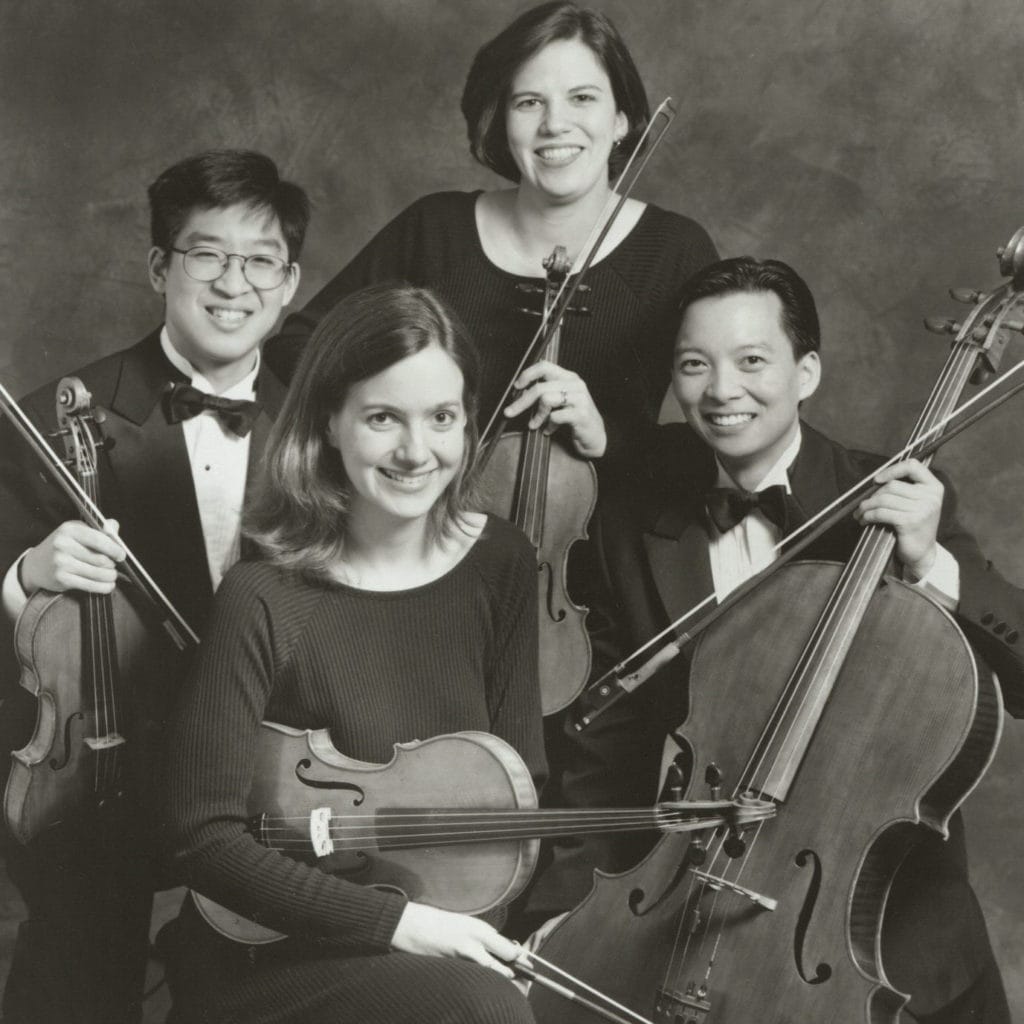
Maia Quartet
The Maia Quartet came to the University of Iowa as Quartet in Residence in 1998 and stayed for thirteen years. Violist Beth Oakes became director of the University of Iowa String Quartet Residency Program, bringing nationally renowned ensembles to Iowa City to work with students and delight audiences.
Audio excerpt: Concerto in A minor for String Quartet, op. 131 / Louis Spohr
Following the 2008 flood of the Iowa River, the School of Music scrambled to find performance venues for the Fall semester. The Chamber Orchestra landed in MacBride Hall Auditorium in November for a double bill of Haydn’s Symphony in Eb Major, No. 103 “Drum Roll” and this three movement concerto for string quartet by Spohr – listen to the Allegro moderato opening movement below.
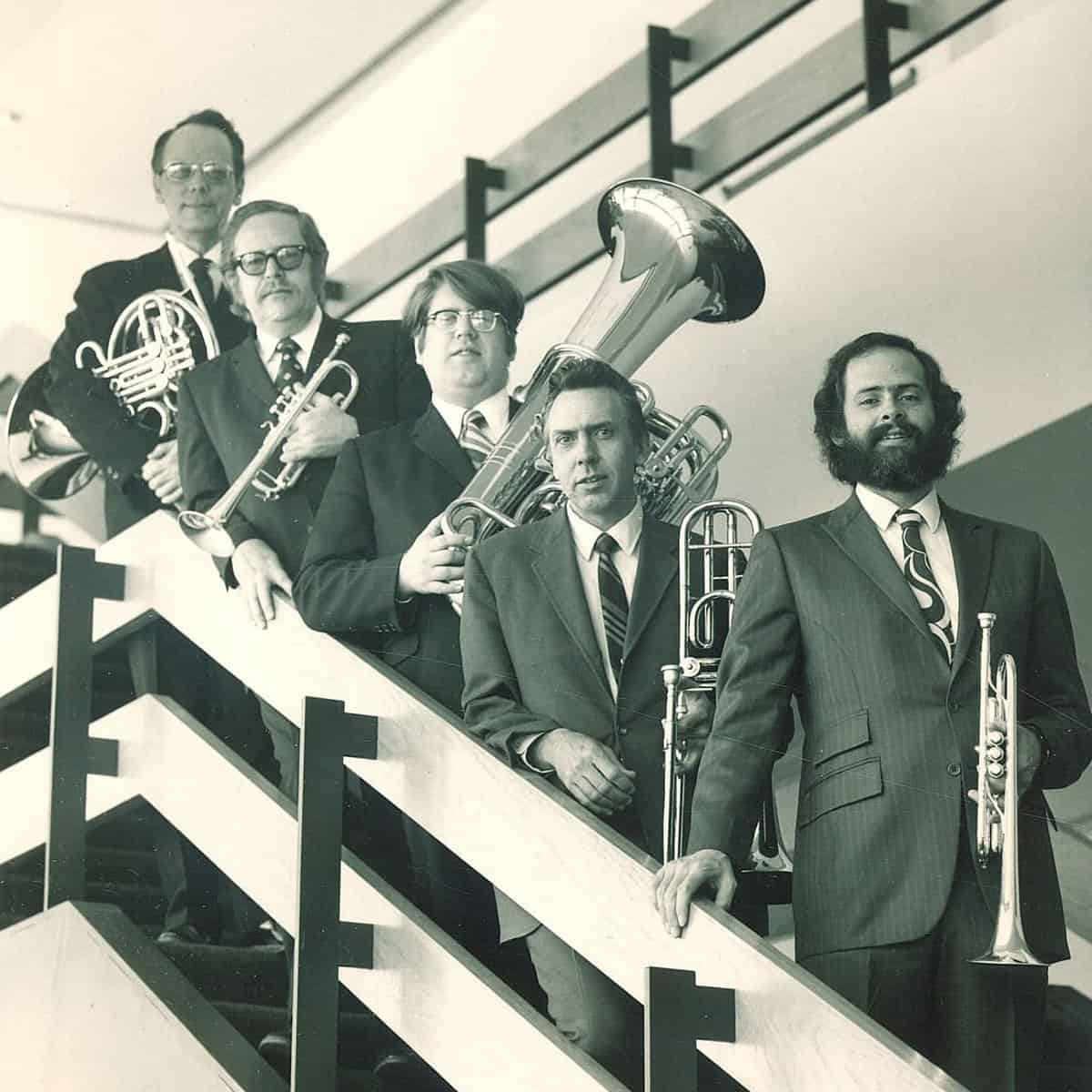
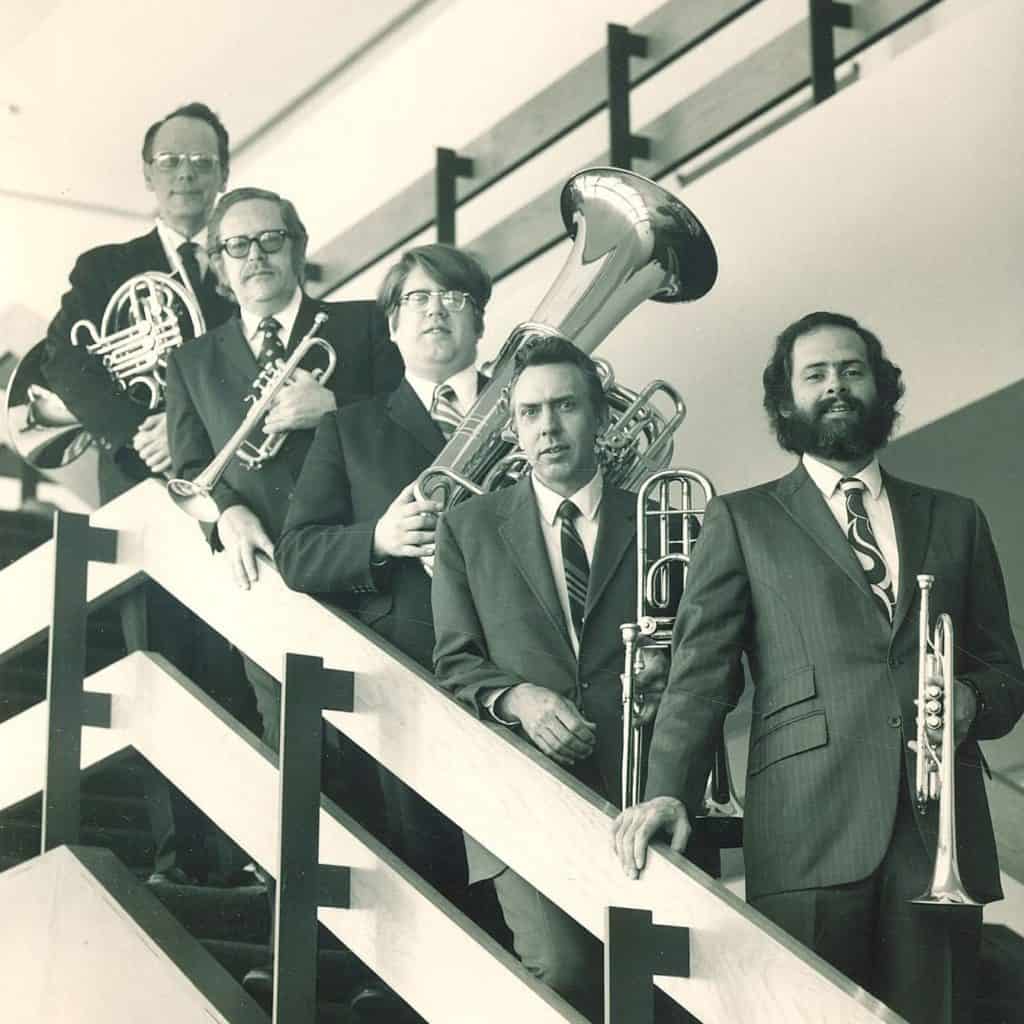
Iowa Brass Quintet
The Iowa Brass Quintet has been providing an aural counterpart to faculty and resident string ensembles since 1963. Members have included faculty musicians Paul Anderson, Kristen Thelander, and Jeff Agrell (horn); John Beer, David Greenhoe, and Amy Schendel (Trumpet); John Hill, George Krem, and David Gier (trombone); Robert Yeats and John Manning (tuba), along with a variety of graduate students and local brass players stepping in on second trumpet to complete the ensemble.
Audio excerpt: Quartet No. 2, op. 29 / Wilhelm Ramsøe
This work rounded out a recital in 2014 when the ensemble included Amy Schendel and Laura Saylor (trumpet); Jeff Agrell (horn); Dave Gier and Jonathan Allen (trombone); and John Manning (tuba). This is a rather early brass quintet, and one of five composed by Ramsøe, who was himself a violist. This movement is the Minuetto.
Iowa Woodwind Quintet
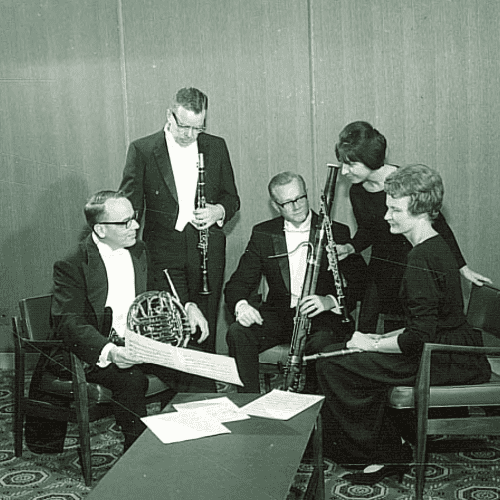
The Iowa Woodwind Quintet officially launched in 1964, though like the brass quintet, faculty quintet playing preceded a formal ensemble. Long-time members included Betty Bang Mather, Tamara Thweatt, and Nicole Esposito (flute); James Lakin, Mark Weiger, and Andy Parker (oboe); Thomas Ayres and Maurita Murphy Mead (clarinet); Paul Anderson, Kristin Thelander, and Jeffrey Agrell (horn); Ronald Tyree and Benjamin Coelho (bassoon).
Audio excerpt: Suite for Winds No. 1, Op. 57 / Charles Lefebvre
A popular work for woodwind quintet, this recording of the Suite for Winds by Lefebrve was performed on a 1991 recital featuring Betty Bang Mather (flute), Mark Weiger (oboe), Maurita Murphy Mead (clarinet), Ronald Tyree (bassoon), and Kristin Thelander (horn).
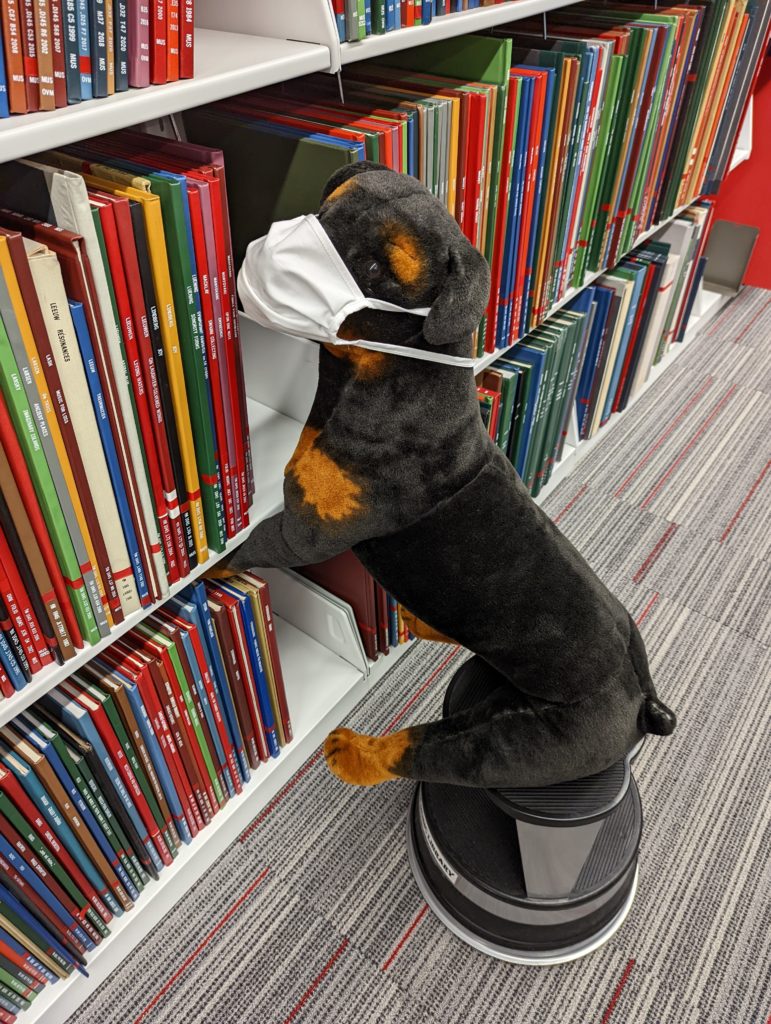
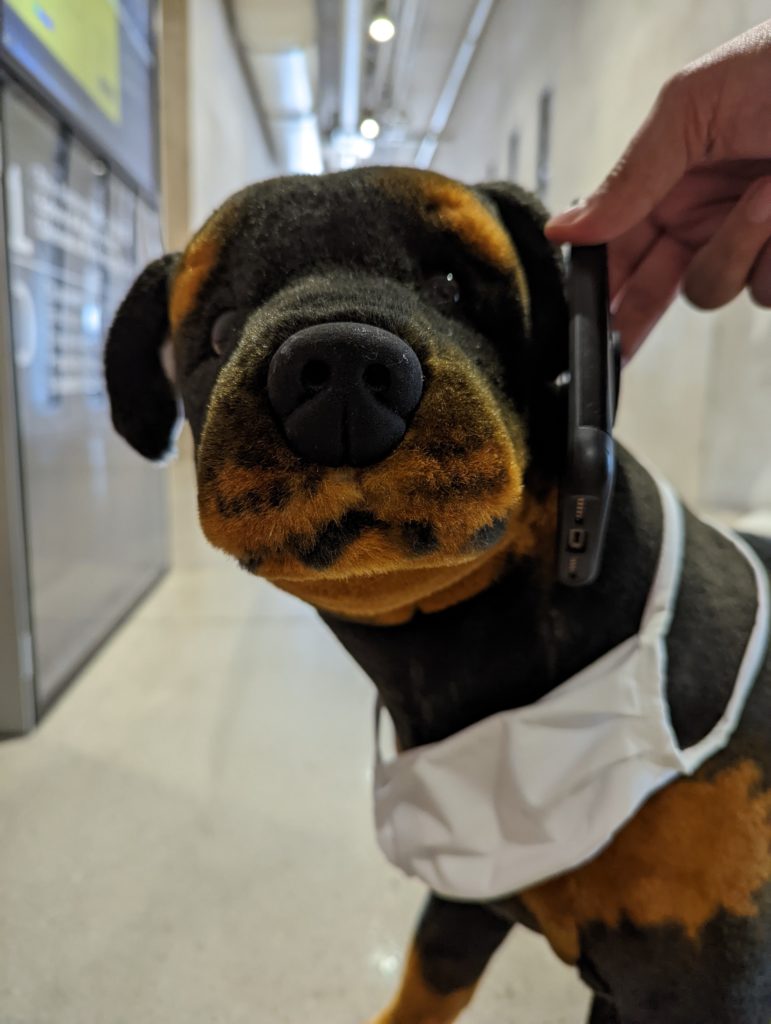
The Rita Benton Music Library is excited to have students and faculty return to campus to use the scores, books, recordings, journals, and other resources available in our stacks. It can be tricky to navigate the Music Library for the first…or twentieth…time, so every year our resident mascot Wulfie Parsons writes up his favorite tips and tricks so patrons can have the best experience possible when using the library.
Go for a walk in the stacks.
Wulfie likes to go for a stroll throughout the library. It reminds him where things are located, he likes to look at the covers of the new magazine issues by the west window, and he always takes a moment to howl under the Chihuly sculpture by the south window.
Taking a walk through the stacks can help you figure for where the scores are located, how to find biographies of your favorite composer or performer in the books, and a chance to try out the push-button compact shelving at the very back of the library. Don’t worry, the shelves can’t close on you while browsing the collection, though we can’t comment on if that’s why Wulfie has such a short tail. 🙁
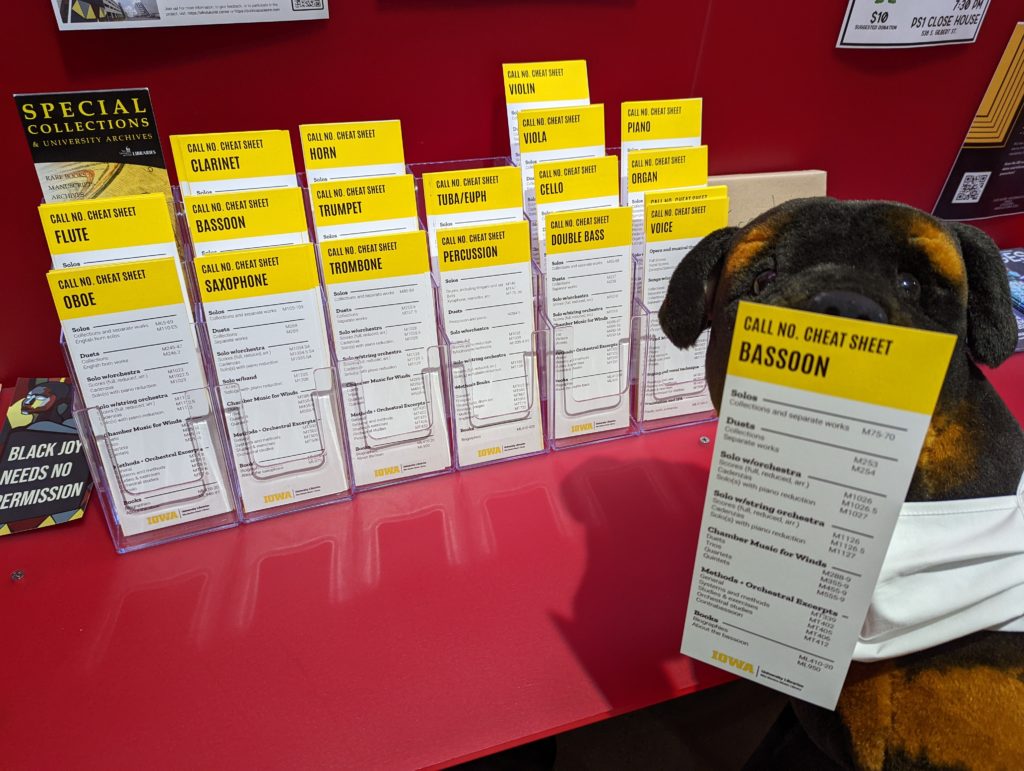
Grab a Call Number Cheat Sheet.
Whatever your voice or instrument, the Music Library has a short cheat sheet of call numbers to help you browse in the stacks. For example, if you’re a trombone player, it will show you that Solos are in M90-94 while Methods Books are in MT 460-472.
The Cheat Sheets are available in the Lobby area of the Music Library, just to your right after entering. You can also find them on the multiple voice and instrument guides on the Music Library’s website. Strings | Woodwinds | Brass | Percussion | Piano and Organ (coming soon) | Voice
Lost? Ask for help!
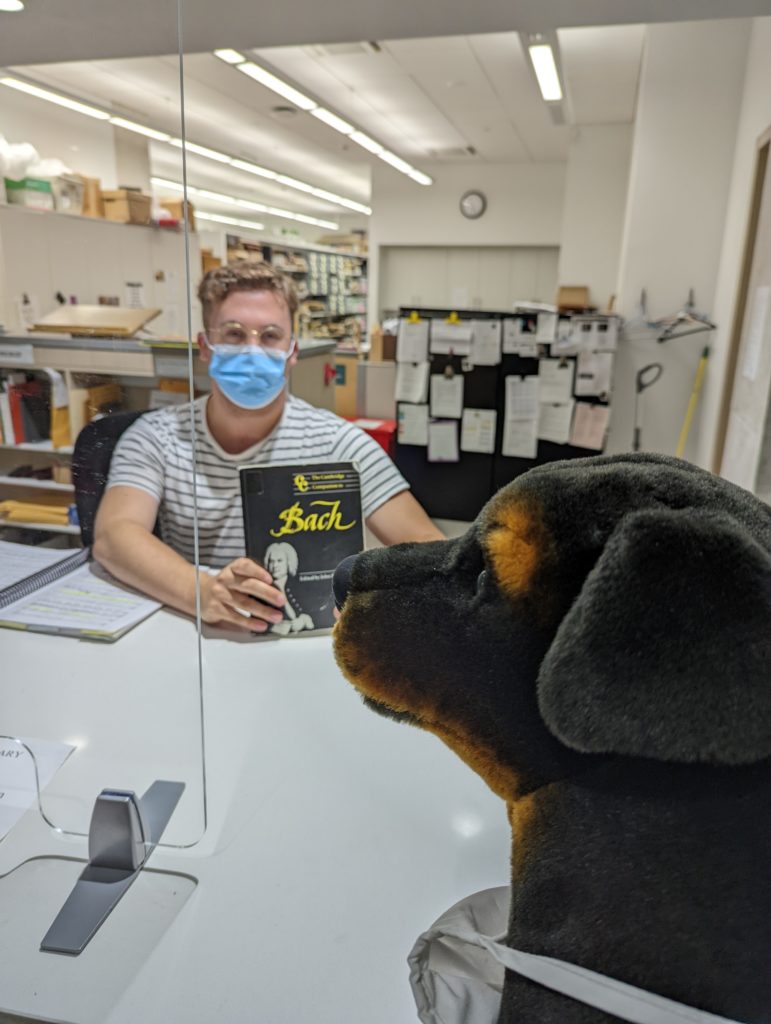
Even a stroll through the stacks won’t unlock all the Music Library’s secrets. Sometimes, you might need help finding a score or have questions about accessing a library database, or want recommendations of where to look for books on a topic or scores for a certain ensemble. The friendly student workers and full-time staff at the Music Library are here to help, so head over to the Service Desk and ask for assistance. If you need help with your research and would like to talk to our Music Librarian, Katie Buehner, you can schedule a time to meet with her on Zoom or in person, or you can email her your questions.
Take that phone call in the hall.
Please do not hold Zoom and other video or audio phone calls in the Music Library. The Library is one of the few quiet spaces in Voxman, and students seem to prefer it that way. If you need to hold a video or audio phone call, there are many other spaces in Voxman that are less disruptive to others and their studies.
If you are studying in the Music Library and receive a call, please step into the hallway to answer it.
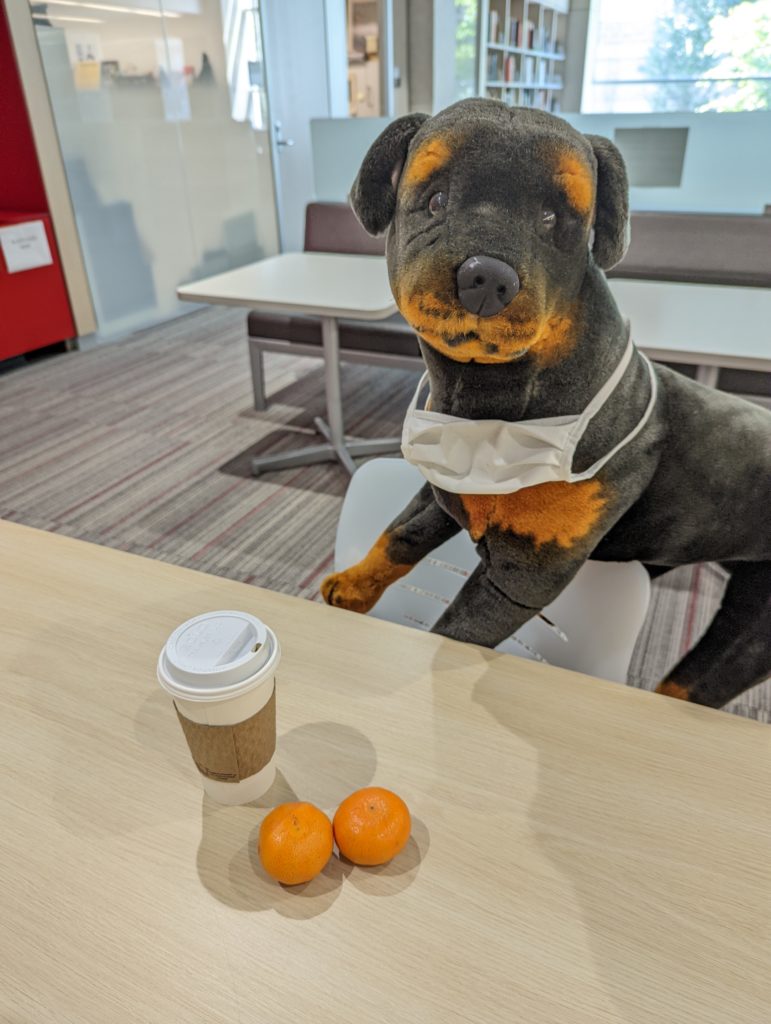
Treats, not meals.
Wulfie’s a big fan of treats, like biscuits and pig’s ears. But he saves messy things, like wet food, for eating outside of the Music Library. Please feel free to bring snacks, like granola bars or a cup of coffee (with a lid), into the Music Library, but please eat meals, like Panchero’s burritos or pizza in the Student Lounge one floor below. There are trash and recycling bins located at the library entrance and near the printers where you can dispose of empty containers and other food-related debris. And you can always bring Wulfie a treat, he’s particularly fond of chicken bits.
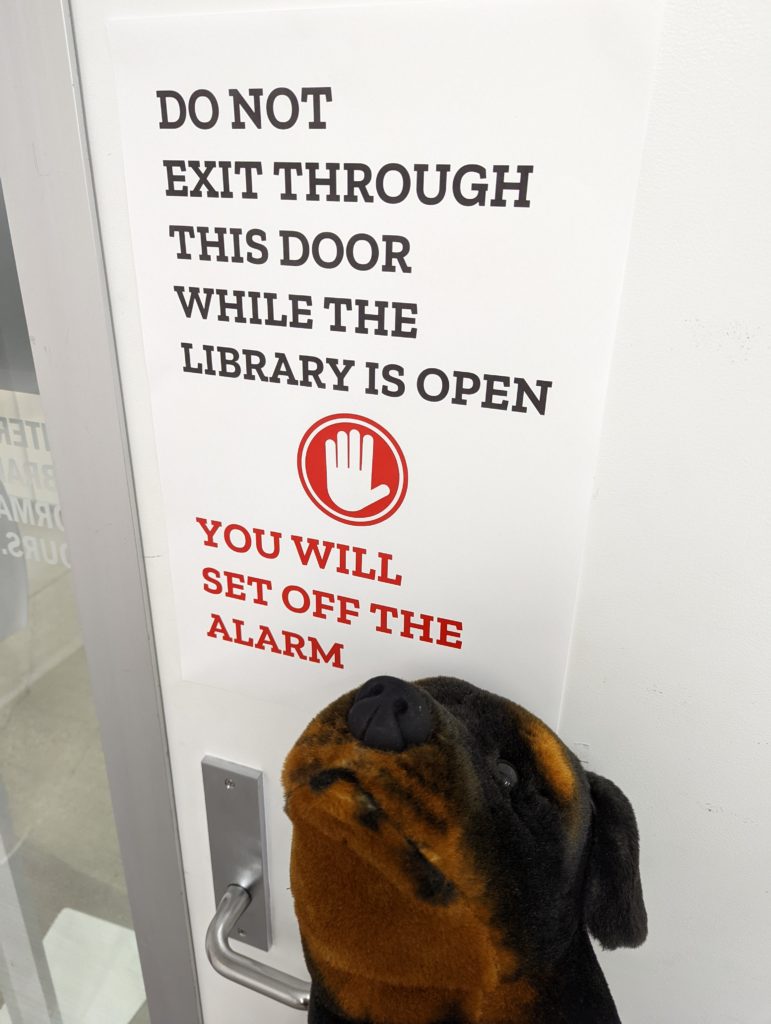
Don’t be alarmed by the Computer Lab.
If the Library is open, please enter the adjacent Computer Lab THROUGH THE LIBRARY. If you try to enter or exit from the hallway, a very loud alarm will sound. When the Library is closed, you can swipe into the Computer Lab from the Hallway using your Iowa One Card.If you accidentally trigger the alarm, library staff can turn it off.
We usually don’t need to be told, it’s loud enough that we’ll come running…while Wulfie howls along.
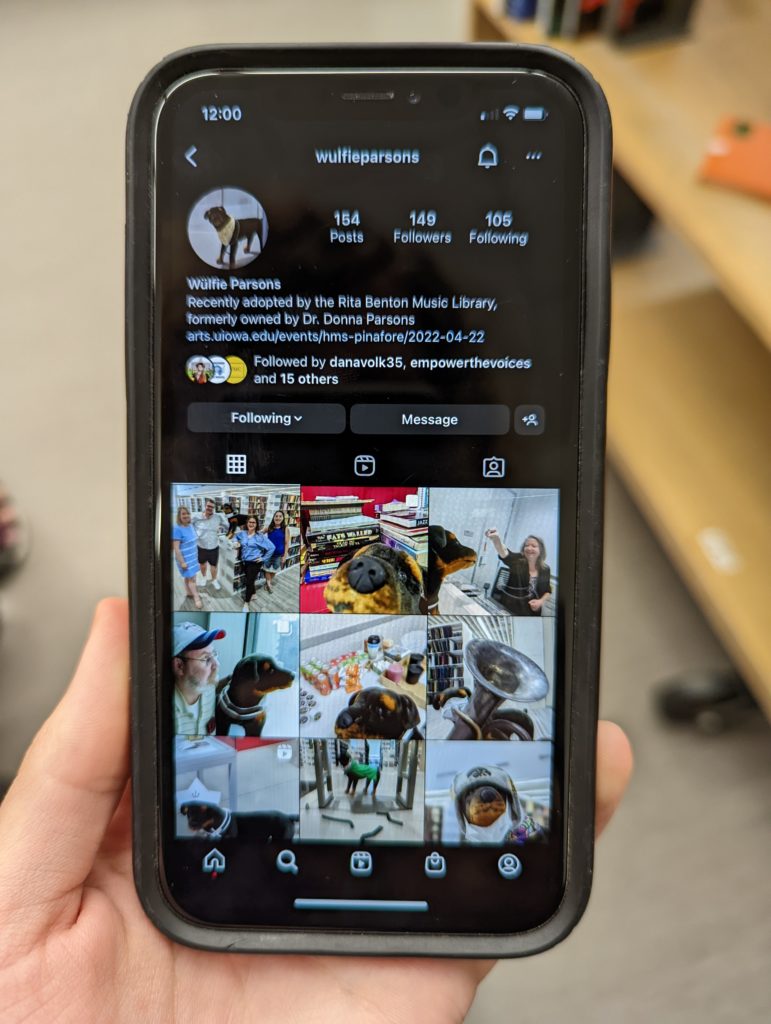
Check out – or help us populate – Wulfie’s Instagram!
Wulfie likes to share his library adventures with friends online, and you can find his feed @wulfieparsons on Instagram. If you take a selfie with Wulfie, tag him! And he always appreciates a scritch between the ears, it can be good luck before a test or a jury.
Filip Šír, coordinator for Digitization of Audio Documents at the National Museum (Prague), will talk of his work to track down and preserve early 20th century Czech sound recordings made in the United States. Ed. Jedlička cylinder recordings from the Music Library’s collections will also be exhibited. Filip’s book on this topic, co-authored with collector Gabriel Gossel and published in 2018, talks about a number of important Czech recording artists and producers, including Jedlička and Chicago-based Joseph Jiran.
If you’re interested in archives, historical sound recordings, immigrant cultures, or Czech history, be sure to attend!
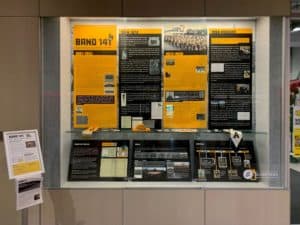
This Fall, come to the Voxman Music Building for BAND 141, a look at the Hawkeye Marching Band. Director Eric Bush donated a significant collection of materials from the Band’s history including photographs, drill charts, papers, scrapbooks, uniform pieces, audio and video recordings, and other memorabilia to the Rita Benton Music Library in 2020. The exhibit draws from these donated materials, as well as several other collections held in University Archives such as the UI Yearbooks, Charles B. Righter Papers, Scottish Highlander Records, and the Daily Iowan archives.
The exhibit opened September 3. Start your visit on the first floor by the School of Music offices where you can explore the band’s history through its thirteen directors, core song list, innovative formations, and wide ranging uniforms. The exhibit continues on the second floor alongside the Recital Hall, highlighting the Band’s drum majors, alumni, the Golden Girl, and Scottish Highlanders. And lastly, keep your eye online for certain exhibit pieces either on the HMB’s social media feeds or the Music Library’s website.
Discovering lost pieces of music in dusty archives is what most people think musicologists do. We only make the news if someone finds an unknown manuscript by a famous composer buried in a library. It’s true that the most rewarding part of my job is getting to hold centuries-old letters, scores, and concert programs in my hands and to imagine their earlier lives. But “dusty archives”? No, thanks to the Rita Benton Music Library’s digitization of rare scores, I made my biggest discovery on the internet: a volume of sonatas that may have belonged to the family of the novelist Jane Austen.
This story starts a few years back when George McTyre, a doctoral voice student, took me out for coffee. He had one more music history requirement, and he wanted me to offer an interesting class. By the time I’d finished my cappuccino, I’d agreed to teach “Music in the World of Jane Austen.” Designing the course was not exactly a challenge for me. I confess that I’m a “Janeite”—I’ve read all of Austen’s novels multiple times, have seen the movie adaptations, and own a plastic Austen action figure. I even have the voice of Mr. Darcy greeting callers on my cell phone.
In addition to being a writer, Austen was an amateur pianist who practiced every morning before breakfast. The music manuscripts she copied by hand survive, as do many published pieces that belonged to her and to other women in her family circle. These compositions became my class’s “textbook,” as students learned about music making in England during Austen’s lifetime. The Rita Benton Music Library owns many eighteenth-century scores similar to those the writer might have played. When we moved into the Voxman Music Building in 2016, I decided to offer a class based entirely on rare materials in the Library’s Arthur and Miriam Canter Rare Book Room. Featured prominently would be the extensive collection of historic scores by composer Ignaz Pleyel (1757-1831). The compositions of Pleyel, a contemporary of Franz Joseph Haydn, were popular throughout Europe. Rita Benton was the leading scholar of his music, and the Music Library’s Pleyel collection is unparalleled.
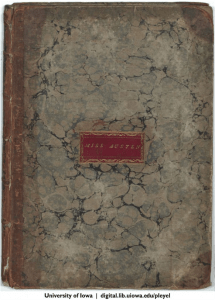
Late one night I was perusing the virtual Pleyel scores available online through the Iowa Digital Library. I found a set of six sonatas bound in a volume labeled “Miss Austen.” I emailed librarian Katie Buehner and joked about my “discovery.” But then I looked more closely. Iowa’s sonatas have penciled-in fingerings that resemble the fingerings in another copy of Pleyel’s sonatas, this one owned by Jane Austen’s sister-in-law, Elizabeth Knight. Here things get a little complicated. Elizabeth was the wife of Edward Austen. Edward had been adopted by the wealthy Knights, and he later changed his own family’s name when he received his inheritance. Thus his wife was “Mrs. Austen” or “Mrs. Knight,” never “Miss Austen,” so it’s not clear that Iowa’s Pleyel sonatas could have belonged to her. Another possible owner of the sonatas is Elizabeth’s daughter, Fanny Austen, Jane’s favorite niece, who played the piano very well. Of course, one cannot help but wonder if the volume ever found its way to Jane’s sister, Miss Cassandra Austen or to Jane herself.
I’ve explored the possibilities for the provenance of Iowa’s Pleyel Sonatas in an article for Fontes artis musicae, the journal of the International Association of Music Libraries. I wish I could say I have positive proof that an Austen performed from this particular score. Unfortunately, the complete origins of the “Miss Austen” volume remain a mystery. Still, we can imagine that while taking a break from working on Pride and Prejudice or Emma, Jane Austen enjoyed a rendition of a Pleyel Sonata performed by her talented niece or sat down at the pianoforte and played from the score herself.
About the Author
Marian Wilson Kimber is Professor of Musicology in the School of Music. She has published numerous articles about Felix Mendelssohn, Fanny Mendelssohn Hensel and spoken recitation in concert life. Her book, The Elocutionists: Women, Music, and the Spoken Word (University of Illinois Press, 2017) won the H. Earle Johnson Subvention from the Society for American Music. Wilson Kimber is a founding member of the duo, Red Vespa, which performs comic spoken word pieces by women composers.