Open ’til Midnight FINAL WEEK HOURS
Sun, May 11: 2pm—Midnight Mon, May 12 —Thursday, May 15: 8:30 am–Midnight
Friday, May 16: 8:30 am — 5 pm
May 17 & 18: CLOSED
Open ’til Midnight FINAL WEEK HOURS
Sun, May 11: 2pm—Midnight Mon, May 12 —Thursday, May 15: 8:30 am–Midnight
Friday, May 16: 8:30 am — 5 pm
May 17 & 18: CLOSED

Happy Earth Day! Today, April 22, Earth Day celebrations are occurring throughout the United States as well as around the world. This year’s theme, Green Cities, focuses on sustainable communities. Denis Hayes was the first coordinator of Earth Day, an environmental “teach-in” held on April 22, 1970. In the first Earth Day participants from two thousand colleges and universities, roughly ten thousand primary and secondary schools, and hundreds of communities across the United States “brought 20 million Americans out into the spring sunshine for peaceful demonstrations in favor of environmental reform.” He founded the Earth Day Network in Washington, DC and expanded it to 192 countries. Time Magazine named him “Hero of the planet” in 1999. His mentor, former US Senator from Wisconsin, Gaylord Nelson, originated the idea 44 years ago, in 1970, to promote and support responsible protection of our environment, the Earth. Gaylord Nelson hired Denis Hayes, a student attending the Kennedy School of Government at Harvard University to organize the first Earth Day. In 1995, Nelson was awarded the Presidential Medal of Freedom in recognition of his work.
The first to propose an international day to honor the Earth was peace activist John McConnell. His vision, formed at a UNESCO conference on the environment in 1969, included a celebration to be held on the first day of spring in the Northern Hemisphere: March 21, McConnell’s proposal led to a proclamation signed by Secretary General U Thant at the United Nations in 1971, initiating an annual Earth Day on April 22nd. McConnell later founded the Earth Society in 1976 with anthropologist Margaret Mead.
Sources:
April 22 Is Earth Day: What it Means, (2014) from http://usparks.about.com/od/conservationpreservation/a/earth_day.htm
Brosnan, Kathleen A. Encyclopedia of American Environmental History Volume II. New York: Facts on File, Inc. An imprint of Infobase Publishing, 2011. Engineering Library Folio GE 150 .E53 2011 V.2 http://infohawk.uiowa.edu/F/?func=find-b&find_code=SYS&local_base=UIOWA&request=005765304
Earth Day Extravaganza Sheds Its Humble Roots (April 22, 1990) from http://www.nytimes.com/1990/04/22/us/earth-day-extravaganza-sheds-its-humble-roots.html?scp=2&sq=%22earth+day%22&st=nyt
Earth Day History: The History of Earth Day (2014) from http://environment.about.com/od/environmentalevents/a/twoearthdays.htm
Gorman, Hugh S. The Story of N: A Social History of the Nitrogen Cycle and the Challenge of Sustainability. N.J. : Rutgers University Press, 2013. Engineering Library TD196.N55 G67 2013. http://infohawk.uiowa.edu/F/?func=find-b&find_code=SYS&local_base=UIOWA&request=007232308
Khale, Lynn R, and Eda Gurel-Atay, editors. Communicating Sustainability for the Green Economy. New York: M.E. Sharpe, 2014. Engineering Library HC79. E5.C61236 2014. http://infohawk.uiowa.edu/F/?func=find-b&find_code=SYS&local_base=UIOWA&request=007444474
Taback, H.J. Environmental Ethics and Sustainability: A Casebook for Environmental Professionals. Florida, Boca Raton: CRC Press 2014. Engineering Library GE42. T33 2014. http://infohawk.uiowa.edu/F/?func=find-b&find_code=SYS&local_base=UIOWA&request=007366984
United Nations Framework Convention on Climate Change, (2014) from https://unfccc.int/2860.php
Who Invented Earth Day? ( 2014) from http://environment.about.com/od/earthday/f/who-invented-earth-day.htm
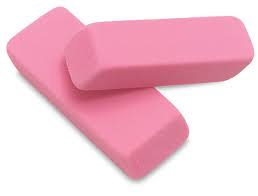
April 15th is National Rubber Eraser Day!
When celebrating the invention of the eraser, the names and stories of several European scientists intertwine: Frenchman Charles Marie de la Condamine, Portuguese Jean Hyacinthe de Magellan, and Englishmen Edward Nairne and Joseph Priestley are collectively responsible for its discovery and use.
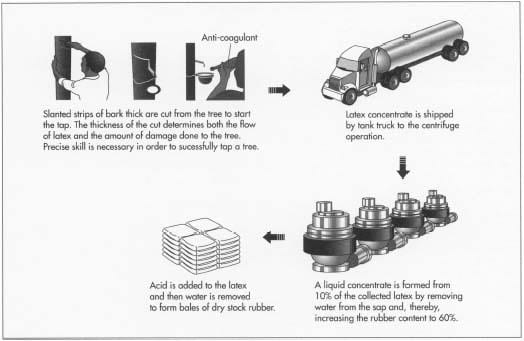
Condamine was sent to South America in 1735 by the French Academy of Science to calculate the diameter of the Earth at the equator. In his travels through Peru, Ecuador, and Brazil, he was fascinated by caoutchouc, a milky white elastic substance produced under the bark of a tropical tree. He returned with samples in 1745. By 1752, Jean Hyacinthe de Magellan, a Portuguese scientist who corresponded with internationally known scientists of his day, is thought to have been the person responsible for suggesting that caoutchouc be used as an eraser in the Proceedings of the French Academy. Until that time, pieces of bread had been used to eliminate marks on paper. According to Inventors and Inventions, Sir John Priestly noted the erasing properties of vegetable gum: “I have seen a substance excellently adapted to the purpose of wiping from paper the mark of black pencil lead.” By 1778, Priestley suggested that caoutchouc be called “rubber” for its properties. A decade later, by 1790, the word “eraser” was in use and referred to the object used to remove pencil marks.
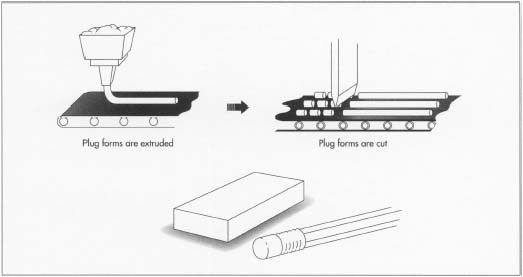
In 1839, American Charles Goodyear developed and patented a process to keep the rubber material from rotting. The process, vulcanization which is named after the Roman god of fire, cured and stabilized the rubber. Today, erasers are made from synthetic rubber or vinyl. The engineering and production process involved can be seen in a short You Tube video by the Staedtler Corporation http://youtu.be/FocX6Fews6k or in the article Eraser: Raw Materials and Manufacturing Process are described in detail at a site called: http://www.madehow.com/Volume-5/Eraser.html
Sources:
Hyacinthe Magellan (2014) retrieved from http://www.amphilsoc.org/exhibits/magellan/magellan.htm
Innovateus, Edward Nairne (2006-2013) retrieved from http://www.innovateus.net/inventor/edward-nairne
Online Etymology Dictionary (2001-2014) retrieved from http://etymonline.com/index.php?allowed_in_frame=0&search=eraser&searchmode=none
Colonel Percy Harrison Fawcett, Charles Marie De La Condamine (1999) http://www.phfawcettsweb.org/condam.htm
Patents:
Combination of Lead-pencil and eraser (US 19783A) https://www.google.com/patents/US19783?dq=eraser&hl=en&sa=X&ei=_GVNU4qLL4KE2wXRhIHQAg&ved=0CDUQ6AEwAA
April 16th – Keeping up with Your Research: Alerts and Notifications
Learn to set up alerts and notifications on some of your favorite databases and library resources so that you can keep up to date on the latest information in your area of research. Taught by Kari Kozak (Head, Lichtenberger Engineering Library).
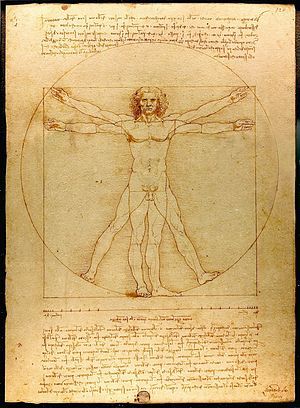
Come see the exhibit on Leonardo da Vinci: The Engineer at the Lichtenberger Engineering Library. The exhibit includes models of some of his engineering feats: a catapult and a multiple sling designed as war machines to hurl stones, a paddleboat and a great kite. Stop by and see pictures of his underwater breathing machine, a steam cannon, a gigantic crossbow and the Vitruvian man.
Included in the exhibit case are facsimiles from the University’s Special Collections of da Vinci’s original manuscripts printed from the collection of the Institute de France. Twelve manuscripts written between 1492 and 1516 were brought back to Italy by Francesco Melzi, his favorite pupil, after da Vinci’s death. These facsimiles feature over five thousand pages of drawings and notes in his characteristic “mirror-image” hand-writing, running from right. The sections on display in the case are those related to: the military art, optics, geometry, the flight of birds and hydraulics.
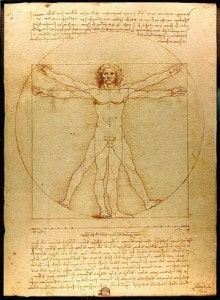
One of Da Vinci’s famous drawings is of the Vitruvian Man, a drawing created in 1490, is accompanied by notes based on the work of the architect Vitruvius and Book III of his treatise De Architectura. Vitruvius the architect described the human body with having ideal proportions. The drawing, pen and ink on paper, depicts a male figure in a square within a circle. The drawings sometimes referred to as the “Proportions of Man,” and named in honor of the architect Vitruvius, represent da Vinci’s blend of art and science. Encyclopaedia Brittanica online states that da Vinci “believed the workings of the human body to be an analogy for the workings of the universe.”
Those of you interested in hydraulics may know about Enzo Macagno. In 1960, Macagno became interested in studies of the history of fluid mechanics and the life of da Vinci. Along with his colleague and late wife, Matilde, Macagno became an international expert on da Vinci, publishing numerous articles and IIHR monographs on the interpretation, analysis, and synthesis of da Vinci’s codices and manuscripts as they relate to fluid-flow and transport phenomena. You will find more information in the exhibit case and two monographs from Special Collections on Macagno’s work.
This is just a sampling of what can be seen at the Lichtenberger Engineering Library’s Leonardo Da Vinci: The Engineer exhibit. Stop by to learn more!
References
Capra, Fritjof. The Science of Leonardo. New York: Doubleday,2007. Engineering Library Q143.L5 C37 2007 http://infohawk.uiowa.edu/F/?func=find-b&find_code=SYS&local_base=UIOWA&request=004251437
da Vinci, Leonardo, 1452-1519. Leonard da Vinci: scientist, inventor, Artist. Ostfildern-Ruit [Germany]: Verlage Gerd Hatje, 1997. Engineering Library N6923.L33 A4 1997 http://infohawk.uiowa.edu/F/?func=find-b&find_code=SYS&local_base=UIOWA&request=007162629
Kemp, Martin. Leonard Da Vinci Experience, Experiment and Design. Oxford: Princeton University Press, 2006. Art Oversize FOLIO N6923.L33 K449 2006. http://infohawk.uiowa.edu/F/?func=find-b&find_code=SYS&local_base=UIOWA&request=003637253
Laurenza, Domenico. Leonardo on Flight. Baltimore: The John Hopkins University press,2004. Engineering Library TL540.L4 L38 2007. http://infohawk.uiowa.edu/F/?func=find-b&find_code=SYS&local_base=UIOWA&request=004220622
Moon, Francis C.The Machines of Leonardo Da Vinci and Franz Reuleaux. New York: Springer, 2007. Engineering Library TJ 230 .M66 2007. http://infohawk.uiowa.edu/F/?func=find-b&find_code=SYS&local_base=UIOWA&request=004382572
Museo Nazionale Della Scienza E Della Technologia Leonardo Da Vinci.(2014).Retrieved from http://www.museoscienza.org/english/leonardo/manoscritti/
Engineering and basketball go together as we begin the Sweet 16 games in the NCAA tournament, but just how has engineering affected the game?
History

In 1891, at Springfield College, Massachusetts, Dr. James Naismith, a thirty-year old physical education instructor, was encouraged to create an indoor, winter “athletic distraction.” Using two vegetable baskets, a soccer ball, nine men per team, and a ladder to retrieve the ball from the basket, the game of basketball came into existence. He never entertained the notion of patenting his new game because it was for recreational fun. “Basketball is just a game to play. It doesn’t need a coach… you don’t coach basketball, you just play it.” Despite his comment, in 1900 he became the basketball coach for the Jayhawks at the University of Kansas.
Between 1892 and 1894, formal rules were devised, an inflated leather, albeit occasionally lopsided, ball was invented, backboards were designed so fans could not reach over and deflect the shots, and iron hoops and hammock-style enclosed baskets were introduced to the game. It was another decade before open-ended nets were used. On January 18, 1896, the first “experimental” college basketball game was played between the University of Iowa and the University of Chicago. The final score: Chicago 15, Iowa 12.
The Ball
In the 1930s a flurry of patents were filed suggesting that the game was becoming a viably commercial sport. However, the ball is considered the most important piece of equipment. The original basketball was patented in 1929 (see U.S. Patent 1,718,305). It was made of leather on the outside and butyl rubber on the inside. Zinc and cooper plates imprinted the label onto the ball. Today, the Wilson Sports Good Company is maker of the official NCA basketball, the Solution. The company’s patented composite-leather technology absorbs moisture and the pebbled-triangle design creates for better ball handling (see U.S. Patent 4,570,931).
The game of basketball continues to evolve with technology enhancements such as breakaway rims, vision replay, and performance shoes. If only Dr. Naismith could have foreseen the future of his fun “athletic distraction.”
References
The Physics of Basketball (Engineering Library QC26 .F66 2006)
Two Guys From Barnum, Iowa and How They Helped Save Basketball: A History of U.S. Patent 4,534,556 by Francis B. Francois (2008)
America’s Story from America’s Library
Top 5: Early Basketball Patents
Join us tomorrow Wednesday March 26th for a 15 minute class on using–Protein Database: 3-D Protein structures. The class will be held at 2:30 in the Engineering Library (2001C SC) http://goo.gl/N9eS1v
Taught by Chris Childs (Health Sciences Education and Outreach Librarian, Hardin Library for the Health Sciences)
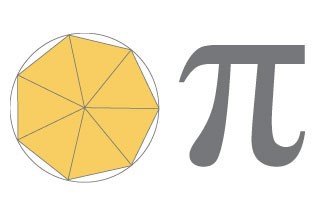
On March 14 at 1:59 pm we gather together to celebrate the most famous and mysterious of numbers. That Pi is defined as the ratio of the circumference of a circle to its diameter seems simple enough but Pi turns out to be an “irrational number.” Computer scientists have calculated billions of digits of pi, starting with 3.14159265358979323…, no recognizable pattern emerges in the digits. Scientists could continue calculating the next digit all the way to infinity and still have no idea which digit might emerge next. To these facts can be added that March 14 is also Einstein’s birthday.
Pi is a number that has fascinated scholars for 4,000 years. The mathematical history of pi comes from around the world. In 1900 B.C., the Babylonians calculated the area of the circle by taking 3 times the square of its radius. One Babylonian tablet (ca 1900-1680 B.C.) indicates a value of 3.125 for pi, which is a close approximation. Around 1650 B.C., the Rhind Papyrus, a famous document of the Egyptian Middle Kingdom, also calculated the area of a circle which gave the approximate value of 3.1605.
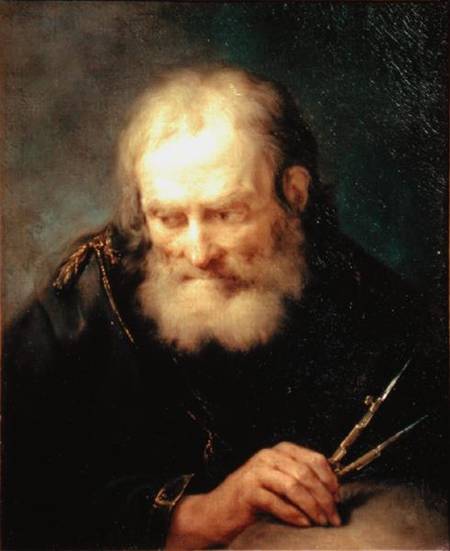
In 250 B.C., the Greek mathematician Archimedes calculated the circumference of a circle to its diameter. Archimedes value , was not only more accurate; it was the first theoretical rather than measured calculations of pi. Archimedes knew that he had not found the value of pi but only an approximation. He used a fairy simply geometrical approach for his calculations. See how he did it by launching the interactive model on this pbs.org site: http://www.pbs.org/wgbh/nova/physics/approximating-pi.html
Zu Chongzhi (429-501 AD?) was a Chinese mathematician and astronomer, who was not familiar with Archimedes method. He calculated the value of the ratio of the circumference of a circle to its diameter. Unfortunately, his book has been lost so very little is known of his work.
In 1761, a Swiss mathematician Johann Heinrich Lambert (1782-1777) proved the irrationality of pi. An irrational number is a number that cannot be made into a fraction where the decimal never ends or repeat sequences.
By 1882, F. Lindeman proved that pi was transcendental, that is, that pi is not the root of any algebraic equation with rational coefficients. This discovery proved that you can’t “square the circle” which was a problem that vexed many mathematicians up to that time. Another fascination for mathematicians throughout history was to calculate the digits of pi, but until computers, less than 1,000 digits had been calculated. With the calculations of the computer, millions of digits have been calculated.
REFERENCES:
Adiran, Y. E. O. The Pleasures of Pi, e and Other Interesting Numbers. Singapore: World Scientific Pub., c2006. Engineering Library QA95 .A2 2006
Alsina, Claudi. Icons of Mathematics: An Exploration of Twenty Key Images. Washington, D.C.: Mathematical Association of America c2011. http://site.ebrary.com/lib/uiowa/Doc?id=10728529
Beckman, Petr. The History of Pi. Boulder: Colorado: The Golem Press, 1977. Main Math Collection QA484 .B4 1977
Chongzhi, Zu. Encyclopedia Britannica. Encyclopedia Britannica Online. Encyclopedia Britannica Inc., 2014. Web, 10 March 2014. Http://wwwbritannica.com / EBchecked/topic/1073884/Zu-Chongzhi. Main Reference Collection AE5 .E363 2010
Exploratorium. (2014). Pi Day. Retrieved from http://www.exploratorium.edu/pi/
Gillings, R. Mathematics in the Time of the Pharaohs. Boston, MA: MIT Press, 89-103, 1972. Main Math Collection QA27.E3 G52
Gardner, Milo. “Rhind Papyrus.” From MathWorld–A Wolfram Web Resource, created by Eric W. Weisstein. http://mathworld.wolfram.com/RhindPapyrus.html
A facsimile of this papyrus can also be found at the
Main Oversize FOLIO PJ1681 R5 1927
Main Math Collection FOLIO PJ1681 R5 1927
Hobson, Ernest William. Squaring the Circle and Other Monographs. New York: Chelsea, 1953. Main Math Collection QA467 .H62 1953
KHANACADEMY. (2014). A Song About A Circle Constant. Retrieved from https://www.khanacademy.org/math/recreational-math/vi-hart/pi-tau/v/a-song-about-a-circle-constant
Libeskind, Shlomo. Euclidean and Transformational Geometry: A Deductive Inquiry. Sudbury, Mass.: Jones and Bartlett Publishers, c 2008. Engineering Library QA453 .L53 2008
Mackenzie, D. “Fractions to Make an Egyptian Scribe Blanch.” Science 278, 224, 1997.
McCall, Martin W. Classical Mechanics: From Newton to Einstein: A Modern Introduction. Hoboken, NJ: Wiley, 2010. Engineering Library QC125.2 .M385 2011
Robins, G. and Shute, C. The Rhind Mathematical Papyrus: An Ancient Egyptian Text. New York: Dover, 1990. Main Math Collection QA30.3 .R63 1987
Weingardt, Richard. Circles in The Sky: The Life and Times of George Ferris. Reston, VA,: American Society of Civil Engineers, C.2009. Engineering Library TA140.F455 W45 2009
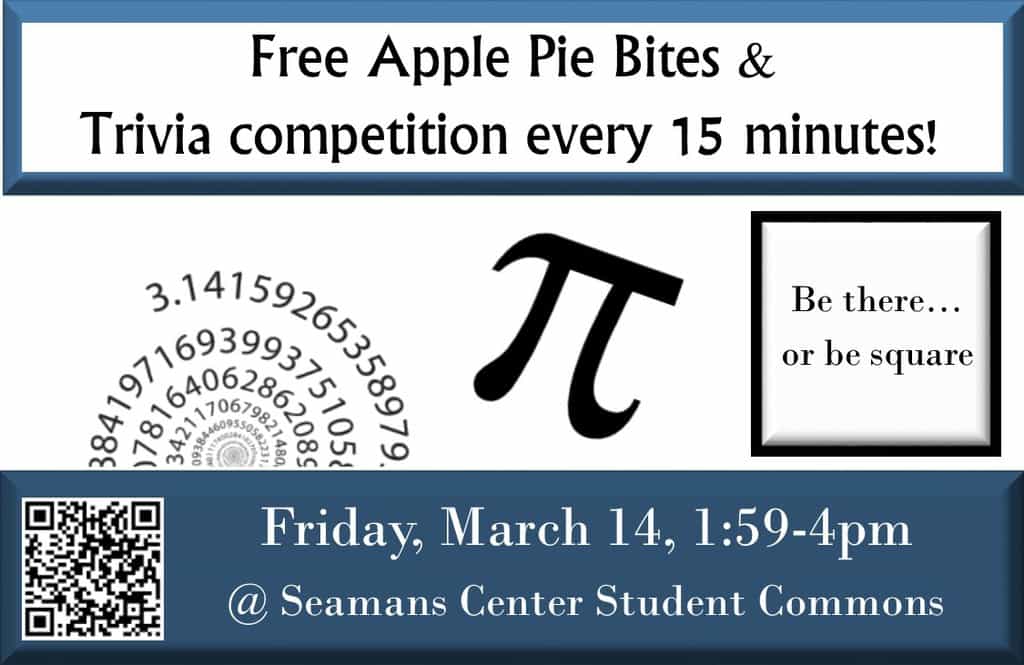 Join the Lichtenberger Engineering Library and the People in Engineering LLC for an exciting afternoon of free pie and Pi(e) trivia.
The fun begins at 1:59 pm on 3.14 in the Seamans Center Student Commons.
Show off your knowledge of Pi(e). Form a team of four and pre-register for a trivia game at http://goo.gl/Ncnvmy.
Pi Day is open to all students, faculty, and staff. Be there or……. be square!
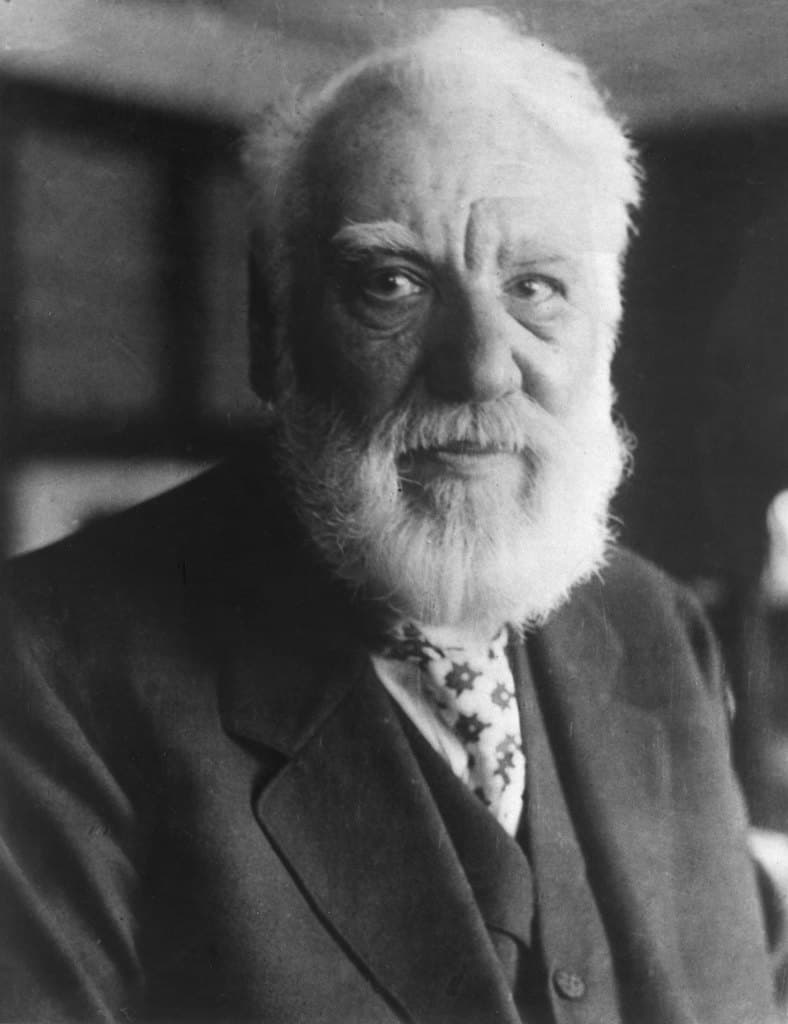 Alexander Graham Bell is known as an inventor, scientist, and engineering. He is well-known for his invention of the telephone and was involved in many other inventions.
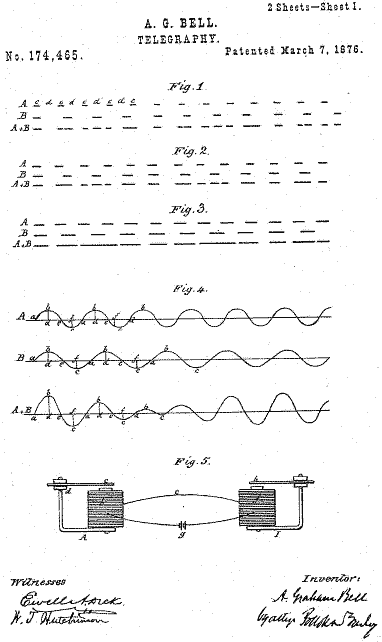
His invention of the telephone came from his desire to help the deaf hear and had done research into speech articulation following his father’s work. The patent was issued on March 7, 1876. The telephone itself is clouded with controversy of who invented it first and lead to a series of lawsuits. This includes lawsuits with such people as an Italian inventor, Antonio Meucci. The most famous conflict is with Elisha Gray , who visited the patent office the same day as Bell had submitted his patent application with a claim on a similar design. Bell eventually came up on top in these cases and, with in a year of patenting, set up the Bell Telephone Company.
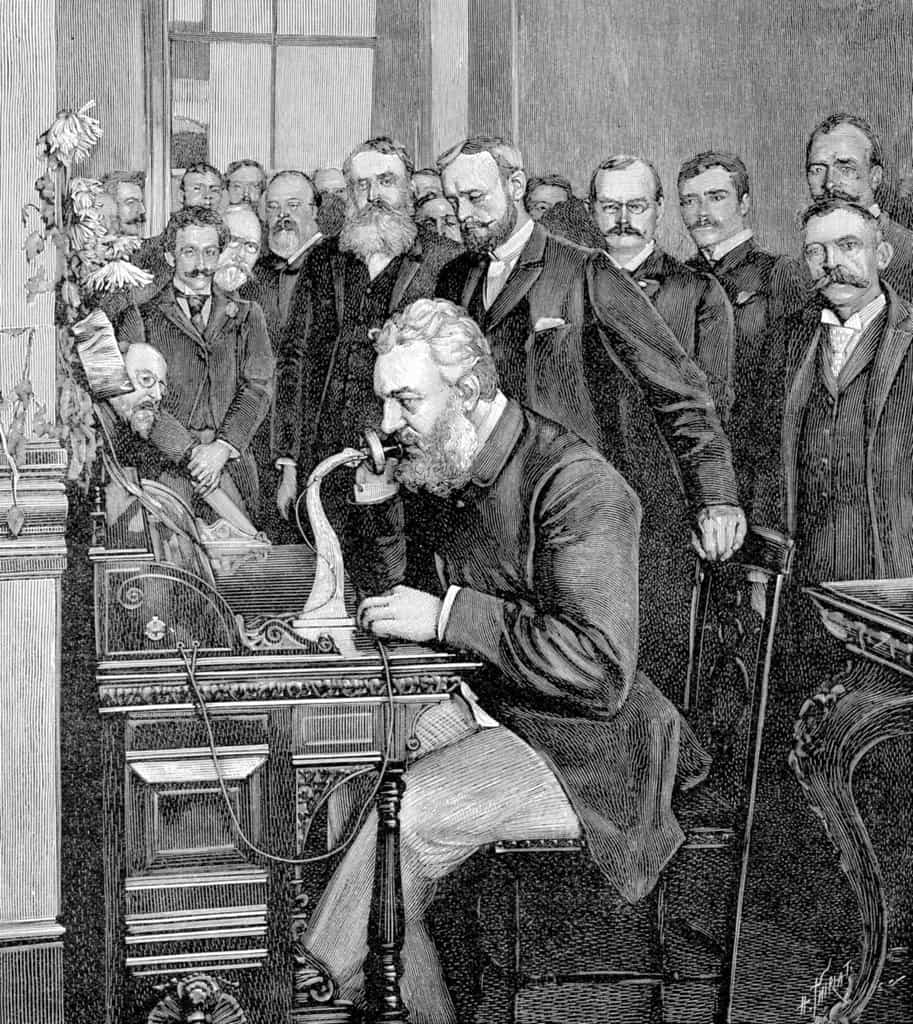
After the telephone, Bell went on to completely different experiments and inventions. Many of these were related to the areas of medical science. He worked extensively on creating a mechanical breathing apparatus, the predecessor of the iron lung. He had hope to save the lives of drowning victims and premature babies. Bell also conducted research into heavier-than-air flight and founded the Aerial Experiment Association.

Bell sought to advance scientific knowledge and was one of the founding members of the National Geographic Society. He was the president from 1898 to 1903.
Learn More:
References: