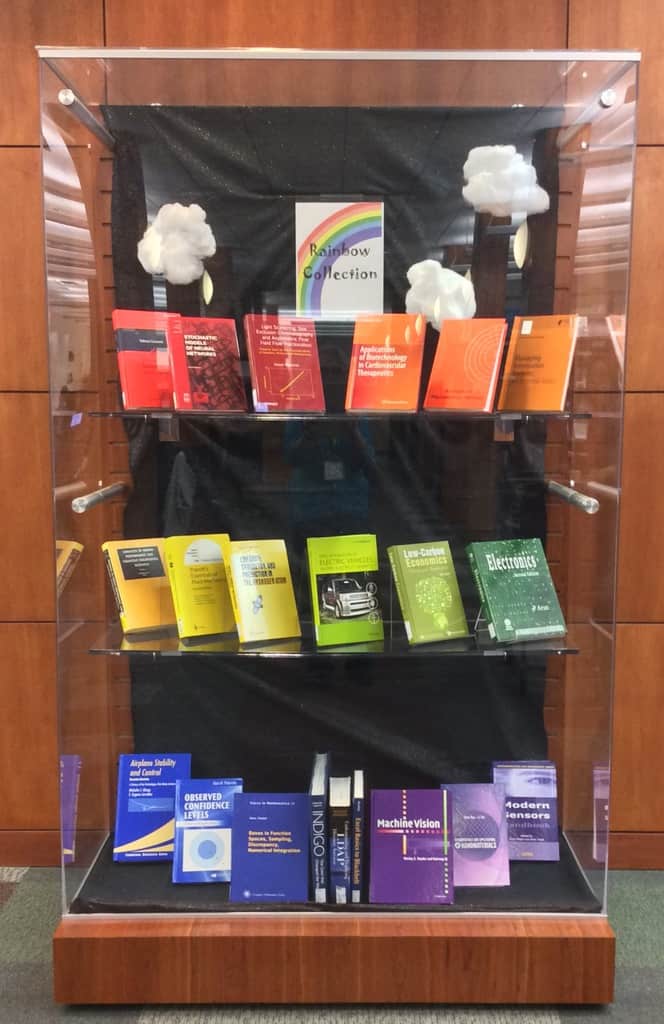
The Rainbow Collection!
When you browse our collection of 50,000 books, you’ll see that our shelves are filled with, well, every color of the rainbow! Our exhibit shows a rainbow of colored book covers – from all the differing engineering disciplines – and will be up through January, 2016.
So what is a rainbow and what’s on the other side?
In the 1660s, Sir Isaac Newton began experimenting with light and prisms. He deduced that all the colors are present in white light and white is really not a color unto itself. Up until that time, it was believed that white was a separate color. This discovery was quite revolutionary at that time and was not well accepted. And that, in a nutshell, is what makes up a rainbow… White light and something to act as a prism.
Have you ever thought about where the names of the colors came from? Newton named them! In The Secret Language of Color: Science, Nature, History, Culture, Beauty of Red, Orange, Yellow, Green, Blue & Violet, author Joann Eckstut says, “…Taken with the idea that the rainbow should reflect the musical scale, Newton decided to name his colors in accordance with aesthetics. There are seven main tones in the musical scale, so Newton came up with seven corresponding colors. Hence the origin of ROYGBIV, the acronym by which we know Newton’s seven spectral colors – red, orange, yellow, green, blue, indigo, and violet…” (Scientists later, perhaps not surprisingly, set aside the correlation to the musical scale).
The colors of a rainbow are lined up, top to bottom, from the longest to the shortest wave length. In a double rainbow, the colors in the second – less intense arc – are reversed because the light is reflected twice in each rain drop. Each band of color is not really a band, either – it is a continuous spectrum of color. The number of photoreceptors in our eyes causes our brain to see the bands of colors. If we had more photoreceptors, we would see more colors.
Because it is is a continuous spectrum, the colors fade seamlessly into each other and it is often difficult to distinguish the colors. ROYGBIV is still used to teach the colors of the rainbow, even though most people have trouble identifying indigo. Indeed, the names of colors evolve over time. The color Newton called indigo, is now mostly considered to be plain old blue… Another interesting color fact is why “violet” is named violet and not purple. Violet is a spectral color that is bluish purple. Purple is not a spectral color, but is a creation of a mixture of colors.
And what’s on the other side?
Did you know that no one sees a rainbow in the same way? Each rainbow is unique to you! Why? Because each drop of rain (or atmospheric moisture) acts as a prism. The white light enters the raindrop and is bent into all the colors of the rainbow. With the countless number of raindrops refracting the light, what you see depends on where you are standing. Thus, no one sees a rainbow in exactly the same way, even when standing next to each other! White light and raindrops (or prisms, or anything that will refract the light).
The next time you see a rainbow, think of the millions of raindrops it takes to create the beautiful colors! And don”t forget to stop in and see our Rainbow Collection of books!!
That keeps us star-gazing?
Someday we’ll find it
The rainbow connection
Rainbow Connection
Music and Lyrics by Paul Williams and Kenny Ascher
Performed by Jim Henson
Resources:
Eckstut, Joann. 2013. The secret language of color: science, nature, history, culture, beauty of red, orange, yellow, green, blue & violet. New York : Black Dog & Leventhal Publishers: Distributed by Workman Pub. Engineering Library QC495.3 .E25 2013.
Newton and the Color Spectrum. Color Vision & Art. webexhibits. Accessed November 10, 2015
The Muppet Movie – Rainbow Connection. youtube.com Accessed Nov. 12, 2015.
The Muppet Movie. IMDb. Accessed Nov. 12, 2015
Other Resources:
Ohta, Noboru. 2005 Colorimetry: fundamentals and applications. Chichester, West Sussex, England : Hoboken, NJ, USA : J. Wiley. Engineering Library QC495.8 .O38 2005
Hoeppe, Gotz. 2007. Why the sky is blue: discovering the color of life. Princeton, NJ : Princeton University Press. Engineering Library QC494.7 .H6413 2007