Publishers Category

0

Iowa Provost Barry Butler signs open statement supporting accessible scholarship and opposing RWA

University of Iowa Provost Barry Butler and ten other University Provosts from Big Ten institutions have issued a public statement opposing the Research Works Act and supporting taxpayer access to federally funded research results, such as that mandated by NIH.

“Because of our strong belief in open sharing of information, we were disturbed to see that recently introduced legislation (The Research Works Act, H.R. 3699) called for a rollback of the progress being made toward opening communication channels for sharing publicly funded research findings with the American people. Were this bill to pass, it would reverse a 2008 administrative mandate by the National Institutes of Health that grantees deposit the results of their funded research in a publicly accessible archive, and prohibit other agencies from issuing similar mandates going forward. We believe that this legislation would significantly undermine access to the new ideas that result from government-funded research, access that we encourage to the public at-large, to a worldwide network of leading scholars, and to future generations of scholars who are today’s undergraduate and graduate students. In our view, ratification of the proposed legislation would represent a step backward in the ongoing enlightenment of society through research and education”

The Provosts’ call for a “local agenda” on their respective campuses is especially encouraging for those long engaged with these issues:

“In addition to our concern about the impact external entities have in shaping the research and communication agenda of our universities, we are cognizant that senior campus administrators and faculty leaders could be working more effectively to ensure that their own campus policies are aligned with professed campus norms. Some examples of how we might do more to influence campus behaviors include:

  • Encouraging faculty members to retain enough rights in their published intellectual property that they can share it with colleagues and students, deposit it in open access repositories, and repurpose it for future research.
  • Ensuring that promotion and tenure review are flexible enough to recognize and reward new modes of communicating research outcomes.
  • Ensuring that our own university presses and scholarly societies are creating models of scholarly publishing that unequivocally serve the research and educational goals of our universities, and/or the social goals of our communities.
  • Encouraging libraries and faculty to work together to assess the value of purchased or licensed content, and the appropriate terms governing its use.”

Read more: http://www.insidehighered.com/views/2012/02/23/essay-open-access-scholarship#ixzz1nDbenvbl
Inside Higher Ed

0

Local costs for journals

A boycott of Elsevier journals has been growing to show opposition to their support of the Research Works Act and their 36% profits (see Research Bought, Then Paid For – an Op-Ed in the New York Times, Elsevier boycott gains momentum, Elsevier responds to the boycott, and “Of goats and headaches”–The Economist on journal publishing for previous posts on these issues ).

There have also been prominent articles about the lack of public accessibility of academic research, such as “Locked in the Ivory Tower: Why JSTOR Imprisons Academic Research”  which appeared in The Atlantic on Jan 20, 2012. This particular article points to JSTOR as an example of the “broken economics of academic publishing”. Nancy Sims from University of Minnesota wrote “Academic publishing is full of problems; lets get them right” which is a good response to the Atlantic article, correcting some of the specifics.

Since that time, we have seen faculty taking note of the cost of some e-journal packages and collections of titles, most notably the $2.9 million figure from Purdue when that institution came close to cancelling their Elsevier package in December. (“Purdue re-signs contract for online scholastic access” )

In order to keep Iowa faculty informed about the cost of journals from a variety of sources, we offer these figures for University of Iowa costs from FY 2011:

 Publisher  Cost # of Titles
Elsevier  $       1,641,530

2095

Wiley/Blackwell  $           868,031

1304

Springer  $           607,540

400

Sage  $           243,647

608

JSTOR  $             97,602

2319

Cambridge UP  $             43,940

145

Project Muse  $             33,210

500

Oxford UP  $             21,313

250

Please note that the JSTOR figure is for back content (the so-called moving wall), not current issues.

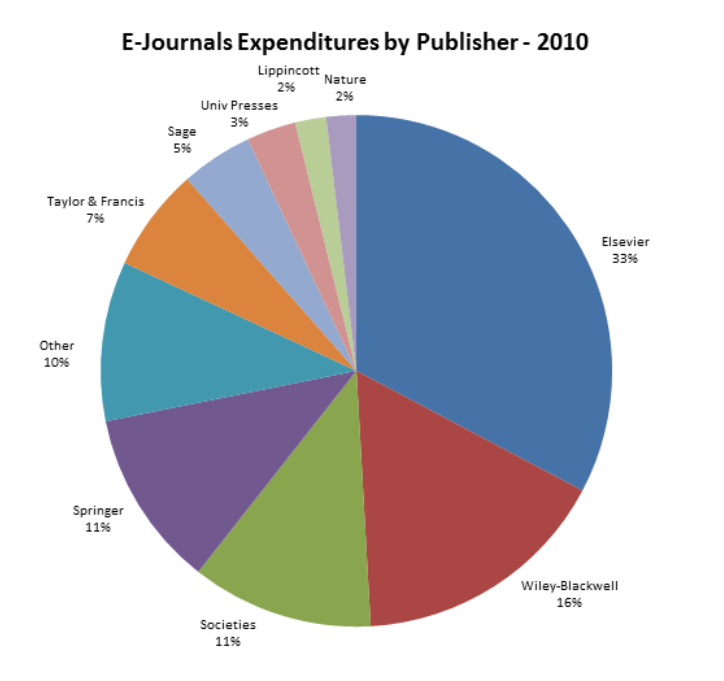
The following chart offers another way to view the relative size shares of the pie different publishers receive from our acquisitions budget (the denominator for these percentages is total spending on e-journals). The data is slightly older than that used above.

0

Coercive Citations

Just when you think you’ve seen it all when it comes to scholarly publishing, a brief in today’s Chronicle of Higher Education online notes a new way some publishers have found to puff-up a journal’s impact.  It reports findings from a recently published survey in Science which indicate that some journal editors “… often ask prospective authors to add superfluous citations of the journal to articles, and authors feel they can’t refuse.”  Here is a link to the article, which includes a summary of the paper in Science.

0

Elsevier responds to the boycott

As the number of signers of the Elsevier boycott passed 2,400 (see yesterday’s blog post–the total this morning is over 2,600), an Elsevier spokesman responded, as reported in the Chronicle of Higher Education:

“Over the past 10 years, our prices have been in the lowest quartile in the publishing industry,” said Alicia Wise, Elsevier’s director of universal access. “Last year our prices were lower than our competitors’. I’m not sure why we are the focus of this boycott, but I’m very concerned about one dissatisfied scientist, and I’m concerned about 2,000.”

Boycotters dispute the claim:

Protesters disagree, and say Elsevier is emblematic of an abusive publishing industry. “The government pays me and other scientists to produce work, and we give it away to private entities,” says Brett S. Abrahams, an assistant professor of genetics at the Albert Einstein College of Medicine. “

Web site for the boycott is here: http://thecostofknowledge.com/

0

Elsevier boycott gains momentum

A boycott aimed at the publisher Elsevier, initiated by Timothy Gowers, a prominent mathematician from the University of Cambridge, has picked up support in recent days, attracting as of Jan. 31 at 4 pm CST over 2350 signatures. One of the motivations for his call for a boycott was Elsevier’s support for the Research Works Act (RWA–see our blog post of January 11th).

Writing in the Chronicle of Higher Education Josh Fischman reports:

 “Timothy Gowers of the University of Cambridge, who won the Fields Medal for his research, has organized a boycott of Elsevier because, he says, its pricing and policies restrict access to work that should be much more easily available. . . The company has sinned in three areas, according to the boycotters: It charges too much for its journals; it bundles subscriptions to lesser journals together with valuable ones, forcing libraries to spend money to buy things they don’t want in order to get a few things they do want; and, most recently, it has supported a proposed federal law (called the Research Works Act) that would prevent agencies like the National Institutes of Health from making all articles written by its grant recipients freely available.

For the full Chronicle article see http://chronicle.com/blogs/wiredcampus/elsevier-publishing-boycott-gathers-steam-among-academics/35216?sid=wc&utm_source=wc&utm_medium=en

The boycott’s web site (where you can sign of if you’re so minded) is http://thecostofknowledge.com/

0

“Tough love for authors”: © ≠ Ownership

Interesting post by Rich Anderson on the balance between authors’ rights as creators and readers’ rights to make use of their creations. Additional comments on ebooks, the Authors’ Guild suit against Hathi Trust, and other matters.

See http://scholarlykitchen.sspnet.org/2011/10/25/some-tough-love-for-authors/

0

Authors’ Guild vs Hathi Trust et al–continuing developments

Statements and observations continued through the end of last week and beyond arising from the Authors’ Guild suit against Hathi Trust. Much of the focus centered on the orphans listed by Michigan that turned out not to be. Stories in Inside Higher Education and the Chronicle provide summaries and links to the various statements. Worth noting is Kevin Smith’s open letter to one author of a work shown not to be an orphan arguing that the best chance for this book to find readers today would be exposure in digital form in HathiTrust.

0

Authors’ group sues HathiTrust, Michigan and other universities.

From the September 13th Inside Higher Education:

The Authors Guild on Monday sued the HathiTrust (a consortium of universities) as well as Cornell and Indiana Universities and the Universities of California, Michigan and Wisconsin, charging widespread copyright violations. The universities and the trust have worked with Google on its project to digitize books (a project now on hold) and on a recent effort to release to their campus communities digitized copies of “orphan works” ….”

Iowa had been poised to join Michigan and others in making available “orphan works” which we held in print form to the campus.

0

Appeals court decision on “first sale” doctrine could affect library lending

A decision by the Second Circuit Court of Appeals on the First Sale doctrine could affect the right of libraries to lend (and individuals to resell) some books.  See the analysis of Duke Scholarly Communications Officer Kevin Smith at http://blogs.library.duke.edu/scholcomm/2011/08/24/getting-first-sale-wrong/ and

0

The Georgia State filing – A declaration of war on the faculty?

In another blog post on the Georgia State e-reserves case, Paul Courant, University Librarian (and former Provost) at the University of Michigan, argues that the plaintiffs (Cambridge & Oxford University Presses plus Sage, supported by the Copyright Clearance Center) have crossed the “boundary from adversary to enemy.” Two paragraphs quoted below–for the entire post, see http://paulcourant.net/2011/06/09/the-georgia-state-filing-a-declaration-of-war-on-the-faculty/

The plaintiff’s draft order applies formally only to Georgia State, but if the Court grants the plaintiffs what they seek, the result will be, in the words of Duke University’s Kevin Smith, “a nightmare scenario for higher education:” fair use would be destroyed, university faculty, students, and staff would be subjected to outrageously restrictive copyright policies, and every university would be required to hire a squad of copyright cops to ensure that faculty do the publishers’ bidding. And while it’s not an uncommon strategy to ask for far more than you expect to receive in a negotiation, which this proposed injunction surely is, your “highball” offer is certainly something that you wouldn’t mind having. What the plaintiffs are saying is that they are quite willing impose enormous costs on academic performance and academic freedom in exchange for higher profits. This is not the request of a friendly adversary; this is the attack of an enemy. (Yes, academic authors would also receive some financial benefit, but note that the typical split for incremental revenue is around 90-10 in favor of publishers, and that the additional revenue that publishers would receive under the plaintiffs’ draft order would be obtained NO additional cost incurred by the publishers beyond cashing checks and paying their lawyers.)

As a faculty member, I do not know that I could comply with the restrictions in the proposed injunction for using copyrighted material in my classroom; they are too onerous and much too expensive. As an author and an educator, I have a great respect for copyright law, and I believe in a balance between creating incentives for authors and promoting the ”progress of science and the useful arts.” The proposed injunction does not strike that balance; it unreasonably restricts access to copyrighted works, eliminates fair use, and will force professors to spend much of their time in an exercise of copyright self-censorship. Imagine that if every time you wanted to quote from a text, show an image, or distribute a handout to your students you had to seek the approval of the University Copyright Police; the consequences would be dramatic. (Lest you think I am exaggerating, check out the form that, were the publishers to have their way, faculty would have to fill out every time they put copyrighted works on electronic reserve.